
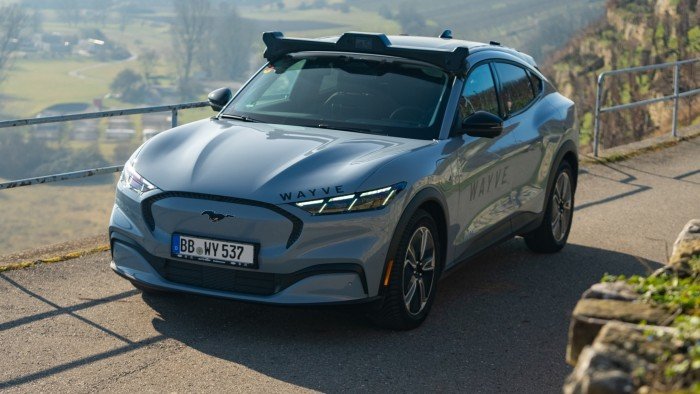
Wayve, the London-based autonomous driving start-up, is accelerating its international expansion after raising more than $1bn from investors including SoftBank, Microsoft and Nvidia in one of Europe’s biggest artificial intelligence deals last year.
Alex Kendall, Wayve’s co-founder and chief executive, said it was testing its self-driving cars in Germany and the US, and setting its sights on Japan, as it hoped to “soon” clinch its first deals with automakers to build its software into production vehicles.
“We’ve gone from the UK to the US and now Germany, and we’re not stopping there,” Kendall said. Calling 2025 a “year of global expansion”, he told the Financial Times he was “super excited” about SoftBank’s home country of Japan, adding: “Watch this space.”
Founded in 2017, Wayve has emerged as one of the UK’s highest-profile AI companies at a time when British and European leaders are anxious to ensure the continent is not left behind by the US and China in the rapidly evolving industry.
It is also seen as Europe’s best hope in autonomous driving, as US-based Tesla and Waymo race against Chinese rivals including electric-vehicle maker BYD and robotaxis from Baidu, WeRide and Pony.ai.

Wayve has established an office in Stuttgart and began fleet operations in Germany late last month after obtaining the necessary regulatory approvals for autonomous testing. The German automotive regulator’s experimental testing permit will also allow Wayve to test across the EU.
Wayve, which also added Uber as an investor last August, is opening overseas outposts to get closer to the world’s largest automakers while testing its vehicles in new regions, driving cultures and weather conditions.
“When you think about where the automotive powerhouses are around the world, Germany has got to be one of the top names,” he said. “I hope that it’s a way that German and European tech can compete on a global scale.”
It opened an office in Silicon Valley and began testing in the San Francisco Bay Area last October, and is soon planning to drive up the US West Coast to Vancouver, where it has another R&D outpost.
“Global expansion is important to us because if you’re a car manufacturer, it’s no good if your [assisted driving] feature just works in a single city; you want it to work globally,” Kendall said.
Wayve’s system operates on a single AI model, regardless of where the vehicle is deployed. It took only a couple of weeks to adapt from London’s crooked streets to driving on the other side of the road in San Francisco, Kendall said. “We could go to any UK city and now any German city and you’ll see [a good assisted-driving] performance, sight unseen.”

The company is taking a different approach to autonomous driving compared with Alphabet-owned Waymo, which is expanding its robotaxi operations across the US after launching publicly in San Francisco last year.
Kendall claims Wayve will eventually be able to offer similar capabilities at a fraction of the cost of Waymo’s vehicles, which currently cost tens of thousands of dollars to fit out with the high-priced sensors, including lasers, and computing equipment that its fully driverless system needs to operate safely.
He argues that Wayve is building a more flexible and responsive system that learns as it goes along, rather than requiring high-definition 3D maps and extensive test runs before launching in any given city.
Wayve’s current system delivers “Level 2” advanced driver assistance software, industry terminology for a capability that still requires active monitoring by a human driver behind the wheel, similar to Tesla’s Autopilot. Like Tesla, Wayve’s technology relies primarily on cameras and computers that Kendall says cost hundreds of dollars, not tens of thousands.
Automakers are already building the necessary hardware into some of their high-end vehicles, he said, so adopting Wayve’s system would require a simple software update. Building up to Level 3 — an “eyes off” system that can sometimes still require a human to take back control — will require more sensors that he still believes will cost as little as $2,000.
Kendall is betting that this incremental approach will be a “faster route” to full autonomy than Waymo’s all-or-nothing driverless system.
“We’re focused on getting the system deployed with major manufacturers in millions of unit volumes as a driver assistance system, and using that to grow the experience up to Level 4 experiences,” he said, referring to the point at which vehicles can drive themselves completely.
“We’ve had exploratory conversations with almost every [auto manufacturer] there is,” he said. “And in the last six months, it’s just gone up another gear. Especially the last three months, all of a sudden there’s this urgency.”
Recent months have delivered mixed signals on the future of autonomous driving, which has taken many years longer to reach public roads than proponents suggested when Google’s self-driving car project debuted 15 years ago.
Last October, Elon Musk unveiled Tesla’s “Cybercab” robotaxi that the electric-vehicle company hopes to start manufacturing as soon as next year. After Waymo raised a $5.6bn funding round in the same month, the Alphabet subsidiary said recently it planned to expand its testing to more than 10 new cities this year.
However, General Motors shut down development of its Cruise robotaxi in December, citing the “considerable time and resources that would be needed to scale the business” after pouring more than $10bn into the venture since 2016.
Not every automaker wanted to be an early adopter of autonomous cars, Kendall acknowledged, given the cost, risk and potential disruption to their existing business models.
“There’s a real diversity in European businesses with how they’re approaching this. Some are content and have actually told me they don’t want to be the leaders,” he said. “But others have said, ‘We pride ourselves in innovating and being first’ . . . They see the incredible progress that’s happening in China and the US and they want to compete.”
