


gilaxia
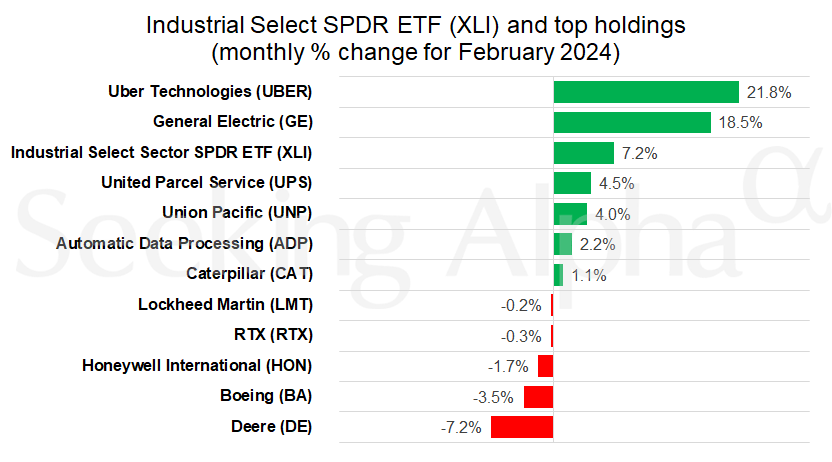
Uber Technologies (NYSE:UBER) and General Electric (NYSE:GE) in February led gains among the biggest industrial companies in U.S. markets, which are having their best start to the year since 2019.
The Industrial Select Sector SPDR ETF (NYSEARCA:XLI), whose top holdings include some of the largest U.S. companies in the manufacturing, transportation and business-services industries, rose 7.2% in February and closed at a record high.
The performance mirrored February gains for U.S. stocks, with the Standard & Poor’s 500 stock index (SP500) rising 5.2%, the Dow Industrials Average (DJI) advancing 2.2% and the Nasdaq Composite (COMP.IND) climbing 6.1% record highs.
Investors are looking for signs that the Federal Reserve will declare victory over inflation and cut interest rates this year, which would benefit riskier investments such as stocks.
Company news
Uber Technologies (UBER), which despite its app-developer roots is classified as an industrial company, gained almost 22% in February.
The ride-hailing and food-delivery giant last month was added to the Dow Jones Transportation Average, replacing low-cost airline JetBlue (NASDAQ:JBLU). Uber (UBER) also nudged out defense contractor Lockheed Martin (NYSE:LMT) as a top 10 holding for the Industrial Select Sector SPDR ETF (XLI).
Uber’s (UBER) stock jumped 14% on February 14, when the company at its yearly investor day announced a $7 billion stock buyback and set an aggressive goal for three-year growth.
General Electric (GE) rose almost 19% in February and closed at a record high. The company is set to spin out its power-turbine business, GE Vernova (EGV), on April 2, leaving jet-engine maker GE Aerospace (GE) as the remainder of the storied industrial conglomerate. The aerospace business has seen strong demand as airlines order more planes to keep up with a resurgence in air travel.
Industrial decliners
Several companies weighed on the performance of the Industrial Select Sector SPDR ETF (XLI) in February, including Deere (NYSE:DE) and Boeing (NYSE:BA).
Deere (DE) fell 7.2% for the month and is back to levels first reached three years ago. The maker of farm machinery two weeks ago provided a disappointing outlook for the year.
Company management estimated net income of $7.5 billion to $7.75 billion for 2024, compared with the average estimate at the time of $7.83 billion among Wall Street analysts.
“Moving forward, we expect fleet replenishment to moderate as agricultural fundamentals normalize from record levels in 2022 and 2023,” John May, chairman and chief executive officer of Deere (DE), said in a statement with its earnings announcement.
Boeing (BA) slumped 3.5% in February to bring its year-to-date loss to 22%. The aerospace and defense giant is working to recover from a midflight accident on a new plane flown by Alaska Airlines (NYSE:ALK).
The incident on January 5 renewed questions about Boeing’s (BA) quality and safety controls. The U.S. Federal Aviation Administration last week gave the company 90 days to fix its safety culture amid ongoing probes into the Alaska Airlines (ALK) midair emergency.
