
Timothy Taylor, at Conversable Economist, had a post on August 13 titled “What Economic Ideas are True and Nontrivial?”
He starts with a famous story that Paul Samuelson told and I’ll quote it here:
[O]ur subject puts its best foot forward when it speaks out on international trade. This was brought home to me years ago when I was in the Society of Fellows at Harvard along with the mathematician Stanislaw Ulam. Ulam, who was to become an originator of the Monte Carlo method and co-discoverer of the hydrogen bomb, was already at a tender age a world famous topologist. And he was a delightful conversationalist, wandering lazily over all domains of knowledge. He used to tease me by saying, ‘Name me one proposition in all of the social sciences which is both true and non-trivial.’ This was a test that I always failed. But now, some thirty years later, on the staircase so to speak, an appropriate answer occurs to me: The Ricardian theory of comparative advantage; the demonstration that trade is mutually profitable even when one country is absolutely more – or less – productive in terms of every commodity. That it is logically true need not be argued before a mathematician; that it is not trivial is attested by the thousands of important and intelligent men who have never been able to grasp the doctrine for themselves or to believe it after it was explained to them.
Tim keys in on the last sentence in the above Samuelson quote. He writes:
If the “non-trivial” criterion can be met by any economic theory where thousands of intelligent and important people are unable to grasp or believe it, then it seems to me that many economic theories are true and (apparently) non-trivial, including the (apparently) widespread belief that governments can set prices or impose tariffs without experiencing tradeoffs, along with many more. The news headlines provide examples of (apparently) intelligent and important people who seem unable to grasp or believe economic insights pretty much every day.
I think Tim means that the true statement is that a government that sets prices and imposes tariffs will experience tradeoffs.
That reminded me of a question that Armen Alchian and William Allen asked in their economics textbook University Economics. I came across it when I was TA-ing for an introductory microeconomics course during my first year at UCLA.
Here’s question #21 from Chapter 13 of the third edition of University Economics (p. 21):
Evidence of the very extent of specialization of knowledge is provided by Albert Einstein’s assertion just prior to his death (Socialist International Information): “The economic anarchy of capitalist society as it exists today is in my view the main cause of our evils. Production is carried on for profit, not for use.” Give evidence of your superiority over Einstein by exposing his error in economic analysis.
I won’t bother answering their question because I think that, especially to readers of EconLog, the answer is obvious.
I’ll give another one. We often see apparently intelligent people, observing that the share of income of the bottom 20% has fallen, argue that the poor are getting poorer. There are two problems with this. The more obvious is that the share of a growing income can be falling but the average incomes of people in that lowest quintile can be rising. The second, and less obvious, is that the people in the lowest quintile in one year are not all the same people in the next year. And over a decade, there is huge mobility among income quintiles. (There’s a third problem also: income, though positively correlated with wealth, it not perfectly correlated. Someone can be in the bottom quintile of income and still be fairly wealthy.)
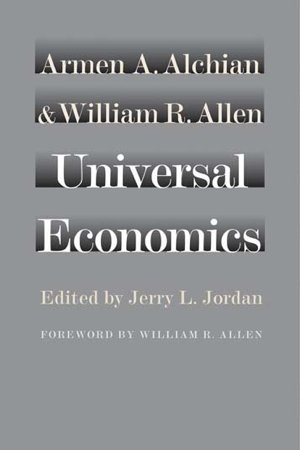
Note: The related pic is of Universal Economics, an update of the old Alchian and Allen text.
