
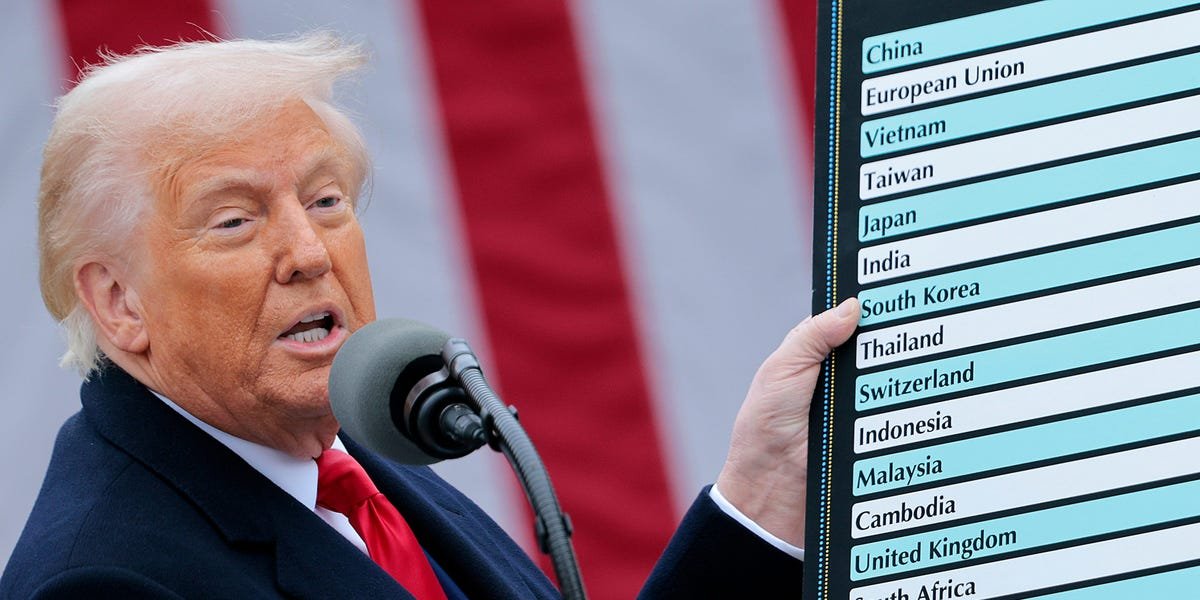
At Wednesday’s hearing on the legality of President Donald Trump’s tariffs, the Supreme Court grappled with a central question: Is this too much power for a president to have on his own?
The justices heard arguments over the “Liberation Day” tariffs Trump imposed on the rest of the world, as well as the other tariffs he justified under the International Emergency Economic Powers Act.
IEEPA gives presidents the power to “regulate” importation in times of emergency. According to the Trump administration, that includes the ability to impose taxes on imported goods — a power no previous president has ever claimed from the Carter-era law.
During Wednesday’s arguments, the justices questioned whether the issue should be considered under the “major questions doctrine” — the legal principle that says Congress needs to be crystal-clear when granting presidents power over matters of significant economic or political importance.
A majority of the nine justices asked pointed questions to Solicitor General D. John Sauer, who represented the Trump administration.
Justices Neil Gorsuch and Amy Coney Barrett, both appointed by Trump in his first term, pressed back on the administration’s arguments that it could assume so much power from the law’s language.
Barrett pushed Sauer to point to any “any other time in history” where “regulate importation” meant the power to impose tariffs.
When Sauer pointed to an appellate court decision in a different case and delved into the “long historical pedigree” of how authority is delegated from Congress to the executive branch, Barrett appeared unsatisfied.
“Could you just answer the justice’s question?” Justice Sonia Sotomayor cut in.
The three justices appointed by Democratic presidents appeared flatly opposed to the notion that “regulate importation” covers tariffs at all.
Related stories

Business Insider tells the innovative stories you want to know
Business Insider tells the innovative stories you want to know
Sotomayor agreed with the lawyers for companies that opposed the tariffs, pointing out that Congress has been clear about taxation and tariff powers in other laws.
“It’s a congressional power, not a presidential power, to tax,” Sotomayor said while grilling Sauer. “And you want to say tariffs are not our taxes, but that’s exactly what they are. It’s generating money from American citizens — revenue.”
Justice Neil Gorsuch, who Trump appointed in his first presidential term, and Chief Justice John Roberts also expressed concerns.
Tariffs and taxes, Gorsuch said, should be treated with special care. They were “part of the spark of the American Revolution,” he said. If the Supreme Court allowed presidents to have broad taxing powers on their own, he said, Congress would “never get that power back.”
“The power to reach into the pockets of the American people is just different,” Gorsuch said. “And it’s been different since the founding.”
Tariffs are at the center of Trump’s economic policies
The Supreme Court is weighing whether IEEPA gives presidents the power to impose tariffs at all and, if they do, whether that violates the Constitution’s separation of powers.
The case — which the Supreme Court put on the fast track — has high stakes for the Trump administration’s economic policies. He has used tariffs as his most potent weapon while negotiating trade deals with other countries. The Supreme Court could issue a ruling in a matter of weeks or months.
Wednesday’s hearing combined two cases brought by two different groups of companies that filed lawsuits seeking to block the tariffs brought under IEEPA, which are by far the most sweeping of the tariffs Trump imposed.
Trump has also issued tariffs using other laws, which he could continue to do if the Supreme Court rules against him.
But those non-IEEPA tariffs have more stringent limits, like built-in expiration dates, caps on how high the tariffs can be, and less flexibility to impose them on imports from particular countries.
At Wednesday’s hearing, Justices Brett Kavanaugh, Clarence Thomas, and Samuel Alito appeared to take a broader view of a president’s power.
Andrew Harnik/Getty Images
Those powers are at their height, Alito suggested, in national emergencies, which are exactly the types of scenarios that IEEPA was designed to address. And so it was no surprise, he said, that the law would give the president a lot of power in those situations.
“Isn’t it the very nature of an emergency provision that is going to be more open-ended?” Alito asked Neal Katyal, an attorney at Milbank representing the companies challenging the tariffs. He said Trump “has torn up the entire tariff architecture,” including by issuing tariffs on imports from allied countries with which the United States has a trade surplus, like Switzerland.
“That is just not something that any president has ever had the power to do in our history,” said Katyal, who served as Solicitor General during the Obama administration. “And the idea that Congress, by implication, did this in 1977 and handed him all this power — I think is really difficult.”
Some of the conservative justices, while skeptical that Trump could use IEEPA with tariffs, struggled to square that with the law allowing presidents to impose embargoes.
Barrett asked Oregon Solicitor General Benjamin Gutman — who represented a coalition of twelve states challenging the tariffs — why a president couldn’t use the “weaker medicine” of taxing imports if they were allowed to block trade altogether.
The discrepancy left an “odd doughnut hole” that would go against “common sense,” Kavanaugh said.
“With your interpretation, the president could shut down all trade with every other country in the world or impose some significant quota on imports from every other country in the world, but would not allow a 1% tariff,” Kavanaugh told Gutman.
Gutman said tariffing power was “a fundamentally different power” because it raised revenue, and the Constitution’s framers were particularly worried about “actions that bring in revenue from the pockets of taxpayers” like tariffs and taxes.
“It’s not a donut hole,” Gutman said. “It’s a different kind of pastry.”
