
Trickle-down economics is often caricatured as the claim that by giving money to the rich, the benefits will eventually trickle down to the poor. That theory is probably false, but that’s not what advocates of trickle-down are actually recommending.
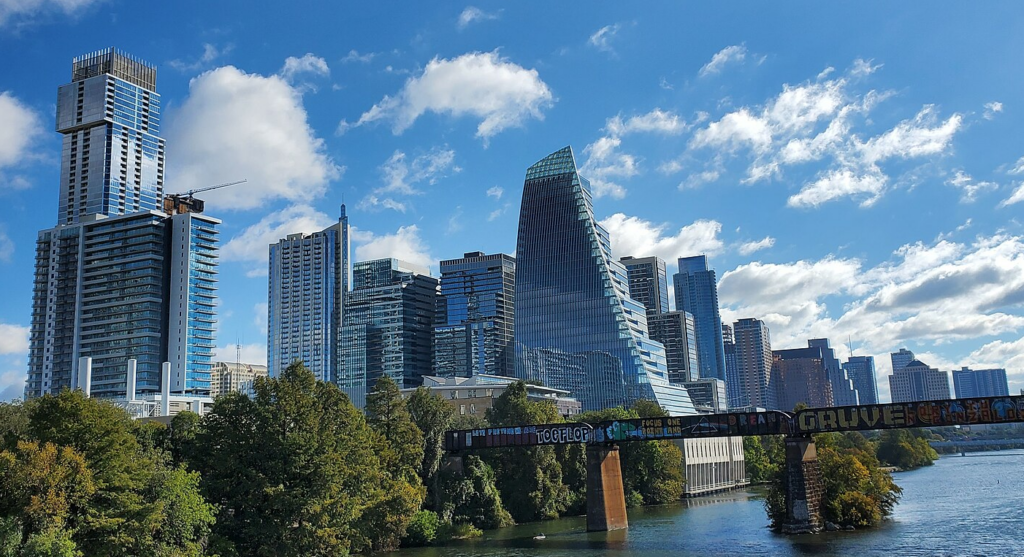
Housing is one area where trickle-down actually does work. A recent Kevin Erdmann post showed that rents in Austin, Texas have declined especially sharply at the lower end of the income distribution (red dots), partly due to sharply increased construction of multi-family units:

Here’s how Erdmann explains the situation:
Filtering rules housing. New private construction is just about the most progressive, equalizing economic activity that America can engage in under our current conditions!
The implications of this are doubly positive. Generally, the new units are “luxury” units, tending to be high end.
- The main effect of new high end homes is to reduce the rents on low end homes.
- And, that also means that “oversupply” mostly affects rents on old, aging units. When the average rent in Austin is down 3%, that means that high end rents are only down 1%. So, declining rents don’t have nearly as strong an effect on the viability of new projects as they seem to at first blush.
Austin is a rare exception to the general trend in America toward increasing restrictions on home building, the so-called “Nimby” movement. The increase in housing construction has allowed Austin to see falling rents, despite very rapid population growth. This helps the poor.
Seven years ago, I argued that we should focus on building so-called “unaffordable housing”, that is, housing that the median income buyer cannot afford. This allows us to gradually upgrade the quality of our housing stock, and lets lower income people move into units vacated by those buying the newer luxury units.
In another post, Erdmann makes an impassioned plea to stop implementing counterproductive regulations:
As of now, bills have been introduced in several states to block corporate ownership of single-family homes.
Arizona. Connecticut. Indiana. New Hampshire. New York. Oklahoma. Texas. Utah. Virginia. . . .
I am at a loss. It will be a slow-motion train wreck of a staggering scale. I am here waiting for the train, but I am powerless to stop it.
The typical young family with, say, a 720 credit score can’t buy a home today. We won’t build more apartments as a substitute. I recently watched a large apartment building get blocked in the Phoenix area, and one of the big complaints was that if they allowed it, families would live there. This all happens quite explicitly. In every case, the obstructors just imagine that someone, somewhere, will be allowed to build something.
The sponsors of these bills think the same thing. If we ban corporations, surely there is some mysterious figure on the sidelines who will build the new homes instead.
No! They won’t! The rest of them have already been banned! About a million homes are built for the portion of Americans still allowed to buy them. Another 500,000 apartments are built for tenants. That’s not enough! It’s not nearly enough!
So, where is that family going to live? They aren’t allowed to buy a home, live in a new apartment, and now, potentially, they won’t be able to rent a single-family home.
I regard Kevin as our most knowledgeable real estate expert. He is similarly pessimistic:
I just can’t believe what we are capable of doing to ourselves simply out of ignorance.
I knew this day was coming. But, seeing it happen has gutted me. I’ve been watching for it and predicting it, but until today, in the back of my head, there was a little voice saying, “No. Surely not.” But, it’s happening.
Unfortunately, we’ve entered a new dark age of economics. I fear it may be decades before we come to our senses.
