
Why are some people cruel? Why are some governments cruel? Do cruel governments require cruel citizens? I take cruelty to refer to Merriam-Webster’s definition of cruel as “disposed to inflict pain or suffering: devoid of humane feeling.”
An individual is cruel who has a taste for cruelty, i.e. cruelty is an argument of his utility function. He will satisfy this preference when he can do it at a price that he considers acceptable. This is the standard price theory model, which remains useful despite all its critiques: the individual maximizes his utility given his preferences and the constraints he faces.
Why are some governments cruel, whether we are speaking of the Russian government intentionally attacking Ukrainian civilians and torturing prisoners of war, or the American government inflicting pain or distress on immigrants? (Of course, there is a difference in degree between these two cases of cruelty.) It is a matter of incentives: if those who disobey government decrees risk not only punishments but cruel punishments, disobedience is reduced. In short, governments use cruelty when it contributes to the realization of their policies, and no constitutional or other binding constraints exist.
A government (or “the state”) is not a supernatural being or a biological organism, but an organization of individuals who determine policies or enforce them. Cruelty in public policy depends on the costs and benefits of the individual rulers, their agents, and their supporters (at least their important supporters). A cruel government is made of, or supported by, cruel individuals, but the process of public choice may increase the extent of cruelty.

For one thing, the cruelty of a government will increase through selection. Individuals with a taste for cruelty will self-select for government roles: politicians, prosecutors, security personnel, torturers, etc. A government known for its cruelty will attract more cruel rulers and servants—which is related to Friedrich Hayek fear of the rule of the worst (see his 1944 book The Road to Selfdom; see also my review of this book).
Cruelty will likely increase as political rulers discover that hatred can be used to further their ambitions. Scapegoats, preferably unarmed and defenseless, are useful for a politician to both explain away his failures and enflame his supporters. Propaganda can present hated or to-be-hated minorities as “the worst of the worst” or “animals.” The more the rule of law has been compromised (at the limit, up to the aphorism attributed to Lavrentiy Beria, Stalin’s secret police chief, “Show me the man and I’ll find you the crime”), the more we would expect cruelty to follow hatred.
Economist Edward Glaezer modeled the supply of hatred by politicians and the demand for it by voters. In his model, the supply of hatred depends on the existence of minority groups or “out-groups” that can be turned into scapegoats (the Blacks not so long ago, the immigrants today) and thus help “entrepreneurs of hate” in political competition. Other things being equal (including the individuals’ taste for cruelty), the demand for hatred is favored by “citizens’ willingness to accept false hate-creating stories [as] determined by the costs and returns to acquiring information” (Edward L. Glaezer, “The Political Economy of Hatred,” Quarterly Journal of Economics, Vol. 120, No. 1 [February 2005], pp. 45-86). Since the typical citizen’s probability of changing the result of an election is infinitesimally small and the cost of political information remains very high—despite or because of social media—the voter will remain rationally ignorant and tend to hate the people his political tribe hates.
Constitutions, norms (morals), religion (or at least certain forms of religion), trade, and other soft habits of civilization (les mœurs douces) can act as constraints to cruelty. They decrease the demand for it or limit its supply. In his book The Problem of Political Authority (see my review), philosopher Michael Huemer observes that, over a certain period of time, mores have become softer, more respectful of individual dignity, and less cruel. Political authorities may have helped but, past a certain point, the constraints on them can collapse, perhaps suddenly like an avalanche. Totalitarian regimes illustrate this. The North Korean or Russian states are not less cruel than political authorities in the High Middle Ages. Past a certain point, the state may contribute not to civilizing mores but, on the contrary, to fueling cruelty.
Cruel governments don’t require cruel people or at least not a majority of them, and perhaps only a small proportion. Many factors explain that. First, a government can contribute to making its subjects cruel through political hatred, propaganda, and selection (pulling the cruel to the top), as suggested above. Second, it appears easy to be cruel only toward foreigners or domestic minorities whose support the government doesn’t need. Professor Rudolph Rummel of the University of Hawaii estimated that, during the 20th century, states killed millions, if not hundreds of millions, of their own citizens, excluding interstate wars. Third, let’s not forget the Condorcet paradox: in a democratic society, an electoral majority can very well “prefer” the rule of law to despotism, despotism to poverty, poverty to cruel government, but then cruel government to the rule of law—as revealed if and when the latter alternative is the one put to the vote.
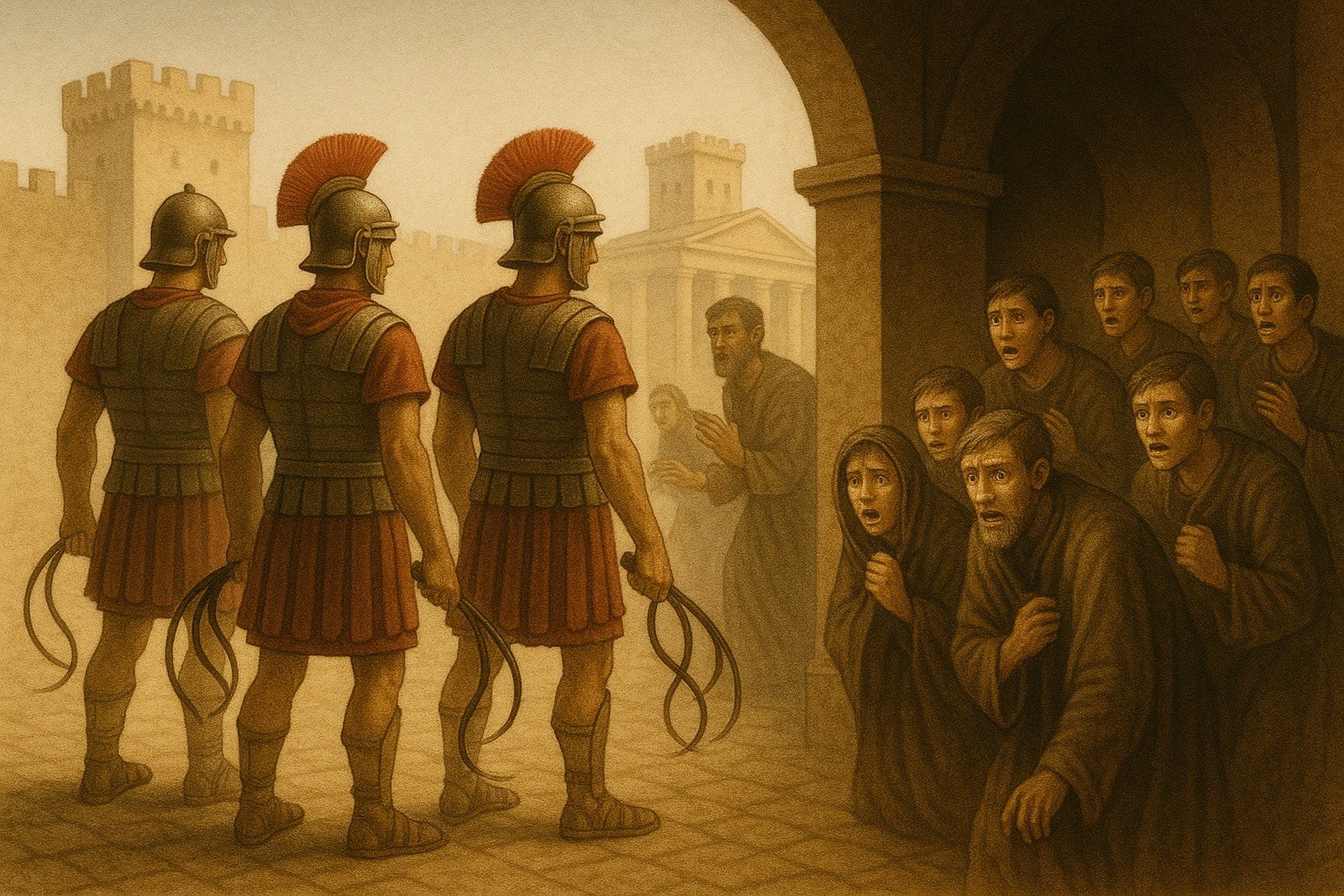
Finally, note that political cruelty is a boomerang. Nothing guarantees the demanders of cruelty that the cruel enforcers of their demand will always only target others. The brutes live among the people. The Roman legions are stationed in Rome.
******************************
The Roman legions in Rome, as viewed by ChatGPT
