
- Supply chains disruptions have repeatedly come under the spotlight in recent years.
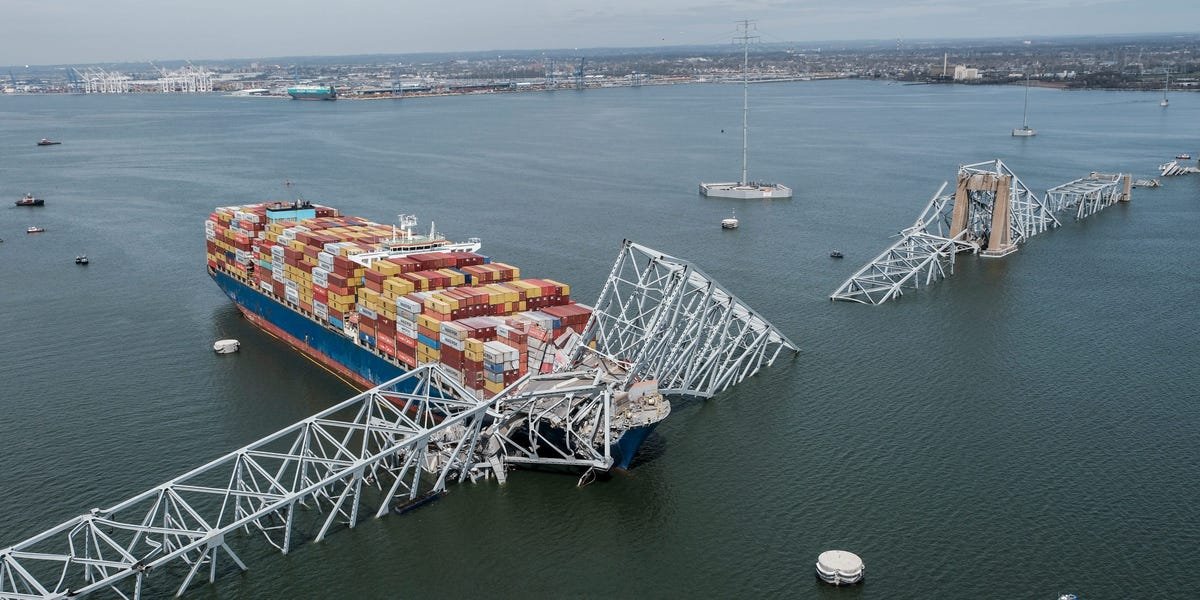
- The collision of the Dali containership with the Baltimore Key Bridge is the latest risk to supply chains.
- Geopolitics, climate change, and shipping incidents all pose risks to supply chains.

Supply chains are the backbone of global trade, but they’ve been largely taken for granted — until recently. Over the past few years, supply chain woes have repeatedly come into the spotlight.
The vital link came under the spotlight when President Donald Trump launched a trade war against China in 2018, prompting investors to reassess their reliance on the factory of the world.
Since then, global integrated supply chain systems just seem to keep getting disrupted — be it by the COVID-19 pandemic or Russia’s war in Ukraine.
On March 26, the Dali — a 984-foot-long cargo ship — collided with the Francis Scott Key Bridge in Baltimore. The Port of Baltimore is now closed to vessels. Its reopening could take months, impacting trade and business.
The auto industry is expected to be disrupted, as the Port of Baltimore is the top handler in the US for car imports and exports, supply chain platform Project44 wrote in a report on March 26.
“The automobile industry is notoriously lean, meaning any disruptions will have ripple effects throughout the manufacturing process,” Project44 wrote.
The domino effect is due to the “just in time” model that supply chains have been relying on for decades. This means materials were moved right before they were needed. The model keeps business operations extremely efficient — but it also opens them up to risks should just one part of the system fail.
“While just-in-time supply chain strategies have been the ‘go-to’ for 40 years, you can only expect something held together by chewing gum and shoelaces to last so long,” Nari Viswanathan, a senior director of supply chain strategy at Coupa, a business spend management platform, told Business Insider.
Viswanathan said “the world has been on a roller coaster that won’t stop” over the last few years, which has in turn sent the world’s supply chains into tailspin after tailspin.
Given that risks impacting supply chains are intertwined, they pose multifaceted risks to operations, Julie Gerdeman, the CEO of Everstream Analytics, a platform for supply-chain risk management, told BI.
Here are three key reasons why supply chains just seem to keep screwing up in recent years.
1. Heightened geopolitical tensions
Geopolitics are one of the biggest drivers of risks in fields ranging from economy to technology. Supply chains are no exception.
The issue first came to the fore in 2018, when Trump imposed high tariffs on a range of Chinese imports. It has become more amplified because of the tech rivalry between the US and China.
Examining ongoing conflicts in the Black Sea and Red Sea respectively shows how geopolitical conflicts affect global supply chains.
Russia’s blockade of the Black Sea amid the war in Ukraine is preventing wheat and sunflower supplies from Ukraine from moving freely to other parts of the world.
The Red Sea — a vital trade route between Europe and Asia — is under siege by Iran-backed Houthi rebels in response to the Israel-Hamas war.
To avoid being caught in the Red Sea attacks, cargo-carrying ships are staying away from the Suez Canal and rerouting via the Cape of Good Hope around the southern tip of Africa — but that will prolong journeys.
2. Climate change
In the summer of 2023, a historic drought affected rainfall that feeds into the Panama Canal, lowering the canal’s water levels and limiting the number and weight of ships that can float on it. The drought was caused by the El Niño weather phenomenon and its warming effects, which were more severe in 2023 due to climate change.
The fall in water levels at the Panama Canal caused a buildup in the number of ships waiting to cross the waterway, increasing transit time and prompting some vessels to reroute through the Cape of Good Hope.
Roughly 40% of US container traffic passes through the Panama Canal. By late November, the wait time for some ships waiting to pass through the waterway was around 20 days — up from five to seven days in October.
“The low water levels at the Panama Canal are a clear example of the effects of climate change in rainfall and weather patterns across the globe, which causes a ripple effect through the supply chain,” shipping giant Maersk told BI in September.
3. Shipping incidents
Ships transport 90% of the world’s trade, and the vessels keep getting bigger and bigger on the back of ballooning trade volumes over the decades.
Containerships such as the Dali, which are typically used to transport consumer and packaged goods, have “grown up in size by as much as 1,500% in the last 50 years,” Captain Rahul Khanna, the global head of marine risk consulting for Allianz, told Business Insider’s Geoff Weiss on Tuesday.
At 984 feet, the Dali is just the “standard size these days,” Allan Post, a veteran ship’s officer told The Conversation on March 26.
With the increase in size, the risk that something goes very wrong also increases.
“A number of recurring themes have emerged in major incidents in recent years, many of which are a consequence of the increased size of vessels,” Justus Heinrich, a shipping product leader at Allianz Commercial, a corporate insurer, wrote in a May 2022 report.
This is best exemplified by the case of the massive 1,312-foot Ever Given container ship, which ran aground and blocked the Suez Canal for six days in March 2021. The incident delayed about 16 million tons of cargo on hundreds of container ships at a time when COVID-19-related movement restrictions were already straining the global shipping system.
Maxar Technologies
To be sure, the number of serious shipping accidents worldwide has declined in the longer term, Allianz wrote in its report. However, incidents involving large vessels — in particular container ships and large vehicle carriers — are resulting in disproportionately large losses.
In fact, the cost of responding to incidents and clean-up is typically many times the ship’s value, per Allianz.
“Larger vessels mean larger losses,” Khanna wrote in the report.
