
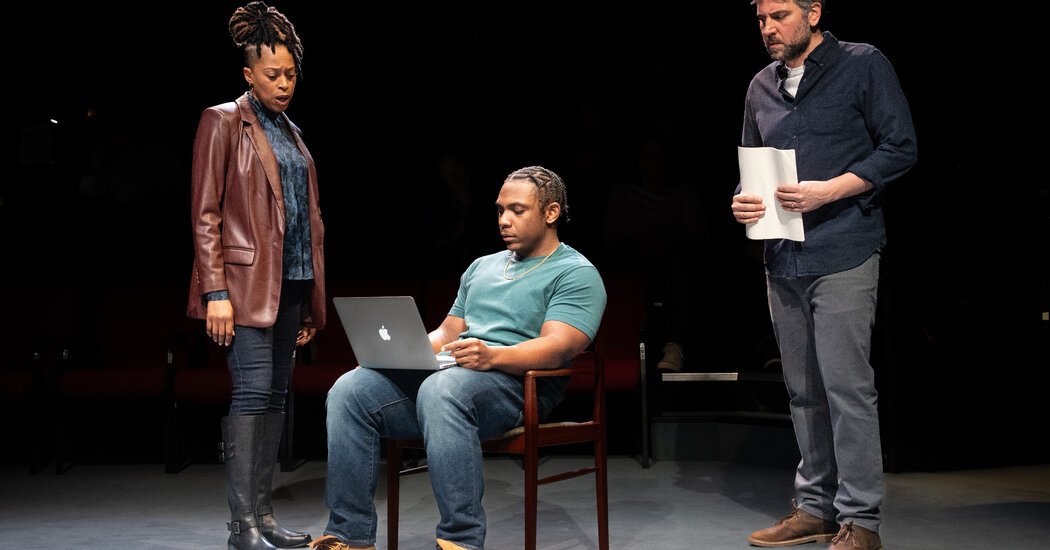
As this is a trial, let’s start with the facts. Asaf Sternheim, who teaches writing at a university a lot like Penn, is asked by a former student, Baron Prince, to endorse a manifesto. The manifesto seeks justice for Baron’s cousin, Deronte, who was killed by police officers while being stopped for a theft he had nothing to do with.
Also pertinent: Asaf (Josh Radnor) is a Jew, albeit the kind that subscribes, as he says, to the “acoustic-guitar-based variety” of Judaism. Baron (Elijah Jones) is Black, as was Deronte.
And one more thing: The 20-page manifesto, tying violence against Black Americans to violence against all subjugated populations, calls for “sanctions on the apartheid state of Israel,” adding that “failure to do so will leave the United States complicit in the ongoing genocide of the Palestinian people.”
You could feel the “uh-oh” in the audience the night I saw “The Ally,” an important, maddening play by Itamar Moses that opened on Tuesday at the Public Theater.
Words like “apartheid” and “genocide,” when applied to Israel and Palestinians, are sure to rile lots of people. But challenging the use of those words will equally rile others. Smack in the middle is Asaf, whom the play proceeds to put through a tribal-political wringer that leaves him — and left me — a limp dishrag.
Whether you think that’s a good thing for a play to do may depend on your tolerance for endless, furious, yet familiar debate. There’s no question that Moses, whose biography as the Berkeley-raised son of Israeli immigrants is a close match for Asaf’s, knows the territory and its every skirmish intimately. It often seems that the arguments, on all sides, have been transcribed from personal experience or the news.
Baron’s argument is, at first, the least problematic; the killing of his cousin is a bright-line injustice. And as Asaf’s wife, Gwen (Joy Osmanski), points out, endorsing the manifesto will help her, too. A university administrator charged with smoothing the extension of the campus into a Black neighborhood — as Penn has a history of doing — she knows that her husband’s signature will be viewed favorably there, at least compared to his refusal. Asaf signs.
But the decision to put aside his concerns about “apartheid” and “genocide” opens the door to further complications. Through that door walk representatives of two student organizations: one Jewish (Madeline Weinstein) and one Palestinian (Michael Khalid Karadsheh). Jointly, they seek Asaf’s support for a plan to bring a controversial speaker to campus. The speaker, whose views resemble those of the Israeli historian Ilan Pappe, has argued for a rethinking of Israel’s foundational and follow-up wars. Usually understood as defensive, these wars were in fact fought aggressively, he posits, “because the likely outcome was more territory.”
Another uh-oh.
And so the provocations and groans continue, for two hours and 40 minutes that could have been half or twice as long. Soon Asaf is being eviscerated by Reuven Fisher (Ben Rosenfield), a religious Jewish graduate student who shreds all the previous arguments, and, more substantially, by Nakia Clark, the Black community organizer who wrote the manifesto in the first place. No matter how Asaf squirms and shifts, everyone, including his wife, finds him guilty of something.
That is, admittedly, the way many progressive Jews feel: unsure how to square their status as part of a threatened minority with their support for others who feel the same way. Why, Asaf asks, does the manifesto wrap all such groups — Palestinians, Black Americans, victims of colonialist oppression worldwide — in its protective arms except one? Regardless of Israel, are not Jews victims of exactly the kinds of persecutions and violence the document condemns?
“I do not believe,” Nakia (Cherise Boothe) finally answers, “that these two struggles are actually the same struggle. And I will not be distracted from the work.”
If that’s a less than satisfactory answer politically, it is even dodgier dramatically. Nakia, it turns out, is Asaf’s ex, though it’s hard to imagine what they saw in each other, she being as unshakable in her positions as Asaf is wobbly in his. And though their scenes burn with an intensity that feels richer than any other in the play — Boothe is especially fearless in the role — the soggy subfloor of personal history creates a kind of believability sinkhole beneath them.
Moses’s earlier works, including the delightful “Bach at Leipzig” and the moving book for “The Band’s Visit,” successfully merge ideas with plot and character. Here, the ideas are so dominant that the plot feels like a Rube Goldberg device and the characters like chessmen, each with just one kind of move. Gwen advances Asaf in whichever direction will serve her administrative needs best. The student leaders, with only the thinnest lamination of personality, exist only to trap him. And Asaf himself is little more than a pawn, refusing to step forth. Were it not for Radnor’s hangdog charm, this ambivalence-monger, comfortable only when tied in knots, would be an insufferable caricature.
The production, directed by Lila Neugebauer, makes modest efforts to create emotion from this, but only gets as far as tension, as the characters circle Asaf in various alignments on the mostly empty Anspacher stage. As such, we are left with just the debate to respond to, which in its exasperating back and forth quickly becomes the dramatic equivalent of the whataboutism the characters condemn. Especially since the Hamas attacks on Israeli citizens on Oct. 7, and Israel’s invasion of Gaza soon thereafter — Moses wrote “The Ally” before those events — we might wish a play to be more than a Magic 8 Ball, delivering different answers depending on how you shake it.
Which is not to say that “The Ally” is artless. Quite the opposite, it is almost too artful, arraying its eloquent arguments in clever pairs of impossible contradiction. If only frustration and hopelessness were feelings worth intensifying, it would win a prize for its form-follows-function design.
But I felt the need for more wisdom than craft. (A feint at this, in the final scene, fizzles.) What looks like a fear of making the wrong statement has prevented Moses, as it prevents Asaf, from making any coherent statement at all. Except perhaps one, and it’s not so small in a world of multiple but often shallow loyalties: The difficulty of acknowledging any other group’s suffering deeply enough to equate it with our own is something, finally, we all have in common.
The Ally
Through March 24 at the Public Theater, Manhattan; publictheater.org. Running time: 2 hours 40 minutes.
