
The Supreme Court expressed strong concerns on Monday about the sweep of state laws restricting how large social media companies moderate user content, a digital free speech case with implications in the political and business arenas.
Separate laws that passed in Florida and Texas and are now challenged in court would require Big Tech companies like X, formerly Twitter, and Facebook to host third-party communications but prevent those businesses from blocking or removing users’ posts based on political viewpoints.
The regulations aim to address what some lawmakers call “censoring” of conservative messages, and banning politicians, like former President Trump, for violating subjective policies over offensive or “problematic” content.
But tech firms claim a First Amendment right as private entities to editorially regulate the billions of daily voices on their platforms — from political discourse and recipe sharing, to incitement and obscenity.
GOP AGS ASK SUPREME COURT TO PEEL BACK CONTENT MODERATION FROM BIG TECH IN LANDMARK FIRST AMENDMENT CASES
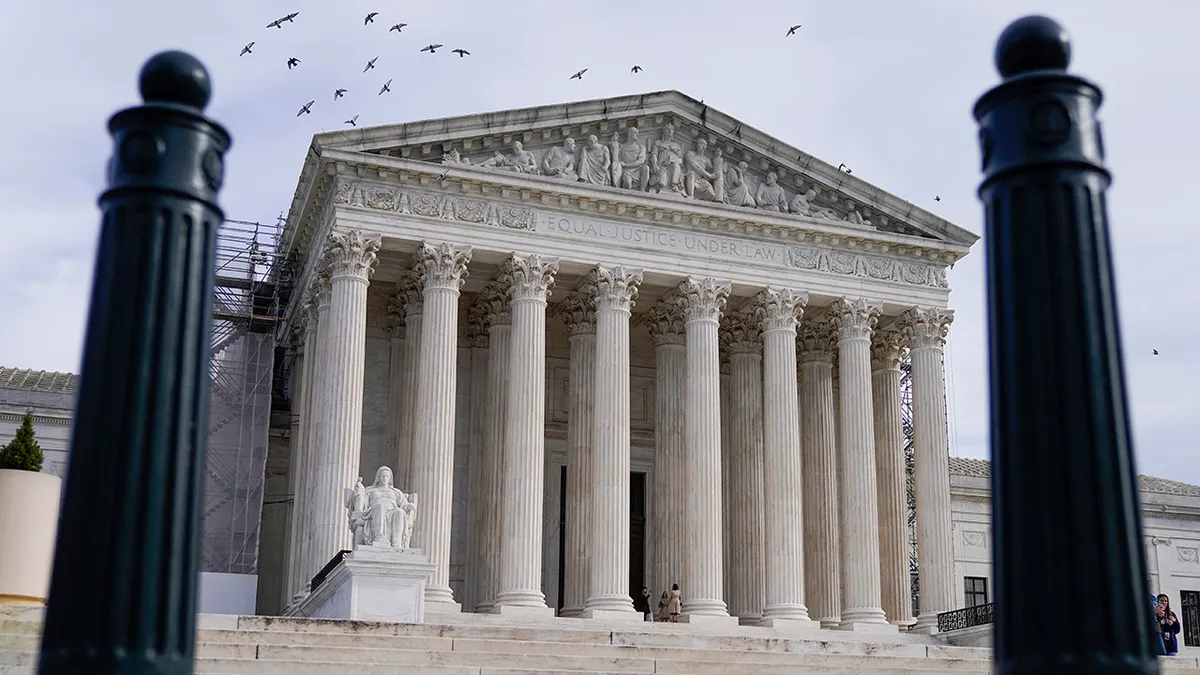
The U.S. Supreme Court is seen, Nov. 15, 2023, in Washington. (AP Photo/Mariam Zuhaib, File)
Justices on both sides of the ideological spectrum openly questioned whether the regulations would make it impossible for private companies to operate as a forum for free speech and expression.
“It covers almost everything,” said Justice Sonia Sotomayor of Florida’s law, which she said would affect what the arts and crafts retailer Etsy would have to allow on its digital marketplace. “That’s viewpoint discrimination. This falls under a whole lot of your listings and bans and disclosure requirements. Why are we imposing that on something like this?”
“The First Amendment restricts what the government can do,” Chief Justice John Roberts told Texas’ solicitor general. “What the government’s doing here is saying ‘you must do this, you must carry these people — you’ve got to explain if you don’t.’ That’s not the First Amendment.”
But there was widespread unease about the best approach they should take at this stage.
Some justices suggested large companies that host wide-ranging speech platforms may be able to exercise greater editorial control, but that e-commerce sites like Etsy, Venmo, and Uber could be regulated by the states to some extent.
“This is a sprawling statute and it makes me a little bit nervous,” said Justice Amy Coney Barrett, over how a court opinion could be applied across the infinite variety of digital media. She said the competing interests “had a bunch of landmines.”
Others on the bench wondered what the effect the big tech companies have on public discourse.
“There’s a lot of new terminology bouncing around in these cases, and just out of curiosity — and one of them is content moderation,” said Justice Samuel Alito. “is it anything more a euphemism for censorship?”
JAN 6 RIOTERS, ABORTION, GUN RIGHTS: A LOOK AHEAD AT LANDMARK CASES SCOTUS WILL HEAR IN 2024
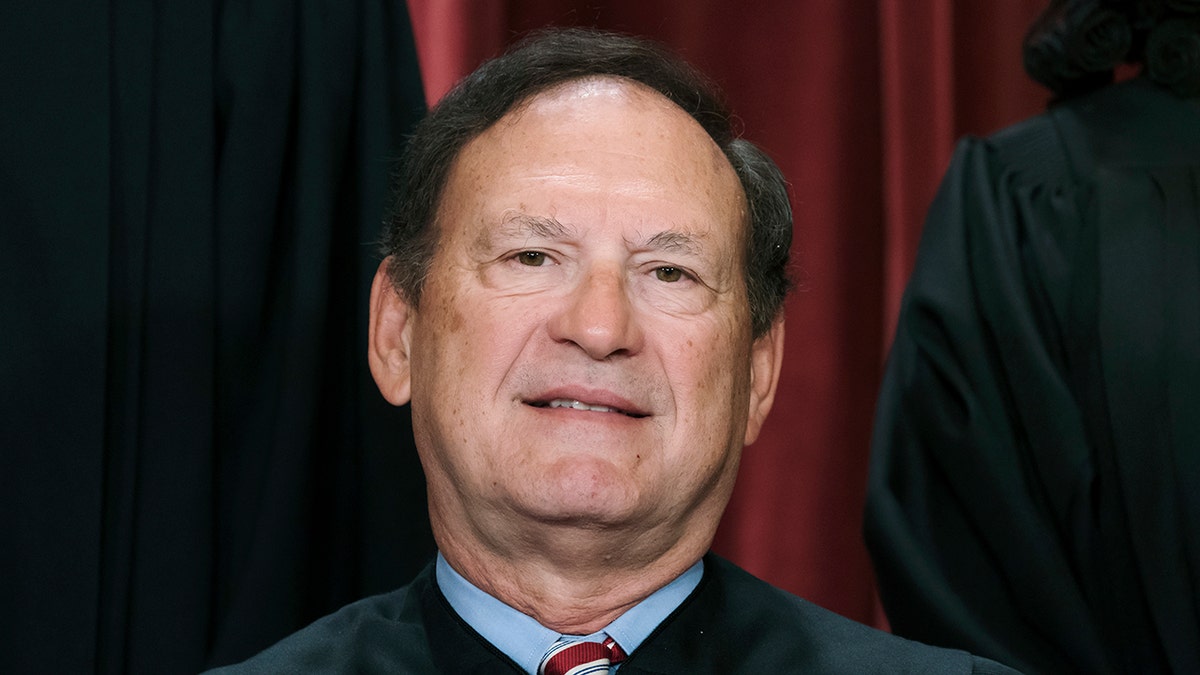
Associate Justice Samuel Alito (AP Photo/J. Scott Applewhite, File)
Alito also warned about resisting “the Orwellian temptation to recategorize offensive conduct in seemingly bland terms.”
The Florida law would block a social media platform from engaging in censoring, prioritizing, or so-called “shadow banning” “based on the content.” It also would prevent “willfully deplatforming a candidate” for public office for material posted by or about that candidate.
Both Florida and Texas would also require those companies to notify a user when their content has been modified or edited, along with an explanation for that action.
The states argue social media companies have outsized influence over what news and information the public sees, and say they have a long tradition of ensuring their citizens have full access to a range of viewpoints, calling social media platforms the new “digital public square.”
The Florida and Texas laws were passed shortly after Twitter/X and Facebook separately removed Trump for their platforms, for his posts related to the Jan. 6, 2021 Capitol riots by his supporters.
Trump and a coalition of Republican-led states are among those filing separate amicus briefs supporting Florida and Texas
The Biden administration has opposed the state laws.
GOP SENATOR URGES SCOTUS TO REIN IN BIG TECH’S CONTENT CENSORSHIP THAT DEFIES ‘LOGIC’
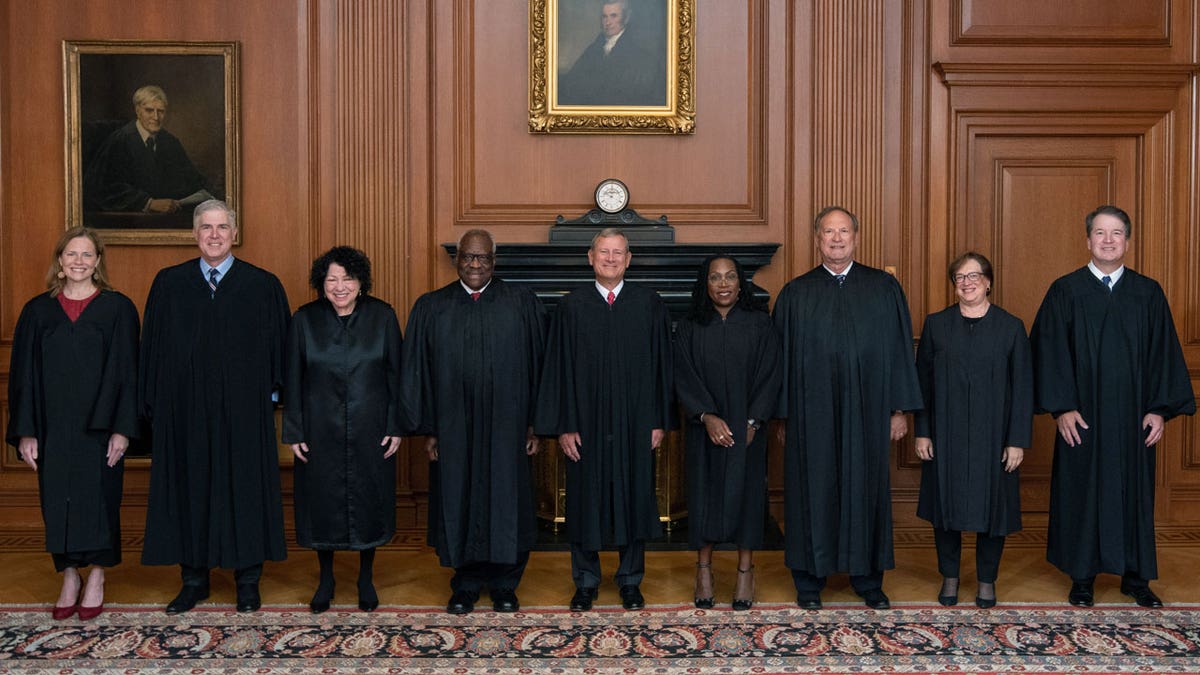
Members of the Supreme Court (Collection of the Supreme Court of the United States via Getty Images)
Trade groups representing big tech companies told the court the laws violate their free speech rights to decide what content meets their policies — saying their forums should not be an open-ended portal for offensive or dangerous speech — including school bullying, harassment, terrorist ideology, racial hatred, medical misinformation and voter fraud.
In almost four hours of oral arguments stretching well into the afternoon, the justices weighed whether to offer a sweeping ruling on the First Amendment implications of the state laws, or a more limited approach that might have the lower courts take another look at how those content moderation policies would be applied.
The U.S. Constitution was ratified by nine of the 13 states, making it binding. (iStock)
“Why isn’t that a classic First Amendment violation for the state to come in and say, ‘We’re not going to allow you to enforce those sorts of restrictions?'” asked Justice Elena Kagan.
“In your opening remarks,’ Justice Brett Kavanaugh asked of Florida’s Solicitor General Henry Whitaker, “you said the design of the First Amendment is to prevent ‘suppression of speech.’ And you left out what I understand to be three key words in the First Amendment or to describe the First Amendment, ‘by the government,'” with Kavanaugh suggesting private companies should be given broader latitude to moderate their users content.
CLICK HERE TO GET THE FOX NEWS APP
Attorneys for the states told the court that social media companies lack free speech protection since they only “host” viewpoints, similar to the telecommunications industry — known as “common carriers” — which transmits speech with no editorial oversight.
“Separating the wheat from the chaff here is pretty difficult,” said Justice Neil Gorsuch.
Justice Clarence Thomas, who light-heartedly noted he was the only member of the court who pre-dated the widespread use of the Internet was especially animated in his extensive bench remarks on the implications, asking tough questions of both sides.
“What do you do if it’s a deep-learning algorithm which teaches itself and has very little human intervention?” he asked at one point. “So who’s speaking then, the algorithm or the person?”
After the arguments, Florida Gov. Ron De Santis — on Twitter/X no less — said, “We’re gonna make sure we’re doing everything we can to ensure people have a right to speak in these public forums. We want more speech, not less speech.”
These cases are just the latest in what is shaping up a busy term on the digital front at the Supreme Court.
The justices in March will hear an appeal from GOP-controlled states over whether federal government efforts to combat disinformation online violate the free speech rights of users on social media platforms.
Here too, those states say conservative political views are being silenced, after pressure on social media firms by the Biden administration.
And the justices have already heard arguments over whether public officials can block critical comments on their social media accounts from constituents.
Rulings in the cases argued Monday, Moody v. NetChoice, LLC and NetChoice, LLC v. Paxton, are expected by late June.
