
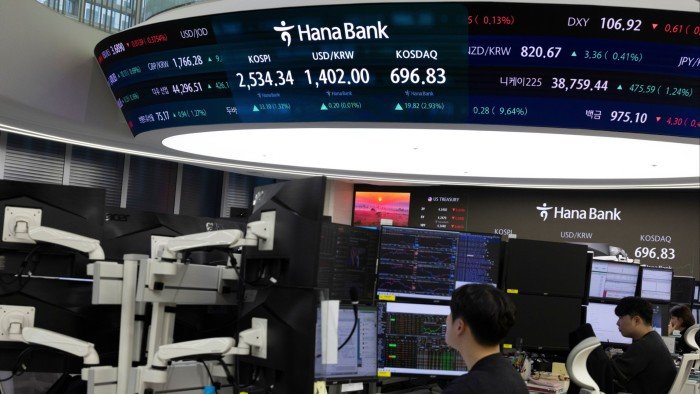
South Korea’s retail investors are flocking to US equities, betting a stock market rally will continue in the second Donald Trump presidency and frustrated by years of poor share performance at home.
Holdings of US stocks by the country’s investors reached a record $112.1bn at the end of 2024, according to Korea Securities Depository data, up 65 per cent from a year earlier.
That contrasts sharply with their net selling of Won5.4tn ($3.6bn) worth of local shares listed on the Kospi benchmark last year, dragging the index down nearly 10 per cent. This came despite the government’s efforts to boost historically low valuations through a “Corporate Value-up” initiative.
Tesla was the most popular overseas stock held by South Korean investors, prompting Elon Musk to call Koreans “smart people” in a post on X in July. South Korean individuals held a combined $24.5bn worth of Tesla shares as of last month, followed by $12.1bn in Nvidia, $4.9bn in Apple and $3.2bn in Microsoft.
“The shift highlights their frustration with the local equity market due to the poor shareholder return,” said Namuh Rhee, head of the Korea Corporate Governance Forum. “The trend is likely to continue unless something dramatic happens.”
Retail investors’ shift to US stocks could even intensify this year due to the uncertainty around recent political upheavals at home. Lawmakers impeached President Yoon Suk Yeol last month after he briefly declared martial law.
South Korea’s annualised 10-year total shareholder return stands at just 5 per cent, compared with 10 per cent in Japan and 13 per cent in the US, according to MSCI data.

HJ Baek, a 39-year-old communications manager at a local brokerage, has been investing in US stocks since 2019 and now holds about Won100mn of US shares, including Tesla, Apple and those in Warren Buffett’s portfolio.
“I prefer to invest in the long term but the domestic stock market is too volatile,” she said. “There are not many local companies with strong growth potential. They are unlikely to rise much even if I hold them for the next 10 years.”
Baek’s foreign portfolio has posted a 20 per cent return so far, while she has lost an estimated 30 per cent from her Won20mn domestic investment in equities.
She is not alone. Many of the country’s 14mn individual investors, known as “ants”, who account for half of average daily turnover compared with 30 per cent for foreigners, have turned to overseas markets for higher returns, frustrated with the “Korea discount” of chronic undervaluations.
About two-thirds of companies in the Kospi trade at a price-to-book ratio of less than one, meaning they are valued below the stated worth of their net assets.
Pessimism about the local stock market has intensified, with Trump’s election raising fears about higher trade tariffs and the possible reduction of subsidies allocated to South Korean battery producers.
Samsung’s shares hit a four-year low in November on growing concern over the weakening technological competitiveness of South Korea’s biggest company, which accounts for 18 per cent of the Kospi.
“With US stocks hitting record highs and local stocks in the doldrums, domestic investors fear missing out on the US boom,” said An Hyung-jin, chief investment officer of Seoul-based Billionfold Asset Management.
To shore up the flagging stock market, South Korean authorities have introduced a new index highlighting companies with improved capital efficiency, under the Value-up initiative. They have also promised to provide tax incentives for businesses that increase shareholder returns, while a capital gains tax, planned for this year, has been scrapped to appease disgruntled investors.
But only 3.9 per cent of South Korea’s 2,600 listed companies have signed up or committed to sign up to Value-up since it was announced in February.
“I had high expectations for the programme but it doesn’t seem so effective with no forceful measures,” said KW Kim, a 42-year-old worker at an online game company, who is suffering from ballooning losses in his Won600mn holdings of a small South Korean biotech company. “It looks more like a value-kill, rather than a value-up programme.”
Analysts blame South Korea’s depressed valuations on a legal and regulatory framework designed to protect the founding families of industrial groups at the expense of minority shareholders.
Retail investors such as Kim are pinning hopes on a pending revision of the Commercial Act, which will impose on board members a legal duty to uphold the interests of shareholders.
“That could be an important catalyst as it means much better board accountability,” said Rhee.
Experts say the country also needs to cut one of the world’s highest inheritance tax rates, reaching up to 65 per cent and providing an incentive to the controlling shareholders of big family-run conglomerates to keep share values of their affiliates artificially low.
“If they are serious about re-rating, authorities should reform the related tax laws because high taxes are the biggest reasons why the controlling shareholders don’t want to boost stock prices,” said Chaiwon Lee, chair of Seoul-based Life Asset Management.
Still, Lee is hopeful that South Korean investors will return to the domestic market, citing the growing valuation gap with the US. “US stocks can’t rise forever. With the domestic market nearing the bottom, I think this can be a buying opportunity,” he said.
But YJ Lee, a 31-year-old civil servant in Seoul who offloaded all her Korean shareholdings in 2019, said she had no plans to invest in local companies again.
“Buying US stocks is a safer bet,” said Lee, who has been investing Won500,000 every month in US stocks since 2022. “They can drop sometimes, but recover faster. I’ll keep on buying them.”
