
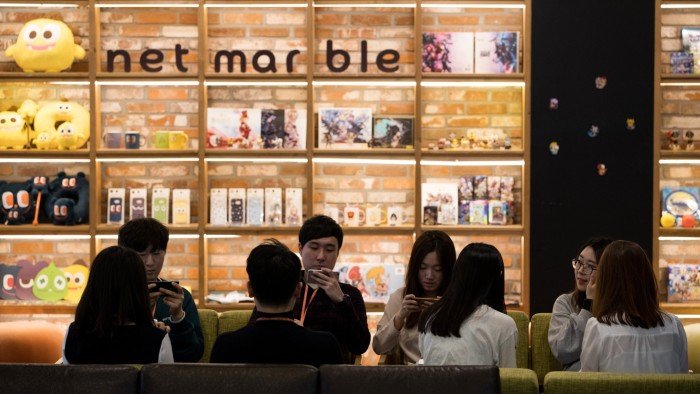
The headquarters of Netmarble, one of South Korea’s leading mobile game producers, used to be called the “lighthouse of Gurodong”, the industrial district in western Seoul, because its engineers often stayed up all night to meet the deadline for game launches.
But Netmarble’s stressful work environment came under the spotlight following a series of worker deaths in 2016, sparking public criticism of so-called “crunch mode” — when developers in the IT industry put in long periods of overtime to finish a project.
And Netmarble was not alone. Naver, South Korea’s biggest search engine, came under fire in 2021, when a developer in his forties died by suicide, leaving a note indicating extreme stress from relentless overtime and workplace bullying.
Now, though, after these cases exposed apparent failures to care for employees’ mental health, a cultural change is afoot in Asia’s fourth-largest economy — albeit slowly. South Korea’s government has promised to overhaul the country’s mental health system, while big companies are providing mental health programmes for their staff.
“Following the tragic incidents in 2016, we have been actively working over the past eight years to encourage a healthier work-life balance for our employees,” says Seijin Park, Netmarble’s spokesperson.
The company has eliminated the so-called “blanket wage system”, under which employees were forced to do overtime for free. It has also set up an on-site healthcare centre staffed with professional counsellors.

Naver, meanwhile, has established an internal human rights committee and says it regularly assesses its corporate culture. It also runs a counselling centre for employees and offers a free annual mental health check-up.
“Employees’ [personal] growth and wellbeing are directly related to corporate competitiveness,” Naver says. “We are trying to ensure that our employees can exert their best ability in their best condition.”
Experts say Korea’s wider work environment has improved since the country limited the maximum working week to 52 hours in 2018 and enacted a law in 2019 to crack down on workplace bullying.
“Productivity has become much more important for Korean companies as the work hours get shorter,” says Jeon Sang-won, who heads a workplace mental health institute at Kangbuk Samsung Hospital in Seoul. “Big IT companies are actively investing in employees’ mental care as they are increasingly aware of the seriousness of presenteeism as well as absenteeism.”
However, many workers still complain of frequent overtime and a hierarchical corporate culture. The country has among the longest working hours in the OECD, and accusations of bullying continue due to the rigid, top-down management style.
“I have to work overtime almost every day when it gets busy,” says a 34-year-old office worker in one of Samsung’s units. “I am exhausted because of high performance pressure. I really wanted to quit when an executive recently cursed at me.”
Like many other big Korean companies, Samsung — whose electronics subsidiary is ranked 49th on the Best Employers Asia-Pacific list — offers free mental health counselling.
The employee says he never used this because of fears that the information could be shared by his managers, but the company insists that the service is strictly confidential.
Samsung says it abides by legal working hours and supports its employees’ work-life balance. It also runs various programmes for their mental health and deals firmly with any reported verbal abuse.
Jeon estimates that 60 per cent of Korean employees’ occupational stress comes from relationship conflict, and attributes it to the value put on team work in Confucian culture.
“They suffer from all kinds of conflict stemming from generational, gender and rank differences,” he says. “Especially, young employees are frustrated with the country’s corporate culture lagging behind generational change, while working mothers show higher occupational stress due to prevalent gender discrimination.”
DH Kim, a communications manager at one of the country’s biggest conglomerates, recently received external counselling for insomnia because of her heavy workload and conflict with her colleagues.
“It is so stressful to adjust to the collective culture,” she says. “For example, you have to attend a company dinner even if you don’t want to.”
Like Kim, many Koreans remain unhappy despite the country’s fast economic growth. South Korea’s suicide rate, at 27.3 per 100,000 people last year, is the highest in the OECD. And, according to the Ministry of Health and Welfare, the number of South Koreans seeking treatment for mental illness increased from 3.2mm in 2017 to 4.3mn in 2022 — a 35 per cent rise.
Last year, President Yoon Suk Yeol set up a committee to oversee new mental health initiatives. He also promised to offer free counselling services for 1mn people and to increase the number of mental healthcare facilities by the time his term ends in 2027.

But Jay Kwon, a senior counsellor at MindGym, which provides corporate wellbeing services, says companies are still too focused on performance to give mental health the attention it deserves.
“Employees in cutting-edge industries are more stressed because of stronger performance pressure, but these companies tend to care more about growth and profits than their employees’ mental wellbeing,” he observes.
Jeon believes Korean companies need to make a systematic effort to overhaul toxic cultures — but reckons most see money spent on conventional management consultancy and facilities as a better way to boost productivity than investments in mental health.
“Most top managers still shun consulting on corporate culture because they don’t want to reveal the dark side of their company,” he says.
However, he adds: “When a fish struggles to breathe, you need to change the water in the fish tank.”
