
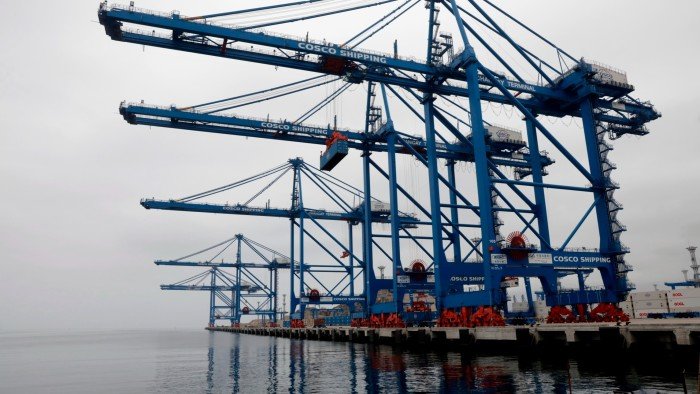
Ahead of the ribbon-cutting at the Port of Chancay — a Chinese-built megaport on Peru’s Pacific coast that is set to transform regional trade — Chinese-made ZPMC unmanned cranes line the quay.
BYD pick-up trucks sit ready to shuttle engineers around, while Huawei 5G internet towers have been freshly constructed to handle the automated operation.
“Everything is made in China,” said a beaming Mario de las Casas, public affairs manager of the port for Cosco Shipping, the Chinese state-owned shipping giant that will operate Chancay once it opens on Thursday. “This is a huge opportunity not just for Peru but for the whole region,” he added, as Peruvian and Chinese flags flapped from street lights.
Peruvian officials argue the port, built by Cosco with local miner Volcan, will transform Peru — a big producer of copper and fruit — into the Singapore of South America, and will upend maritime trade along the continent’s Pacific coast as it can accommodate larger vessels in its deep waters.

But analysts and officials raised concerns that the $3.6bn project, which follows a series of other Chinese infrastructure investments, in effect represents a ceding of Peruvian sovereignty over the port.
The US, for whom growing Chinese influence in Latin America presents a strategic problem, has warned the port could be used by Chinese warships. And the development may present an area of contention with US president-elect Donald Trump as he takes a tougher line against China.
“The risks to Peru are at multiple levels,” said Evan Ellis, professor of Latin American studies at the US Army War College. “Risk number one is the country not reaping the benefits of its abundant resources and geographic position, but rather the Chinese getting those benefits.”
Chinese President Xi Jinping, in Peru this week to attend the Apec summit ahead of a state visit, will appear with Peruvian President Dina Boluarte at Chancay’s inauguration on Thursday via video link from Lima, 80km away. US President Joe Biden will also be in town for the Apec summit on his first and last visit to South America as president — with little to offer.
In May, amid a dispute with Cosco, Peruvian lawmakers passed legislation granting it exclusive rights to operate Chancay, something Ellis said was “previously unthinkable and against the very essence of Peru’s assertion of sovereignty over its own ports, which are its window to the world”.


Peru’s transport minister Raúl Pérez-Reyes shrugged off those concerns, arguing that Chancay will be overseen by Peru’s customs and port authorities.
“In this case it is an investment of Chinese capital, but it is exactly the same as if it were British or North American capital . . . in no case is our sovereignty lost,” Pérez-Reyes said.
He said the port would allow Peru’s booming agricultural sector to keep growing. “What Chancay will do is redirect a portion of cargo and send it directly to Asia.”
Of the $3.6bn cost of construction, $1.3bn had been invested in the initial phase, Cosco said. The deepwater port can berth some of the world’s largest shipping vessels, with a capacity of 22,000 twenty-foot equivalent units, or TEUs, an industry standard for containers. No other port on the Pacific coast of South America can take ships of this size.
Chancay will shave at least 10 days off what was previously a 35-day voyage to China from Peru, meaning vessels will no longer require a stopover at Mexico’s Manzanilla port or California’s Long Beach.
Brazilian cargoes, which sometimes travel eastbound to Asia or via the Panama Canal, will also save at least 10 days of travel time, Cosco said.

A cabotage law passed in May will allow cargo to move between Peruvian ports before coming on land, saving time spent on roads. Cosco has said small vessels from Ecuador, Chile and Colombia would be able to ship goods to Peru’s other ports. These goods would then be moved to and exported from Chancay.
Brazil is also set to benefit, Pérez-Reyes said, by using the Southern Interoceanic Highway, which passes through Brazil’s agricultural hubs of Acre and Rondônia before reaching Peru’s Pacific coast.
Chancay, part of Beijing’s Belt and Road Initiative, adds to a portfolio of Chinese investments that includes Peru’s largest copper mine, Las Bambas, owned by MMG, a Chinese miner.
In April 2023, China Southern Power Grid acquired Enel’s Peruvian electricity business, which supplies power to the northern part of Lima, the country’s capital. The rest of Lima’s electricity supply was sold in 2020 to China’s Three Gorges Corporation, which also owns a Peruvian hydroelectric dam.
Peru in March awarded a concession to build and operate a port in the south to a subsidiary of Chinese company Jinzhao, which runs an iron ore mine near Ica.
By contrast, Peruvian trade minister Úrsula León said the US was missing an opportunity to invest. Beijing and Washington both have free trade agreements with Lima, with the former expected to strengthen its FTA during Xi’s visit.
China is Peru’s largest trade partner, with copper, iron and fishmeal making up the bulk of exports worth a total of $23.1bn in 2023. US-bound exports amounted to $9.1bn.
“There are some opportunities that [the US] is missing, so it’s important that they know a little more about our market,” León said.

León said the US “also has opportunities” to invest in megaprojects, including the planned southern port of Corío. “So we can’t generalise and say that Peru is practically becoming dependent on China,” she said.
The US had discussed Chancay with Peru, the US state department said, and raised “the importance of adequate oversight, security, regulation and fair competition for all key infrastructure projects”.
“We are not asking partners to choose between the United States and [China], but we are demonstrating the benefits of partnership” with the US, the official said.
China is now the biggest trading partner for South America and a major investor in critical minerals, transport and energy projects. Beijing insists its overseas projects aim for mutual benefit, an approach it contrasts with what it calls Washington’s pursuit of hegemony and geopolitical advantage.
Initially Chancay will be able to handle between 1mn and 1.5mn TEUs a year, as well as 6mn tonnes of loose cargo, before increasing that to 3.5mn TEUs a year. The Port of Callao, Peru’s main port, was expanded this year and has annual capacity of 3.7mn TEUs, said the transport ministry.
But Latin America’s port capacity lags well behind Asia, North America and Europe, which have multiple ports with a throughput of more than 10mn TEUs each.

To avoid congestion in the town of Chancay — until recently a sleepy fishing community visited by weekend tourists — Cosco built a 1,830 metre tunnel, Peru’s longest, for trucks to bypass the town. Residents have complained about noise from the port and what they say are threats to fish stocks and wetlands.
Cosco plans a business park beside the port, where China’s biggest electric vehicle maker BYD has expressed interest in opening an assembly plant.
Lawmakers are considering granting the premises exclusive tax breaks, though that has faced pushback over the advantage it would give Chancay over Callao, the state-owned but privately operated port 73km away.
“Investing in Chancay is already attractive enough without having to offer tax breaks,” said Adriana Tudela, an opposition congresswoman. “We are, in essence, creating a huge disadvantage for other ports.”
Before leaving her post as chief of US Southern Command, which covers Latin America and the Caribbean, General Laura Richardson warned Chancay could be used by the Chinese navy. “This is a playbook that we’ve seen play out in other places,” Richardson said.
Alfredo Thorne, a former finance minister who runs an economic consultancy, said while the Chinese investments benefit Peruvian exports, “they carry major political risks, including access to the US market”.
US president-elect Trump, Thorne said, might drag Peru into any spat with Beijing, as he is expected to pursue protectionist policies and take a hard line against China. Trump has proposed a 60 per cent tariff on Chinese goods.
Thorne said: “I don’t see what China’s interest would be in continuing to bet on Peru when it has to face down Trump.”
Additional reporting by Michael Stott in London
