
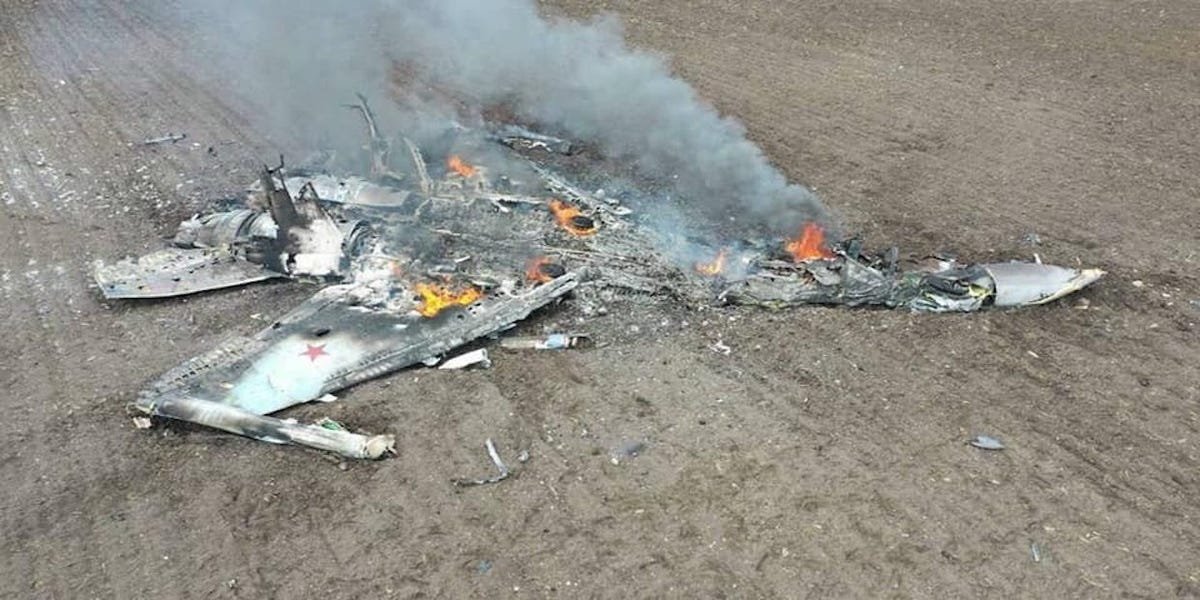
- After nearly two years of combat in Ukraine, Russia’s air force is still largely intact.
- But Moscow has underinvested in aircraft designed for suppressing and destroying enemy air defenses.
- If Russia’s air force can’t perform that mission, Russian ground forces will continue to struggle.

Despite its losses in the Ukraine, Russia’s air force is still quite robust. It began the war with about 900 fighters and other combat aircraft and is estimated to have lost only about 90 jets between February 2022 and September.
What Russia doesn’t have is the support aircraft needed to find and attack enemies on the ground. Even though Russian airpower was expected to be a dominant factor in this war — just as it has been for the US in its wars since 1945 — Russian jets have provided limited support to Russian troops, contributing to the failure of what the Kremlin expected to be an easy conquest.
That shortcoming has allowed Ukrainian anti-aircraft missiles, bolstered by Western-made air defenses, to take a toll on Russian aircraft, forcing the remainder to stay back and lob missiles and bombs at Ukrainian targets in less-precise attacks.
Russian Defense Ministry Press Service via AP
For NATO air forces, the solution would be obvious: conducting suppression of enemy air defenses, or SEAD, and destruction of enemy air defenses, or DEAD, missions to disrupt and destroy surface-to-air missile batteries and air-defense radars.
However, that requires adequate numbers of aircraft for intelligence, surveillance, and reconnaissance, or ISR, and for electronic warfare.
“Russia’s own military experts may not believe Russia has put its money or focus on the right technology,” Cmdr. Matthew Galamison, executive officer of a US Navy electronic-attack squadron, and Michael Petersen, a professor and expert on the Russian military at the US Naval War College, wrote in a recent article for the US Air Force’s Air and Space Operations Review.
“Airpower observers have noted the defense industry has failed to develop capability and capacity, especially in ISR and electronic attack, for the purpose of SEAD and DEAD,” Galamison and Petersen wrote.
Mihail Tokmakov/SOPA Images/LightRocket via Getty Images
The Russian Air Force — known as the VKS — is still focused on the Russian military’s traditional mission of protecting “the Motherland,” according to Galamison and Petersen.
“Russian military strategy has generally prioritized the defense of critical infrastructure and close air support of ground troops rather than power projection in defended airspace,” they wrote. “Because of this, the development of operational concepts and doctrine for air dominance operations, including SEAD/DEAD, has suffered.”
Ideally, strike aircraft entering enemy territory would be escorted by high-performance electronic-attack aircraft — such as the US Navy’s EA-18G Growlers — to jam or deceive enemy air defenses. But the VKS uses converted airliners that can’t survive in contested airspace and various models of Sukhoi fighters with wing-mounted electronic-warfare pods that provide limited support.
Kyiv City government
If airborne jamming isn’t an option, that leaves anti-radiation missiles, such as Russia’s Kh-31, to home in on and destroy enemy radar. Those missiles can be effective if used properly.
“Yet based on videos appearing on social media, the employment altitude, flight profile, and ranges observed are unlikely to maximize the desired effects,” Galamison and Petersen wrote in reference to Russia’s Kh-31 attacks. Ukrainian troops also defend against these attacks by briefly shutting down their radars when they detect an incoming anti-radiation missile, causing it to miss.
As long as Ukraine’s air defenses aren’t suppressed, the Russian Air Force can’t provide meaningful support to ground troops. Without air support, the Russian Army has a problem.
REUTERS/Serhii Nuzhnenko
Many Russian units in Ukraine are composed of ill-trained, poorly armed, and unmotivated conscripts and paroled criminals. Conducting complex operations with such troops is a challenge even when not facing highly motivated defenders like the Ukrainians. Airpower could and should have been an equalizer, helping Russian ground forces make up for other weaknesses.
Russia’s military is taking some steps to compensate for its lack of aerial coverage, according to recent assessments by the British Defence Ministry.
Russia has begun using A-50 early-warning-and-control aircraft to find targets for its S-400 air-defense systems at longer ranges, a change made in part because of Russian concern “about the prospect of Ukraine deploying Western-provided combat aircraft,” the ministry said this month.
Sefa Karacan/Anadolu Agency via Getty Images
A recent sighting of Russia’s Soviet-era M-55 reconnaissance plane carrying a military reconnaissance pod developed for fighter jets is also a sign that Moscow is considering putting the M-55 into use for ISR and target-acquisition missions in Ukraine, the ministry said in a separate update.
With a ceiling of more than 70,000 feet, the M-55’s sensors can work “at considerable stand-off range” to spot Ukrainian troops and air-defense sites from the safety of Russian airspace, the ministry said.
Given Russia’s formidable electronic-warfare capabilities and its deep arsenal, Moscow’s apparent interest in finding Ukraine’s air defenses means Kyiv may soon have to contend with a more effective campaign to suppress them.
Michael Peck is a defense writer whose work has appeared in Forbes, Defense News, Foreign Policy magazine, and other publications. He holds a master’s in political science. Follow him on Twitter and LinkedIn.
