
In the previous posts of this series, I have simply been describing the ideas R. R. Reno lays out in his book The Return of the Strong Gods, attempting to put the case in terms I think Reno himself would agree accurately represents his ideas. At this stage, I’ll be adding my own thoughts to the matter, starting with what I see as good about Reno’s book and his arguments.
Reno’s argument centers on a metaphorical concept of gods – gods than can be strong or weak, unifying or divisive, benevolent or dark. I appreciate the stylistic flourish to this approach – obviously he does not believe that “nationalism” or “patriotism” or “identity” are actual deities, but casting them in a rhetorical style that describes them as such does seem to be appropriate. These kinds of ideas are frequently discussed with a sort of quasi-religious reverence. It’s not for nothing that the quip “politics is the religion of modernity” exists.
An interesting idea proposed by Guido Pincione and Fernando Teson for evaluating a thinker is how well they perform what Pincione and Teson call the Display Test. In their (excellent) book Grandstanding: The Use and Abuse of Moral Talk, Justin Tosi and Brandon Warmke describe it this way:
Virtually every policy proposal would have downsides – perhaps even significant ones – if implemented. If a politician is honest about those downsides and supports the policy anyway, this is good evidence that she supports the policy because she thinks it will secure overall good outcomes. On the other hand, if a politician obscures or refuses to acknowledge the negatives of her proposal, Pincione and Teson suggest she is either ignorant or dishonest. She’s ignorant if she’s not aware of the downsides. She’s dishonest if she’s aware of the downsides but conceals them for rhetorical advantage. As Pincione and Teson put it, she’s a “posturer.”
By this measure, Reno scores exceptionally well. While Reno calls for the return of the strong gods, he takes multiple detours in his argument to stress just how dangerous strong gods can be, and he freely admits that much of the devastation that has been wrought on civilization has been done in the service of strong gods. Describing the carnage of the first half of the 20th century, Reno says,
The streets rang with declarations: The Dictatorship of the Proletariat, the Triumph of the Will, Blood and Soil. In those years, fierce gods trampled the benign managerial habits of commerce and the liberal norms of free consent and democratic deliberation. Strong and dark gods stormed through Europe, eventually setting aflame most of the world and bringing death to millions.
Respectably, Reno does not take the path taken by so many socialists who (falsely) declare “but that wasn’t real socialism!” after yet another attempt at socialism predictably collapses into disaster. Reno doesn’t say the ideas that motivated these disasters weren’t real strong gods. He repeatedly bends over backwards to emphasize that “Men do horrible things in the service of strong gods. Traditional societies justify radical inequalities, calling them expressions of sacred hierarchies. They demand terrible sacrifices for collective aims perfumed with transcendent claims. Modern societies have inflicted unspeakable brutalities in the service of utopian ideologies that claim the supreme sanction of History.” Say what you want about Reno’s worldview, but you can’t accuse him of minimizing or overlooking the risks and downsides of what he advocates.
But while Reno freely admits how dangerous strong gods can be, he believes that human society will always come back to them in one form or another. In this, his thought demonstrates what Michael Freeden, in his book Ideologies and Political Theory, identified as a signature feature of conservative thinking. Conservatives, Freeden says, argue that human societies are limited or structured by “extra-human” forces – forces we cannot alter, and that put limits on what can be achieved. The reign of strong gods over a society is such an extra-human force in Reno’s thinking – one that is driven by fundamental facts of human nature that cannot be changed. All thinking about social order must take place within the constraints of this unalterable fact.
As a result of his own performance of the Display Test, Reno treats those who wished to banish the strong gods with a great deal of respect and sympathy, and he frequently makes an effort to point to areas where their arguments were correct, or their ideas proved beneficial when put into practice. He also avoids the all-too-common trend of acting as though those on the other side of the argument have nothing of value to say:
Our leadership class is not wrong to be nervous about what Trump and other populists represent. We have a great deal to lose. An open society can be wealthy and moderate. Technocratic rationality of the sort encouraged by Popper can lead to well-considered policies. Hayek and Friedman were correct. The decentered play of self-interest in the marketplace can generate wealth and give us elbow room to make up our own minds about how to live.
Reno argues that much of what classical liberals value is good and useful and can be beneficial toward maintaining and improving social order. His objection isn’t that the basic values of the open society are wrong, only that they are incomplete and can’t serve as ends in themselves:
But the open society alone fails to meet our basic human need for a home. True solidarity is not close-minded complacency. It is an active loyalty that aspires to be faithful to a shared love…Without loyalty and the solidarity it breeds we become disquieted, even amidst our pleasures, riches, and relative comity.
Reno also acknowledges the value of liberalism and that strong gods can be liberal gods too. Liberalism guided by a shared commitment to strong gods is beneficial:
They are called “liberal” because they seek to identify a basis for civic loyalty in self-interest…These liberal theories suggest a useful test of the strong gods of public life: Are they humanizing or dehumanizing? Do they lay waste or bring flourishing? Shared loves that abandon individuals to the rapacious, dominating, bloodthirsty impulses of others are surely malevolent, as are the strong gods that imprison on a whim, employ thought police, and confiscate property.
These liberal theories are only me-centered in part. The liberal democratic ethos does not want freedom only in the Roman sense of collective freedom from domination and for self-government. It also values a public spirit of voluntariness: this is my country not merely because I was born here, for if I could, I would actively choose it. The common good of widespread consent to our way of life affects civic affairs in many ways. It is obviously manifest in an all-volunteer military. But in more subtle ways the atmosphere of consent – I’m here because I want to be here! – fuses private interest with public spiritedness. It allows our commercial republic to be both an arena for the pursuit of wealth and self-interest and a genuine republic, a commonwealth we care about for its own sake and which we are willing to sustain, defend, and improve, even at the cost of personal sacrifice.
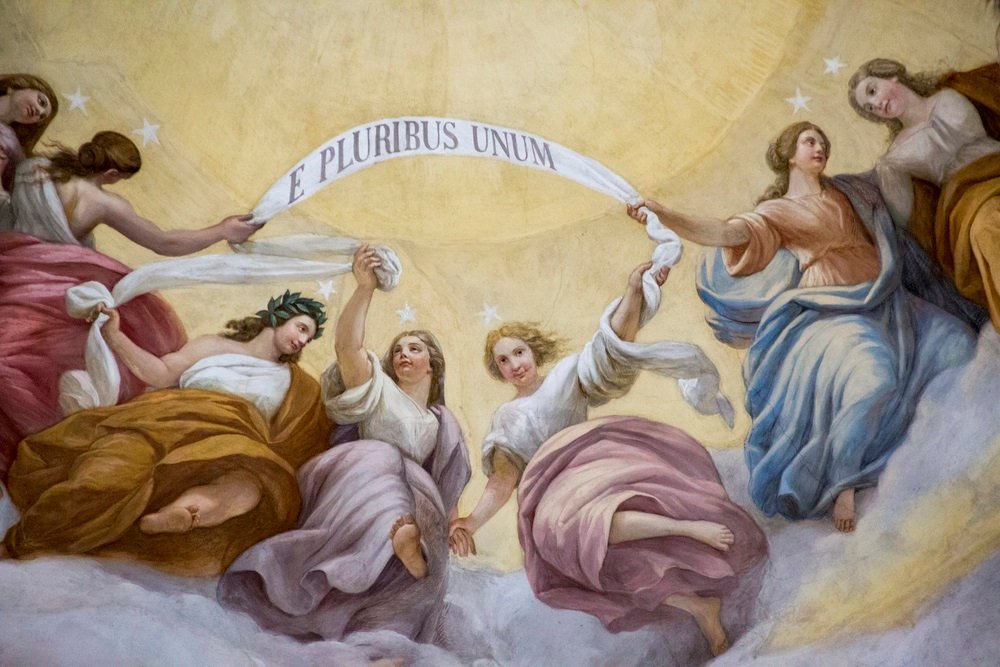
I also think the distinction between transcendent ideas that unite and those that divide is a true and useful one. And I believe Reno is correct that in the last few generations, the latter have been driving out the former. One strong god that seems (to me, anyway) to have been diminished can still be found on the currency of the United States – E pluribus unum, which translates from Latin to “out of many, one.” The idea behind this was that the citizens of America may have family histories that trace back to numerous nations across the world, but nonetheless, in America one is American regardless of that background. Identity politics inverts this idea, fracturing one into many. This has the effect of Balkanizing a citizenry into opposing identities that see each other as rival special interest groups against whom they must compete. This concern, incidentally, was shared by Teddy Roosevelt, who said,
The one absolutely certain way of bringing this nation to ruin, of preventing all possibility of it continuing to be a nation at all, would be to permit it to become a tangle of squabbling nationalities, an intricate knot of German-Americans, Irish-Americans, English-Americans, French-Americans, Scandinavian-Americans or Italian-Americans, each preserving a separate nationality, each at heart feeling more sympathy with Europeans of that nationality, than with the other citizens of the American Republic.
Modern identity politics seems to take things a step further than even this. Roosevelt was worried about a split along one axis – national identity. But modern identity politics has created far more axes upon which people’s “identity” can be divided, an each additional axis compounds the degree to which social unity can be splintered.
But one mustn’t overstate things – E pluribus unum isn’t totally extinct. When I was in the Marines, I met a number of people who had enlisted in the Marine Corps despite not being American citizens. Most of those I knew did eventually gain citizenship – and they all, without fail, seemed very dedicated to the strong god of E pluribus unum. They would react very poorly if you referred to them as Canadian-Americans or Bolivian-Americans or Brazilian-Americans – if you suggested to them they were anything other than just American, full stop, they took it as an insult. They came to America because they wanted to be Americans. They had a negative visceral reaction to the idea of hyphenated identity that far exceeded even what you’d hear from a small town conservative radio talk show host.
I think that in the big picture, and in broad strokes, there is a lot of truth to the framing Reno describes. And temperamentally, I’ve always enjoyed reading the ideas of people who speak in terms of big, bold ideas. But these big picture narratives often have a habit of cracking when you drill down and look into the finer details, and Reno’s narrative is no exception. In my next posts I’ll be describing some important points I think Reno gets wrong.
