

Many Americans are increasingly disillusioned with the ability of the free market to bring down skyrocketing housing prices. More Americans believe housing prices to be inflated by the greed of landlords and lobbyists, combined with the inability of policymakers to effectively regulate housing costs. Proof of this is that rent control has returned to the mainstream. In 2024, 22 rent control/stabilization statewide bills were enacted, and the Biden administration proposed capping rent increases across the country at 5-percent annually. Proponents of rent control agree with Bryan Caplan on one thing: housing prices are artificially high. In his latest appearance on EconTalk, Caplan and Russ Roberts discuss why housing regulations are the disease, not the cure to rent increases.
Roberts and Caplan both dispel myths from both sides of the debate over why housing is so expensive. They mention that anti-regulation proponents often argue that high housing prices are purely caused by supply and demand, people are just willing to pay more to live in cities like New York, Los Angeles, and San Francisco. While the other side believes that corporate greed is responsible for the 21 million rent burdened households in America.
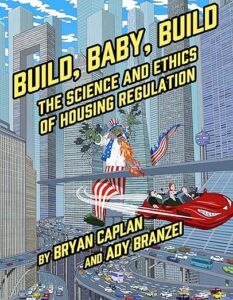
Both sides are missing the point that housing regulations themselves increase the cost of housing. Caplan outlines how local governments often make it exceedingly difficult to build new housing, particularly high-density housing, due to aesthetic, environmental, and urban planning concerns. This causes the cost to produce housing to increase, which is passed on to the consumer through rent increases, for instance. Additionally, pushing down supply causes an artificial shortage of housing, leading consumers to bid up the price. Caplan’s solution is the title of his book, Build, Baby, Build; eliminate regulations choking supply, and unleash the power of the market which incentivizes developers to produce affordable housing.
Caplan adds nuance the public choice viewpoint that inefficient regulations exist because interest groups and self-interested politicians benefit from them, despite their larger dispersed costs to the community. Caplan disagrees. He argues that people 1.) do not believe deregulation will cause prices to decrease, and 2.) favor regulation due to risk aversion. People want to ensure that all concerns, even trivial concerns, are addressed. Because it is so difficult to completely avoid risk, very few projects will meet that threshold.
There’s a common view in public choice that interest groups, and not public opinion drive policy. One of the main things that I’ve been saying in my career is, actually democracies pay a lot of attention to public opinion, it’s just that public opinion is so different from what economists assume it would be…It really is normal for tenants in the United States to oppose new construction… people are very focused on everything that can go wrong, and the government needs to protect us from that long list. If we build more stuff there could be parking problems, it could harm the character of the neighborhood, there could be birds displaced. Economists might think these are just lame excuses, but they strike a chord with most of the population.
But why would people want regulation given its negative effect on supply? Roberts and Caplan acknowledge that deregulation has costs, one of many touched on during the podcast is aesthetic concerns. As Roberts states, it is possible that allowing more high-density housing to be built in San Francisco would reduce neighborhood character. Caplan responds that developers want to provide an aesthetic product, not out of the goodness of their heart, but out of self-interest, as they can then charge higher prices for individuals to live in better looking buildings. To Caplan, a world with less regulation would provide more housing, and more aesthetic housing. This is creative destruction in action, as historical buildings are demolished and replaced by aesthetically and technologically improved buildings.
In the book I have a time machine, Ed Glaeser and I go back to 1931 to see the original Waldorf Astoria Hotel, which was just gorgeous, so it is just a crime to have torn it down, right? Well, guess what came up two years later: The Empire State Building, maybe the most beloved building ever made. You should always be thinking about the future. Anytime you see something you really like, normally there was something there before that was torn down that somebody previously thought was wonderful. I say at least be open-minded the possibility that developers want to make things better.
Roberts points out that restrictive housing directives were not always prevalent, so what is behind the shift in regulatory appetite? Caplan attributes a sizable degree of the pile of red tape to local governments being more attentive to activists, and better organization from concentrated interest groups. Many of these activists are motivated by environmental concerns, revolving around population density and new construction. However, cities have lower carbon emissions per person than more sparsely populated areas, and new construction is more carbon efficient. To Caplan, preventing new housing from being built has a high environmental opportunity cost, and true environmentalist activists would value the harm reduction that new construction provides. However,
…You cannot protect the planet in California because if you prevent people from getting affordable housing in California they are going to move to another place in the country where emissions will be much higher. I you are worried about global warming, what matters is not which part of the country the emissions come from, but instead what the total emissions are. A real green would want give a massive green light to tons of construction in California.
Roberts asserts that proponents of both regulation and deregulation function as if there is a dial of regulation that can be perfectly placed on the optimal level. The problem with the dial is that it is too vague, people focus on the amount of regulation rather than the laws on the books themselves. But this tells us little about what optimal housing policy is. Roberts challenges Caplan on which specific policies he favors, as just cutting half the regulations is too simple. Caplan proposes by-right development, under which if compliance with zoning regulations is met, approval for a project must be granted. This would slash the ability of city councils to discretionarily shut down development.
Caplan suggests a blueprint for success is Houston: a city with lower housing prices, and a population boom. Caplan makes sure to mention that Houston is not an unregulated Kallipolis, but what the city has done is diminish the public will to regulate through contractually internalizing the preferences of particular neighborhoods.
…Houston successfully reduces popular pressure for regulation by respecting not only homeowner associations, but also restrictive covenants. In neighborhoods where people want to regulate, the government lets them do it contractually, which means that if the people have an intense demand for regulation, they can. Meanwhile, neighborhoods where people are more apathetic stay open. You just have a lot more variety, which is crucial, if every major city were half strictly regulated and half wild west, which would probably solve 80% of the problem.
The consequences of over-restriction extend beyond the housing market. As Roberts touches on, housing regulations reducing supply make it more difficult for low socioeconomic status people to live in areas of high economic productivity. But there are reasons for current renters and homeowners to support deregulation. Housing prices would decline, and it would be easier for homeowners to sell their home to a developer, or upgrade from a starter home. Housing regulations are popular even though their costs are high because they are largely unseen. This is why Caplan authored his book, to make the copious benefits of the invisible hand visible.
Related EconTalk Episodes:
Jenny Schuetz on Land Regulation and the Housing Market
Judge Glock on Zoning and Local Government
Katherine Levine Einstein on Neighborhood Defenders
Charles Marohn on Strong Towns, Urban Development, and the Future of American Cities
Alain Bertaud on Cities, Planning, and Order Without Design
Related Liberty Fund Content:
Emily Hamilton on Housing Deregulation, The Great Antidote Podcast
How to Fix the Broken Housing Market, by Jason Jewell, at Law and Liberty
Solving the Housing Crisis, by Mark Pulliam, at Law and Liberty
Not enough housing? Let the market in, by John Phelan, at Econlib
Is Californian Housing Policy a Form of Central Planning? by David Henderson, at Econlib
