

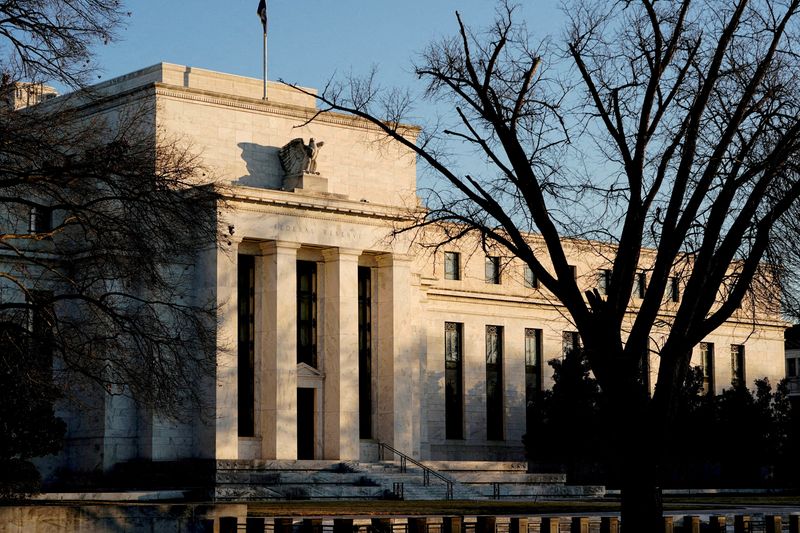
© Reuters. FILE PHOTO: The Federal Reserve building in Washington, U.S., January 26, 2022. REUTERS/Joshua Roberts/File Photo
By Howard Schneider
NEW YORK (Reuters) – The move by major central banks to reduce their asset holdings, begun in 2022 as part of their inflation fight, has had only a modest impact on interest rates and negligible influence on a broad set of other financial indicators, according to new research analyzing the effort’s impact.
The direct effect of “quantitative tightening” efforts on government bond yields in the seven markets under study, including the U.S. and the euro area, was estimated overall at from 4 to 8 basis points for securities maturing a year or more in the future. In the U.S. it was “close to zero” because of the Federal Reserve’s “drip feed” of information that allowed markets to adjust over time.
Because the research focused on market moves the day of and the day after balance sheet policy announcements, asset sales, and other key events, the authors cautioned they might not capture slower-moving effects.
But their bottom line was that quantitative tightening, while more significant than “paint drying,” had far less impact than the central bank bond purchases that stockpiled assets in the first place.
The reference was to a comment by former Fed Chair Janet Yellen, as the Fed approached the point of shrinking its balance sheet in 2017 in an earlier round of quantitative tightening, that she hoped the process would be dull and uneventful – like watching paint dry.
In the wake of $8 trillion added to central bank balance sheets to support economic activity during the pandemic, seven central banks including the Fed, the European Central Bank, the Bank of England, and others have pared about $2.2 trillion of their holdings through direct sales or passive “roll-off.” The authors found that to the extent there is an effect of QT, it is due to central bank announcements of their plans, not the actual transactions.
The findings “should give central banks more confidence to unwind asset purchases in the future,” wrote the authors, Wenxin Du of Columbia Business School, former Bank of England policymaker and MIT-Sloan School of Management professor Kristin Forbes, and Deutsche Bank economist Matthew Luzzetti.
The research was presented on Friday at a University of Chicago Booth School of Business monetary policy forum, with Fed Governor Christopher Waller and Dallas Fed President Lorie Logan scheduled to discuss the findings later Friday morning.
The impact of central bank balance sheet policy on financial conditions has been an area of intense research interest since the Fed and others expanded their asset holdings rapidly to try to lift economic activity once interest rates had been cut to zero during a 2009 to 2010 recession, and then again in response to the pandemic.
While central bank assets purchases, or quantitative easing, have been found to lower long-term interest rates by perhaps a full percentage point or more and to supercharge equity markets, quantitative tightening does not seem to work with the same force in the other direction – something the authors said could be the result of the different economic, liquidity and other conditions likely surrounding each policy.
Central banks including the Fed are now debating how much further to allow balance sheets to shrink, with policymakers cognizant that in the fall of 2019 the Fed let its asset holdings fall too far and touched off a spike in overnight borrowing costs for banks that they had to remedy with a quick resumption of asset purchases.
The authors said they could not rule out similar upheaval this time in a process that is still underway.
“The challenge will be assessing when this smooth adjustment to date could suddenly transition to a liquidity crunch and have a sharper impact on financial markets – similar to that moment when water suddenly boils,” they wrote.
