
Unlock the Editor’s Digest for free
Roula Khalaf, Editor of the FT, selects her favourite stories in this weekly newsletter.
A small start-up in New Zealand claims it has created plasma, the first step towards nuclear fusion, in under two years and for less than $10mn after experimenting with an unconventional reactor design.
OpenStar, founded by chief executive Ratu Mataira in 2021 in his Wellington apartment, said on Tuesday that it had created and contained a plasma cloud at around 300,000 degrees Celsius for 20 seconds in its first experimental reactor.
While much higher plasma temperatures are required to achieve nuclear fusion, OpenStar’s test stands apart for its unconventional reactor design, which the company said could be faster to scale and commercialise.
The promise of fusion — in which hydrogen isotopes collide with each other inside a plasma and fuse, resulting in the release of enormous amounts of energy — has tantalised researchers for decades.

In recent years, significant funding has gone into fusion start-ups, as investors bet that the process could provide cheap, carbon-free energy without long-lived nuclear waste. However, the technology is still being developed and experts say commercialisation is far from being realised.
Several other nuclear fusion projects, including ITER in France, the China Fusion Engineering Test Reactor, and JT-60SA in Japan, use a “tokamak” design pioneered by Soviet scientists in the 1950s. The device consists of plasma contained inside a doughnut-shaped chamber by powerful external magnets.
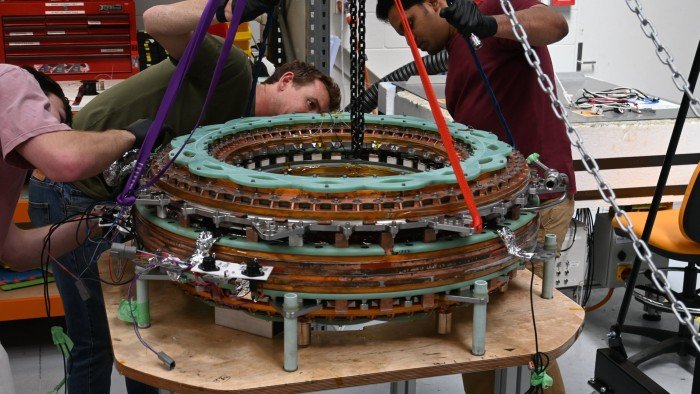
Mataira said OpenStar’s breakthrough had been to turn the tokamak design “inside out”. Instead of magnets outside the chamber, OpenStar levitates a high-temperature superconducting magnet inside the superheated plasma, which is then kept within the magnet’s north-to-south field lines. This allows the plasma, which is so hot it would destroy any material it touches, to be contained inside a vacuum chamber.
“The core engineering challenge is how do you make a magnet that’s surrounded by plasma operate for long enough to be useful,” said Mataira, explaining that the levitating magnet runs on battery power, and that the current design can operate for 80 minutes before needing to be recharged.
He said the design, pioneered in a decade-long experiment by scientists at MIT, would ultimately prove faster to scale than tokamak reactors because it is easier to modify.

“Building a tokamak is like building a ship in a bottle,” said Mataira. “Every design decision you make impacts every other system.” He said upgrading the system could involve building a new reactor and several years of work.
Dennis Whyte, professor at MIT and a co-founder of US-based power fusion company Commonwealth Fusion Systems, said he was “thrilled” that OpenStar had built its levitating magnet reactor. “This adds an exciting option to the diverse approaches to fusion,” he said.
New Zealand passed a law in 1987 to become a nuclear-free zone across its territorial sea, land and air space. It has no nuclear power plants.
But Mataira said OpenStar’s research falls within the country’s radiation safety laws. He predicted that the public would accept the distinction between nuclear fission and fusion, which does not create any radioactive waste.
The start-up has been funded by New Zealand investors to date, but has a goal of raising a series A investment round in the first quarter of 2025. Mataira said the company would ultimately need between $500mn and $1bn to prove out all technical risks.

On its website, OpenStar estimates that nuclear fusion is six years away from being a commercial technology.
“The reason why we are excited by fusion is because we think it can aid the decarbonisation of the energy sector, and for that there is an enormous amount of time pressure,” said Mataira.
