

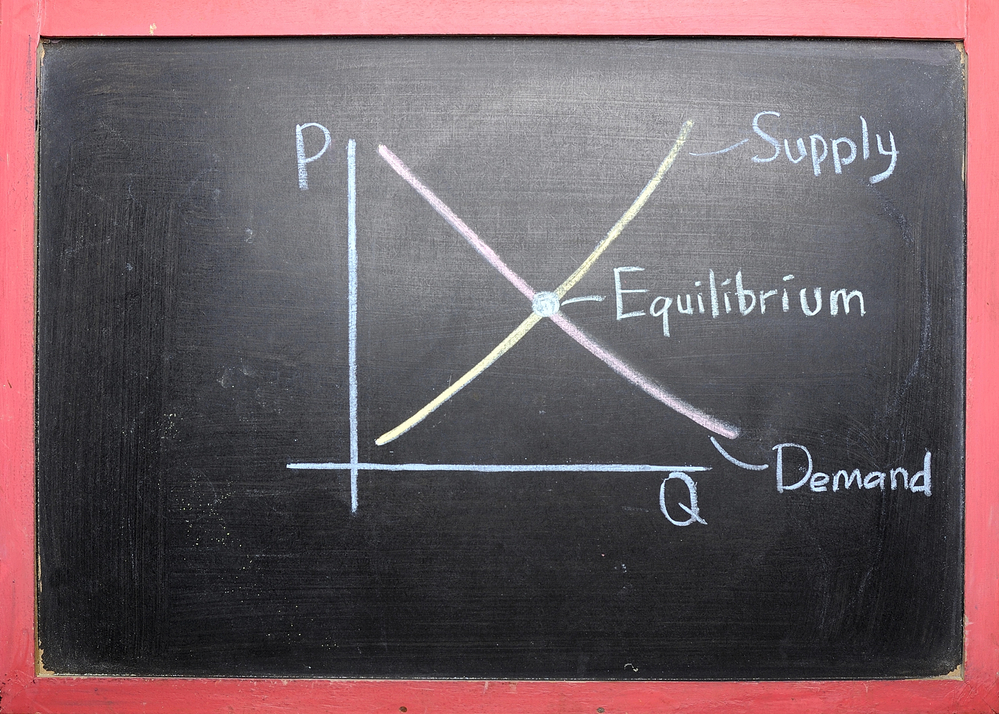
I suspect regular readers of this blog are familiar with what basic economics tells us we can expect to see as a result of price controls. Let’s say that for some good, there is a large positive demand shock or negative supply shock, or both. This shifts the demand curve to the right, or supply curve to the left, or, again, both curves shift right and left respectively. As a result, the market-clearing price – that is, the point where the two curves intersect – sharply increases. If the law prevents the price from rising to the market clearing level, what should we expect to see?
We should expect to see the quantity demanded (i.e., the amount people want to buy at the artificially suppressed price) to vastly exceed the quantity supplied (i.e., the amount producers are willing to sell at the artificially suppressed price). So when price controls are in effect, we should expect to see severe shortages. A knock-on effect of these shortages can be the creation of black markets – funneling the good in question out of the open market and selling it at higher prices through black markets. Black markets, in turn, greatly increase the risk of fraud and deception.
The vast majority of economists oppose price controls for these (among other) reasons. This is true even when, as Jon Murphy recently pointed out, supply is fixed in the short run. If there is a dire need for some good, you want two things to happen. First, you want to increase the quantity supplied. That is to say, you want to ensure that production is operating at the maximum current capacity. And in the longer term, you would want to increase supply – that is, increase the capacity for production. High prices do both – they encourage current producers to crank out as many units as they possibly can with their current capacity, and encourage them and other potential producers to increase their capacity to produce even more the good in question going forward.
Suppose tomorrow, scientists announce that eating 100 grams of cranberries per day has been proven to make one immune from ever developing cancer. What would happen in the short run? There would be a huge increase in the demand for cranberries – the demand curve would shift sharply to the right. Cranberries, in turn, would become much more expensive, so even though demand will drastically increase, the quantity demanded will not rise by all that much, at least in the short run. What would happen on the production front? For any given cranberry farm, you’d expect there are some marginal adjustments they could make to increase output, but those changes hadn’t been worth the cost of making. But when the price rises, those adjustments become worth making. You’d expect current cranberry farmers to immediately try to maximize their yields and push as many cranberries out the door as they possibly could.
In the longer term, you’d expect them to increase their cranberry production capacity, and you’d also expect to see many other people shift away from growing blackberries or marionberries and start growing cranberries instead. This, in turn, shifts the supply curve to the right as well, bringing the market price for cranberries back down. The process of adjustment will take some time, but if your goal was to make sure lots of people can take advantage of cranberries and their cancer-preventing properties, implementing price controls on cranberries would be your worst enemy, because it would prevent these adjustments from occurring. And if that happened, you can expect a black market in cranberries will arise, with all the negative effects that come alongside black markets.
In The Big Fail: What the Pandemic Revealed About Who America Protects and Who It Leaves Behind, Joe Nocera and Bethany McLean lay out in detail many terrible hardships during Covid-19 pandemic caused by shortages of personal protective equipment, or PPE, such as N95 masks or hospital gowns. Everything they lay out reads like a checklist perfectly designed to highlight every negative side effect standard economics predicts when price controls are put into effect. And yet, perplexingly, price controls on PPE are completely absent from the story they tell. They briefly quote a statement made by Jared Kushner saying that free markets were the answer to the problem, and seemingly take that at face value as a representation of what actual policy was. But, of course, there was never anything close to a free market operating with regards to PPE production or distribution. In March 2020, the Trump White House was already issuing statements about how the Federal Government was on the alert to prevent any so-called “price gouging related to medical resources needed to respond to the coronavirus.”
Nocera and McLean describe how a massive black market arose for PPE, and how desperate medical facilities turned to these black markets to try to get the needed supplies. Some facilities were able to acquire supplies on the black market at prices producers were forbidden from selling on the open market – but many others fell victim to fraud.
One other interesting note in the above linked statement from the White House is the assurance that the “Federal Emergency Management Agency (FEMA) is sending respirators, surgical masks, face shields, and gloves to places they are needed most.” That is, FEMA was going to try its hand at distributing resources from a top-down, command and control style. But experience quickly taught people not to trust this. It got to the point that FEMA had to put out a statement of their own addressing concerns that FEMA itself was essentially stealing PPE. FEMA described their actions in this way:
The Department of Justice (DOJ) has assembled a COVID-19 Hoarding and Price Gouging task force to identify cases of price gouging and may alert FEMA to some shipments and stockpiles of PPE. Under Defense Production Act authorities, FEMA may then compel a price gouger to sell PPE in its control to FEMA at prevailing market prices, not gouging prices.
That last sentence is a bit disingenuous – it would be more accurate to say that FEMA would compel people to sell to FEMA at artificially suppressed prices rather than actual market prices. But at least this raised the possibility that FEMA would, as the federal government assured us, send those “respirators, surgical masks, face shields, and gloves to places they are needed most”, right?
Nocera and McLean don’t have much good to say about this here. For example, they describe the case of Marc Schessel, who was attempting to buy N95 masks at market prices to distribute them to hospitals. This is how they described what happened:
The second purpose of the memo was to plead with the Trump Administration to let the hospital consortium he had put together buy twenty-five million N95 masks for which it had contracted in China. “We want to pay the purchase price and pick up the masks today, and then to immediately begin distributing them to the hospitals where they are needed – today,” wrote Schessel. His biggest fear – incredibly – was that the federal government was going to steal them. He had begun to hear rumors that the N95s his consortium was planning to buy were going to be snatched up by FEMA – the Federal Emergency Management Agency – instead. Who could say where they would wind up in FEMA got them?
…Schessel concluded his memo with this promise: “We will make sure the masks get to the hospitals that need them. Today. We will not hoard them so that they get stuck in a bureaucratic abyss or doled out for political purposes.”
Months later, reflecting on his effort to get the government more involved in finding and distributing PPE, a disgusted Schessel said, “It was a complete waste of time. FEMA took the masks. We never saw them again. The government never had the slightest interest in helping hospitals get PPE.”
And it wasn’t just that Schessel, personally, didn’t see them again. No other hospital or medical facility saw them either. And this was not an isolated incident:
Time and again during the first year of the pandemic, one or another arm of the federal government walked off with PPE that a state or a hospital had managed to track down and import. Though there had long been rumors that the PPE wound up hidden away on military bases, the truth is that nobody knows where it went.
While Nocera and McLean document in dramatic detail event after event that perfectly lines up with what economists warn price controls will create, it’s a shame they never examine the link between the policies in place and those outcomes. Nonetheless, they helpfully illustrate just how devastating such policies can be.
