
New radar and missile technology have resulted in a “flattening of the earth” that puts even extremely low-flying aircraft at much higher risk, a Royal Air Force officer said this week.
Air Vice-Marshal James Beck, the RAF’s director of capabilities and programs, said that when he was flying the Tornado multirole combat aircraft in the early 2000s, it was still an “underlying assumption that ultra low flying would allow a formation the ability to penetrate deep into enemy territory without being detected by their integrated air missile defense systems.”
The assumption was that the hostile radars could not see through the ground, and this “underpinned our tactical thinking for many decades,” he said, addressing the UK’s Royal United Services Institute on Monday.
Terrain-masking was long a credible tactic, with fighters flying low and fast beneath the radar horizon and using the earth’s curvature and ground clutter to evade line-of-sight radars. The approach made sense against legacy radars and surface-to-air missile systems. Advancements, however, are making low-level penetration insufficient on its own.
New radar and missile developments have made the classic approach “obsolete,” Beck said, characterizing the shift in technology as tantamount to a “flattening of the earth.”
He pointed to advances in radar technology, like the Active Electronically Scanned Array (AESA) radar, which has electronically steered beams to detect targets and allows crews to track multiple targets. Beck also highlighted the challenge of newer Over-the-Horizon (OTH) radars that can do just what the name implies and see beyond the curve of the earth. And then there are also the “all-pervasive abilities” of airborne surveillance aircraft.
Detection ranges have jumped from hundreds of nautical miles to thousands, he said, adding that the ranges of both surface-to-air and surface-to-surface missiles are also growing rapidly.
Gen. James Hecker, commander of US Air Forces in Europe, said previously that his “number one priority throughout NATO on the air side, is the counter-A2AD missions — so counter anti-access, area-denial missions.” The threats in this space are expanding.
Beck said these developments will soon make it far more difficult for air forces to enter an enemy’s battlespace. Militaries use what’s known as anti-access, area-denial strategies — layers of radars, missiles, and sensors — to keep adversaries out.
Those restricted zones are already vast — “measured in countries,” Beck said — and could expand dramatically. Within the next decade, he predicted, “they will likely be measured in continents.”
Related stories

Business Insider tells the innovative stories you want to know
Business Insider tells the innovative stories you want to know
A big challenge
The flattening of the modern battlespace, Beck warned, will make it increasingly difficult for aircraft to penetrate deep into enemy territory without being detected or engaged.
That’s a problem. Seizing control of the air and penetrating deep to knock out command nodes, logistics hubs, and missile sites far behind the front line are critical to victory.
The war in Ukraine, a grinding attritional fight chewing up equipment and troops, “continues to show us what happens if we fail to master control of the air from the outset,” Beck said.
“Indeed, the longer the conflict reigns, this lesson becomes ever more compelling.”
DANIEL MIHAILESCU/AFP via Getty Images
Neither Ukraine nor Russia has been able to seize control of the air as they are stymied by strong air defense networks that threaten anything flying. There have been numerous videos of Ukrainian combat aircraft flying low, hugging the earth and only popping up to launch munitions, but we’re not seeing penetration flights into enemy-controlled airspace.
Both sides are, however, lobbing drones and missiles deep behind the lines, highlighting the importance of maintaining robust air and missile defense systems, especially given adversary capabilities have, as Beck said, “advanced dramatically.”
“The pace of change continues to accelerate, with an increasing range of state and non-state actors posing new challenges,” he said.
Demands of future war
Taking advantage of new technologies to keep ahead of the curve will be key as the battlespace shifts.
“As a first step,” Beck shared, the UK “will prioritize upgrading our existing command and control capabilities to maximize the effectiveness of current systems and lay the foundation for future enhancements.”
He added that the UK would also capitalize on advances in sensor technology, including surface, airborne, and space-based sensors, “to extend detection and tracking ranges, increasing opportunities to engage and defeat threats through a system of layered defenses.” The aim is also to extend the range of both active and passive defensive systems, he said.
Particularly important work when it comes to being able to penetrate heavily defended airspace is the development of sixth-generation aircraft, like the US Air Force Next Generation Air Dominance program’s F-47 or the Global Combat Air Programme (GCAP) that the UK, Italy, and Japan are working on.
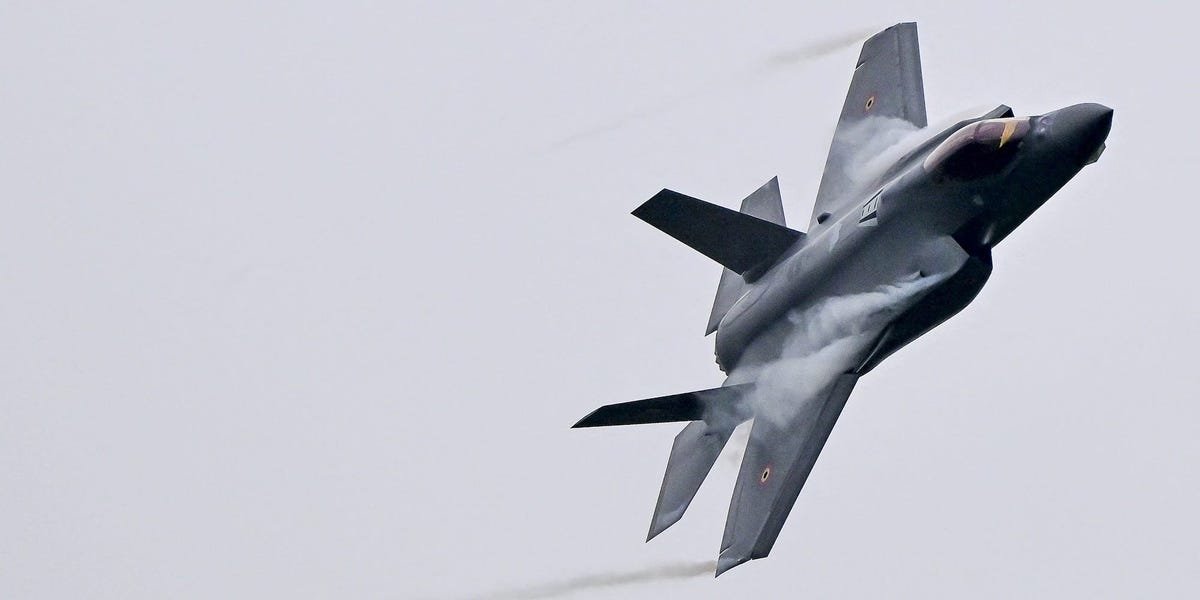
Beck said that right now fifth-generation aircraft like the F-35 Lightning II Joint Strike Fighter are the bare minimum for getting the edge in a modern air war. Sixth-gen fighters will need to bring advanced stealth, among other capabilities.
Without that full-spectrum stealth, aircraft “will be unable to enter an opponent’s A2AD bubble to a level that it would be able to deliver meaningful effect,” he said.
He said sixth-generation aircraft will need to carry out the deep strikes that are becoming increasingly difficult and “detect, select, and prosecute targets that are operating in or on the far side of an opponent’s integrated air missile defense system.”
The UK’s air staff chief, Beck said, “has made it very clear that control of the air is the thing that we must master above all else.”
