
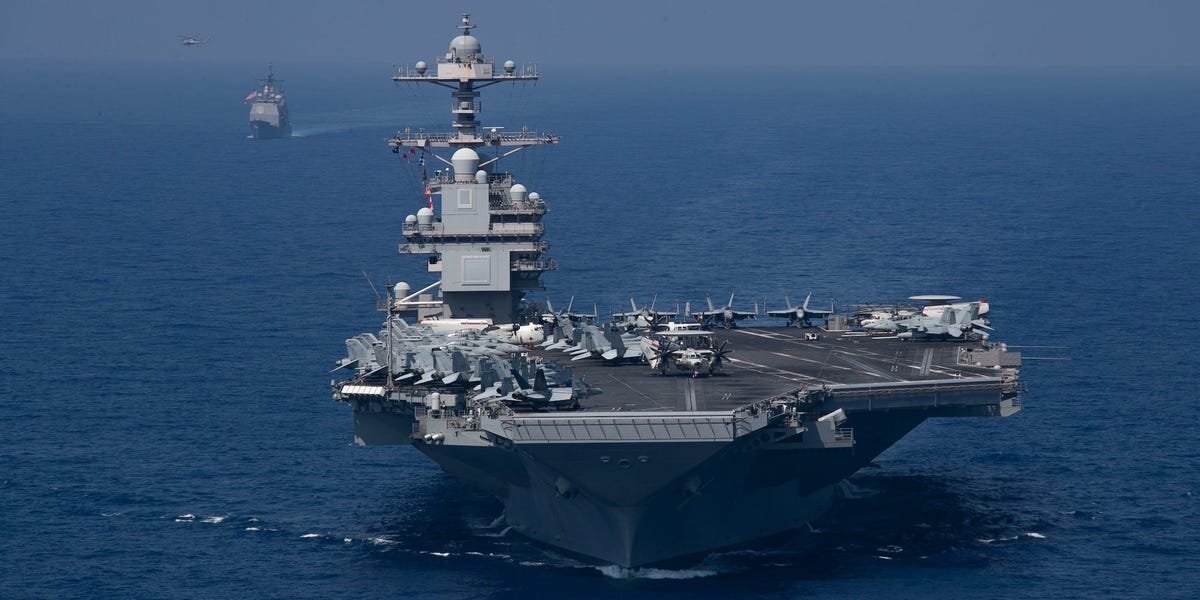
- NATO’s naval power is far superior to Russia’s, which mainly exists to defend its motherland.
- Russia’s fear is that NATO ships could launch strike missiles at the Russian heartland.
- It could force Russia to beef up maritime defenses and distract from rebuilding its battered army.

The age-old rivalry between continental and maritime nations has always been an exercise in frustration. For example, Napoleon and Hitler fumed at the English Channel and Royal Navy that kept their mighty armies from conquering Britain. Conversely, the British needed a continental power with a big army — usually Russia — to fight the French and Germans on land.
Today, NATO’s naval power is far superior to Russia’s. The problem is Russia has always been a continental power whose strength rested on its army. NATO may dominate the oceans, but that may not be much help if Russian tanks invade the Baltic States or Poland.
So, how can NATO exploit its naval advantage? Two British experts have an idea: use NATO’s navies to wage psychological warfare against Russia. Or more specifically, use naval power to scare Moscow into allocating its scarce resources to defending its huge coastlines rather than invading neighbors.
“By forcing Russia to commit to its own defenses in the maritime domain, it would divert critical Russian resources to tasks that the Alliance [NATO] deems less threatening,” wrote Sidharth Kaushal and Rene Balletta in an essay for Britain’s Royal United Services Institute think tank.
For America and Britain, the sea has been a friend: a buffer against invasion, a highway to overseas empire, and a way to ensure that wars are fought on foreign soil. But for Russia, with nearly 24,000 miles of coastline across Europe and Asia, the sea has historically been a source of vulnerability. Though the Russian Navy is one of the world’s largest, it mainly exists to protect the motherland, to support the army, and to provide strategic firepower such as from nuclear missile subs. Many of the cruise missiles that have pummeled Ukrainian cities for the past two years have been launched by the Black Sea Fleet.
But control of the seas, in the way that the famous 19th Century American naval theorist Alfred Thayer Mahan defined it, is not the Russian Navy’s mission. “Rather than naval combat per se, the purpose of Russian sea power is to ensure that the Russian state can compete and engage in conflict safely and effectively,” the essay said.
In the Crimean War of 1854, Russia was defeated by a British and French amphibious assault that captured Sevastopol. In 2024, the fear is that NATO ships could launch long-range guided missiles at the Russian heartland.
There are several ways that NATO can exploit this fear, according to Kaushal and Balletta. Western nations can conduct exercises, forward deploy nuclear submarines closer to Russia, invest in drones and hypersonic missiles, and even convert shipboard anti-aircraft missiles – such as the US SM-2 and SM-6 — into land attack weapons.
As Russia rebuilds its military to replace the enormous losses of the Ukraine war, the Kremlin may feel compelled to divert resources to naval rather than ground forces. “To the extent that the Alliance can expand the area over which Russia must achieve sea denial in order to protect itself against long-range strikes, it can shape the contours of Russian force regeneration,” the essay argued. “It can achieve this primarily in two ways: by expanding its long-range land attack capability, and by operating on new vectors that Russia has not historically had to defend.”
The Kremlin will not find it easy to beef up its maritime defenses. “While Russia can achieve sea denial and a degree of sea control in its coastal seas, contesting freedom of action out to 1,000 kilometers and beyond will be difficult and costly for a country that must also rebuild its forces on land,” said the essay. In particular, while Russia has a large arsenal of anti-ship missiles based on sea and land, it lacks the ISR (intelligence, surveillance and reconnaissance) capabilities to detect distant naval targets and guide missiles toward them.
Ships — especially those intended for blue-water rather than coastal operations — are also expensive to build, maintain, and to crews at a time when the Russian Army and Aerospace Forces are in desperate need of skilled personnel. Russian shipyards are already overburdened, and new vessels may need imported components that are blocked by Western sanctions.
However, the West also suffers from constraints. As the authors acknowledge, some NATO members on Russia’s border — such as Finland and Norway — may become nervous about making Russia nervous. And, of course, there is the fact that Russia has historically feared attack by the West – and it possesses the world’s biggest nuclear arsenal. Stoking the Kremlin’s fear of waves of cruise missiles streaking in from the sea carries a risk of nuclear escalation.
Nonetheless, this approach does leverage NATO’s maritime advantage. Given a choice, the Kremlin would probably prefer to spend resources on buying tanks to fight in Ukraine rather than warships to guard the Baltic. NATO can make that choice even harder.
Michael Peck is a defense writer whose work has appeared in Forbes, Defense News, Foreign Policy magazine, and other publications. He holds a MA in political science from Rutgers Univ. Follow him on Twitter and LinkedIn.
