
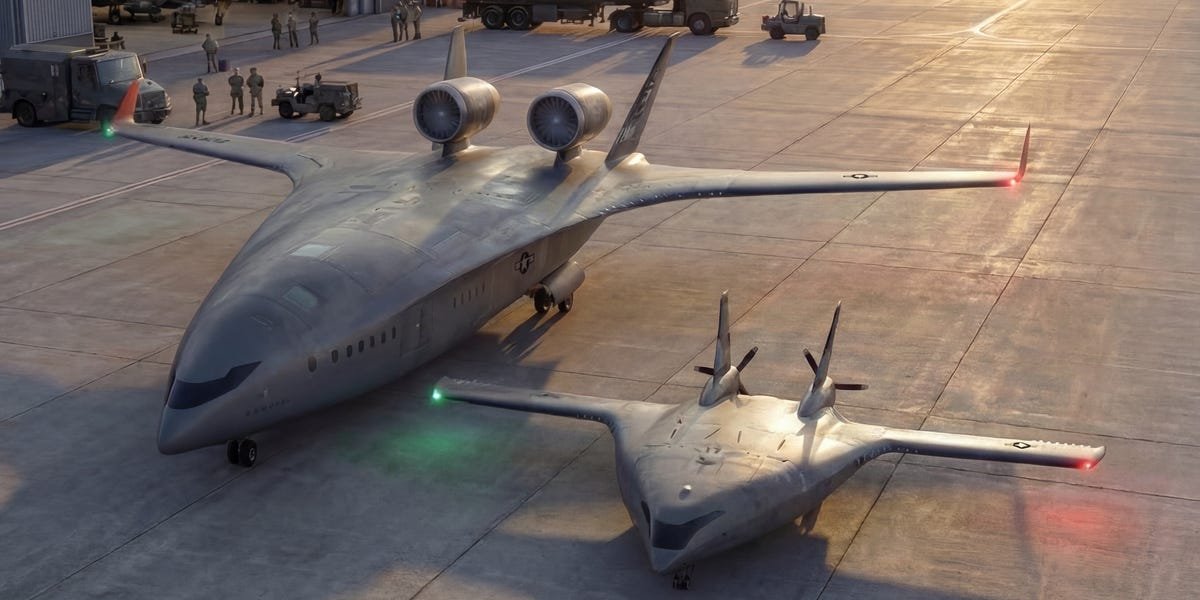
Airbus’ CEO recently said the future of flying is a B2-bomber-shaped “blended-wing body” plane with passengers housed inside the plane’s one giant wing for maximum efficiency.
Aleksey Matyushev, the CEO of the US aerospace startup Natilus, told Business Insider that his company has taken that vision one step further by redesigning its proposed blended-wing plane, Horizon, with plans to offer more lucrative cargo space while still delivering the 50% lower operating costs and up to 250 seats previously promised.
Instead of the single-deck seating layout originally planned, the newly unveiled Horizon Evo — which the company expects to enter service as soon as the early 2030s — reimagines what cargo-heavy passenger jets can look like by adding a “dual-deck” layout.
So far, Natilus’ blended-wing vision is just a sketch on paper, and a mini-sized prototype it’s been flying; actually developing and certifying the new plane type and getting it into the air is a much longer road.
Natilus
Still, the dual-deck idea should be familiar to regulators and airlines, as it is the configuration of traditional tube-and-wing jets where passengers sit in a single level above the cargo hold. When installed on an ultra-wide blended-body, it results in a very cargo-heavy plane.
Evo is expected to boast 2,600 cubic feet of dedicated cargo space on the lower level. For context, most Boeing 737s or Airbus A320s, which are at least 10 feet longer but have a cabin roughly half as wide despite similar wingspans, offer between roughly 1,300 and 1,800 cubic feet of belly cargo space.
This cargo focus comes at a time when belly freight has become one of the most reliable money-makers in aviation (e-commerce helped keep airlines afloat during the pandemic). The lure could help break the Airbus-Boeing duopoly while also addressing a projected shortfall of roughly 15,000 narrow-body aircraft over the next two decades.
“The market has gravitated toward a single-deck [blended-wing] layout because it’s simpler to design and build in many ways, but I just don’t see it as operationally better,” Matyushev said.
Natilus
California-based competitor JetZero, for example, is developing a single-deck version. Company leaders have previously said there is a lower deck for the landing gear and some cargo containers, but it could move that floor up to create more space.
Making a dual-deck layout in a blended-wing aircraft is challenging. Unlike conventional jets, the design spreads volume horizontally rather than vertically, and stacking passengers above a cargo deck in this uniquely triangular-shaped airframe requires careful structural and engineering solutions.
Evo’s cargo economics could shake up the market for freight-reliant carriers. With roughly 11,000 cubic feet of cargo space across its two levels, Matyushev said Evo could serve as a dedicated freighter — potentially replacing planes like the Boeing 757.
“There’s a huge product gap left behind by the 757; companies like UPS and FedEx heavily rely on that configuration,” Matyushev said. “Evo has the same volumetric capacity as a 757 but in a smaller airframe.”
Beyond cargo, Matyushev said the plane’s unique geometry would similarly enhance the customer experience: airlines could fit the wide upper level with unique living spaces, such as a playroom or mini-offices.
Natilus
He added that the economy cabin would feature more overhead bins and three aisles for better comfort, door access, and safety during evacuations: “It’d have four sets of three seats across, which is close to the A380,” Matyushev said, referring to the superjumbo’s possible 11-abreast seats.” We’re thinking about it like a widebody layout in a narrow-body type of footprint.”
Matyushev also said that Evo would have windows — something Airbus’ top executive warned could be absent from some blended-wing designs. A windowless passenger jet could create a claustrophobic environment, and flight attendants may struggle to see outside as easily during an emergency.
Natilus doesn’t have a prototype of Evo, but a subscale model of its blended-wing cargo plane, called Kona, has been test-flying since 2023. Kona has secured orders from companies like US-based Ameriflight and Canada-based Norlinor, while Indian carrier SpiceJet has signed a conditional deal for 100 Evos.
Natilus
Natilus has raised $28 million in Series A financing to support its first full-scale Kona prototype and further development of Evo. It typically costs billions of dollars to develop passenger-ready commercial jetliners, and Natilus has a long way to go.
The 737 Max cost around $2 billion to develop (before safety issues and the subsequent global grounding forced Boeing to redesign the plane). It was built on an older airframe that cost around $1.1 billion, in inflation-adjusted dollars, to develop. Meanwhile, the Airbus A320neo cost just over $1 billion to develop; it was also built on an older airframe, that originally cost around $3 billion to develop.
Natilus isn’t the only company betting on a Jetsons-like blended-wing aircraft. United Airlines has tentatively committed to buying up to 200 of JetZero’s “Z4,” which it previously described to Business Insider as a “living room in the sky.”
Airbus has also been developing a commercial flying wing since 2017 as part of its ZEROe program, which aims to build zero-emission airlines powered by hydrogen rather than traditional jet fuel. That project flew a demonstrator in 2019 but has since been delayed at least a decade from its initial 2035 timeline.
