
by David J. Bier, Cato at Liberty, April 15, 2025.
Excerpt:
I just had a disturbing conversation with a green card holder—a legal permanent resident of the United States. He had asked if he thought traveling internationally was wise for him as someone who has criticized President Trump and Israel and whether he should avoid any further criticism and/or remove any past criticism from his social media before he travels.
In a free society, the answer would be: “You should say whatever you want, criticize whoever you want, and not worry about traveling because the government cannot punish you for what you say.” But until the Supreme Court reaffirms that the First Amendment protects noncitizens in the United States from banishment for their speech—and until President Trump obeys the Supreme Court—we do not live in a free country.
The Trump administration is revoking green cards and visas solely based on speech. Individuals are explicitly being targeted based on “beliefs, statements, or associations” that are “lawful within the United States” but which Secretary of State Marco Rubio has deemed “adverse to the foreign policy of the United States.” Even authoring an op-ed criticizing a foreign government’s foreign policy can now trigger visa revocation. The administration is also searching electronic devices at ports of entry for evidence of “adverse” views.
DRH note: This is a very disturbing post, but I don’t think the title is completely justified. David Bier tries to justify the title by claiming that free speech includes the right for us to hear speech, but I think that’s a stretch.
He’s on stronger ground with this paragraph:
It is no surprise then that President Trump’s administration is threatening US citizens’ free speech rights in many other ways, such as threatening arrests of people who inform noncitizens of their constitutional rights, filing shakedown lawsuits against media companies, attacking law firms that defend unpopular clients, canceling contracts in states where governors have criticized Trump, threatening sanctions against media companies for negative coverage of him, banning disfavored media from the White House, and sanctioning federal contractors for use of the words “diversity, equity, or inclusion.”
Academia and Government
By Steven Landsburg, The Big Questions, April 16, 2025.
Excerpt:
For decades, university administrators have somehow become adept at co-opting university resources to promote their personal social and political agenda. This has affected everything from hiring to course offerings to the funding and composition of athletic teams. Over time, much of this agenda has been encoded in federal mandates.
When parts of this agenda have proven to be controversial or unpopular, administrators have largely avoided defending their policies on the merits, instead falling back on the federal mandates as an excuse. “Hey, we have no choice. We’d lose federal funding if we did anything different.” This dishonestly ignored the option of, for example, resisting intrusive policies through reasoned argument.
Now, all of a sudden, the federal mandates no longer jibe so well with the personal agendas of the administrators, and equally all of a sudden, universities like Harvard are discovering backbones.
I have mixed emotions about all this. It is good for universities (and everyone) to fight back against governments that tell them how to run their businesses. It is bad to fight back selectively, effectively collaborating with the government when it helps you co-opt university resources for your own agenda and then resisting when the government’s agenda starts to deviate from your own. Harvard should have fought back decades ago. Now they’re suddenly fighting back. Will they revert to form in a few years, as a function of who happens to be in the White House? And if so, is a sporadic backbone better or worse than no backbone at all? I’m not sure.
by Marina Nitze, Reason, April 16, 2025.
Excerpt:
Per the PRA, when a government agency wants to create or update an “information collection”—typically a form, though its grasp has extended to user logins and profiles, customer satisfaction surveys, and user research—the central Office of Information and Regulatory Affairs (OIRA) must approve it first.
Approval involves completing forms about the form (which all require several layers of internal agency approval), then submitting that package to an agency’s “desk officer.” The desk officer’s job is to forward the package on to OIRA, a role that the Bobs of Office Space would certainly call into question. Desk officers often contract out this work, though, and prioritize their own efficiencies by submitting one enormous package once a year. A recent submission from the Forest Service contained 151 forms.
Once OIRA receives the package, it (eventually) publishes it in the government’s newspaper, the Federal Register—a staple at every breakfast table. The proposal must be available for public comment for 60 days. The originating agency then compiles responses to any comments received, though it doesn’t have to actually do anything about them. OIRA reviews this package, and the proposal (whether changed or not) is reposted to the Federal Register for 30 more days. After an additional period of OIRA review, it might be approved. This can take years in the worst of circumstances.
by Timothy Taylor, Conversable Economist, April 17, 2025.
Excerpt:
The welfare of a country’s population goes well beyond economic statistics, of course. In one classic example from 2006, Kevin Murphy and Robert Topel offered an attempt to meaure in economic terms the gains to the US population from greater life expectancy and disease reduction over time. Of course, this task requires choosing values for what an additional year of life is worth in dollar terms–always a controversial task. But the values are extraordinarily large. They wrote:
We estimate the economic gains from declining mortality in the United States over the twentieth century, and we value the prospective gains that could be obtained from further progress against major diseases. These values are enormous. Gains in life expectancy over the century were worth over $1.2 million per person to the current population. From 1970 to 2000, gains in life expectancy added about $3.2 trillion per year to national wealth, with half of these gains due to progress against heart disease alone. Looking ahead, we estimate that even modest progress against major diseases would be extremely valuable. For example, a permanent 1 percent reduction in mortality from cancer has a present value to current and future generations of Americans of nearly $500 billion, whereas a cure (if one is feasible) would be worth about $50 trillion.
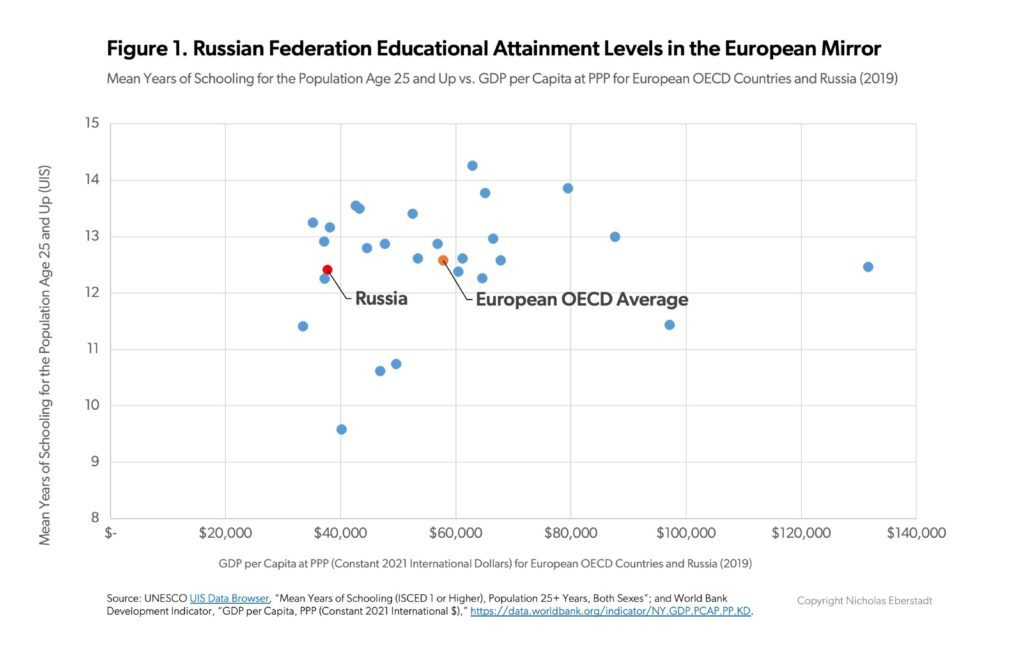
Russia illustrates the opposite situation. It’s health statistics are remarkably poor, suggesting that the overall welfare of Russia’s population is considerably worse than its purely economic statistics would suggest. Nicholas Eberstadt provides the background in “The Russian Paradox: So Much Education, So Little Human Capital” (The American Enterprise, April 8, 2025).
by Amanda Morris, SciTechDaily, April 17, 2025.
Excerpt:
Engineers at Northwestern University have developed an ultra-small pacemaker that is so tiny it can be injected into the body using a syringe.
While it is compatible with hearts of various sizes, the pacemaker is especially well-suited for the delicate hearts of newborns with congenital heart defects.
Smaller than a grain of rice, the device works in tandem with a lightweight, flexible, wireless wearable that attaches to the patient’s chest. When the wearable senses an irregular heartbeat, it automatically emits a pulse of light to activate the pacemaker. These brief light pulses pass through the skin, breastbone, and muscle tissue to regulate the heart’s rhythm.
