
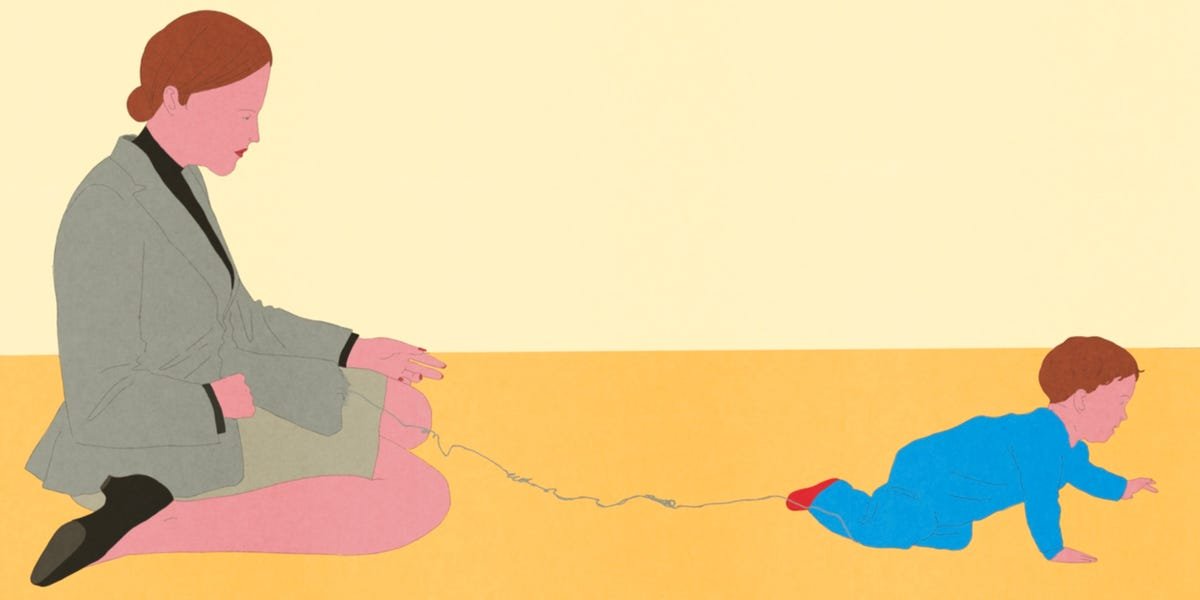
Viviana’s journey to motherhood followed an increasingly common pattern for millennial women.
She knew she wanted children, but her early career in her native Colombia took priority. She met her husband when she was 29. Not long after, she started a job at a pharmaceutical company. The work was intense, but she enjoyed it, which solidified her plan not to get pregnant until she was well into her 30s.
It wasn’t the only reason, though. “It sounds stupid to say now, but I thought my boss would get mad at me if I got pregnant,” she says. “I thought I would somehow be a problem for the company and that it was therefore in some way my responsibility to wait.”
By 36, she felt established enough at work to take time away. She gave birth to her daughter, Amelia, in 2021. “I don’t regret waiting,” Viviana tells me. “I think it was the right thing to do.”
But when she and her family moved to New York City in 2023, the balancing act with her career and motherhood shifted. Though she could’ve transferred her job to the US, she decided to quit. “Starting fresh in a new country, with a different language, new friends, and everything else, I really wanted to be there for my daughter during that adjustment period,” she says.
While she once considered having more than one kid, now she’s not so sure. “I really want to go back to work, and with another kid — especially in New York City — that’s just going to be a really hard thing to do,” she says. “Especially with no family around to support us.”
“Having it all” — raising children while building a professional career — has been the topic of books, movies, TV shows, and conversations ever since women started making strides into the paid-labor market. Now, with more women working than ever before, they’re also waiting longer to have children. According to the Centers for Disease Control and Prevention, the average age at which a woman first gives birth is about 27. It’s not so much that women are choosing their careers over having children, but as the cost of raising a child skyrockets, more feel like they need to wait until their careers are established to start a family. The trouble is that high-paying jobs are often the most demanding, and many people’s careers start taking off in their 30s — the same time many feel ready to have kids.
I talked to more than a dozen mothers working in fields such as finance, retail, and consulting — many of whom are referred to by just their first name to avoid professional repercussions. Most of them waited to have kids until they felt secure and financially stable enough in their careers to do so, only to find it difficult to juggle motherhood with increasing career pressures. In many cases, they say, their employers did little to accommodate them, underscoring a simple truth: For many mothers, work is not working.
For Anastasia Dedik, a 43-year-old professional musician who came to the US from Russia, starting a family wasn’t even a consideration until she finished her education and established herself professionally. By that time, she was 32. Two and a half weeks after she had her daughter, she was back at work as a piano teacher and performer. “I just wanted to make sure I still had work,” she says. Still, it was tough.
“When my daughter was 3 weeks old, I had to go to California for work,” she says, adding, “That was the end of breastfeeding.”
Other mothers I talked to shared similar stories about wanting to ensure career stability before having a baby; many say the cost of childcare was a big reason they waited.
“It felt irresponsible to even start thinking about having a baby at a time when I was spending a lot of my life worrying about paying rent and paying off college debt,” says Molly, a mother of one in New York City who works in publishing. She had her daughter two years ago, when she was 38.
She had calculated that paying for day care or a nanny would leave her and her husband — who works in tech — with little to no savings each month.
I felt like this would set me back on my career trajectory, that it would cause me to lose respectability and influence within the industry.
In a 2023 survey conducted by the American Psychological Association, 66% of parents reported feeling “consumed” by worries about money, compared with 39% of adults who weren’t parents. A Pew survey from 2024, meanwhile, found that among adults under 50 who didn’t have children, 36% said a major reason was that they didn’t think they could afford to raise a child.
Though the women I talked to who waited until their 30s to have children largely said they were confident they made the right decision, many women also described feeling like the choices they made weren’t really choices — they were forced into the decision because no other option made sense.
“I just wasn’t ready to start a family earlier,” June, a consultant living in London who had her first child at 36, tells me. “I felt insecure in my work, didn’t have significant savings, and wanted to spend some time living with my partner before really deciding that we want kids.”
She and her partner also wanted to buy a house before adding on the cost of children. “You just can’t rush that,” she says. They ended up buying the house and moving in when she was a few months pregnant.
By the time the women said they felt financially secure, their careers had also ramped up. Many said that after having a baby they tried to return to work as soon as possible, fearful that — despite widespread pregnancy antidiscrimination laws — they’d be passed over for promotions and pay raises.
“To me, it was a fear of becoming irrelevant if I stayed away too long,” says Anita, a 39-year-old marketing executive and mother of two who lives in Brooklyn, New York. She was particularly afraid that her relationships with clients would deteriorate while she was away. “I felt like this would set me back on my career trajectory, that it would cause me to lose respectability and influence within the industry and therefore become less valuable to my employer.” That, she says, is what kept her from starting a family in her 20s.
She had her first kid at 33. The timing gave her more financial stability and confidence in her career, but returning from her three-month maternity leave was far from easy.
“One sacrifice I had to make almost immediately was nursing my baby,” she recalls. “It was really hard to nurse or express milk when I was going back into the office, so we switched to formula. It broke my heart that this was a decision I was making explicitly because of my work requirements.”
Most of us can’t just opt out of parenting when it’s inconvenient — when it might force us to miss a work deadline.
More women than ever before hold what the Harvard economic historian and labor economist Claudia Goldin calls “greedy” jobs: roles that promise prestige, seniority, and a generous salary but that also require a lot of hours at unpredictable times of the day. Pursuing these jobs can make it easier to be able to afford a family, but balancing them with motherhood is often impossible.
“I was actually contacted by a recruiter while I was on maternity leave,” Anita says. The job “was more prestigious and better paid, but it would’ve involved a huge amount of travel, so I didn’t even apply.” Other women said that after having children they felt forced to forgo certain professional opportunities, such as taking on high-profile projects or pursuing new roles, because of their caring responsibilities. In a Gallup survey last year, 59% of women said they would turn down a promotion that required them to work 60 hours a week — a greater share than the men who said the same.
“Most of us can’t just opt out of parenting when it’s inconvenient — when it might force us to miss a work deadline,” says Nadia, a 37-year-old consultant and mother of two from Canada. Parenting is a full-time job, she adds, even if you have another full-time job.
One study conducted in Sweden a decade ago found that female executives were less likely than their male counterparts to be married, were more likely to be divorced, and, on average, had fewer children. “This is not surprising at all,” Nadia tells me. “It’s just evidence of the fact that women simply can’t have it all.”
Anita blames social norms. “Who does the day care call when a child gets sick? Mom. Who tends to deal with all of the admin associated with kids? Mom. Of course, there are exceptions,” she says, “but in so many heterosexual couples, if no explicit effort is made to redress the balance of responsibilities, Mom is still the primary parent.”
There’s a lot employers could do to even the scales. Some mothers told me that their requests to work remotely were largely denied apart from emergency situations. Others said they were made to feel guilty for having to take time out to pump breast milk or leave work at a set time to accommodate childcare.
Though more companies are offering benefits like paying for fertility treatments, several women argued that employers should first focus on creating work environments that truly accommodate pregnancy and parenthood.
“There’s a certain irony to an employer helping someone get pregnant but then not providing the support she needed once the baby’s been born,” Anita says. For instance, many companies don’t offer things like generous parental leave, accommodations for returning to work, subsidized childcare, and facilities for pumping breast milk. “It feels like some companies are paying lip service here but not really putting themselves in parents’ shoes,” she says.
Between work and parenting, millennials are realizing that something has to give. And it can’t be the parenting.
June, the consultant in London, says she’d like to see her bosses leading by example more by taking all the parental leave they’re entitled to. “That also includes senior women who have children being more open about how they’ve navigated everything,” she says. “It sometimes feels like I’m completely alone in trying to figure everything out, like no one has ever done this before me. And that’s really tough.”
The idea that high-ranking women aren’t taking all the leave they’re entitled to underscores the problem: Even women in power feel afraid of falling behind.
One silver lining is that some millennial parents are going in a different direction.
“Lots of millennials now — both men and women — say that they’re going to take a career break,” says Neha Ruch, a mother of two who wrote “The Power Pause,” a book about taking a career break after having kids. “Hiring managers are getting used to that and are increasingly saying that they would overlook a career break if it was strategically packaged.”
In 2021, LinkedIn added “Stay at Home Parent” as an option in its drop-down menu of job titles. In 2022, it added a “Career Break” label. A survey conducted in Australia in 2024 suggested that employees were more willing to take an extended career break than they were before the COVID-19 pandemic. “We’re seeing a significant shift in attitudes toward career breaks,” Nicole Gorton, a director at Robert Half, which conducted the survey, said at the time.
Many workplaces still offer employees the option to work remotely, have a hybrid schedule, or compress their hours — a huge help for parents. Ana Kent, a mother of three in St. Louis, says that having a child at 27 was manageable because her boss agreed to let her work a four-day week.
But that’s just the beginning of what’s necessary to truly ease the balance. Between work and parenting, millennials are realizing that something has to give. And it can’t be the parenting.
Josie Cox is a journalist who has worked for publications like Reuters, The Independent, and The Wall Street Journal. She is the author of the book, “Women Money Power: The Rise and Fall of Economic Equality.”
