

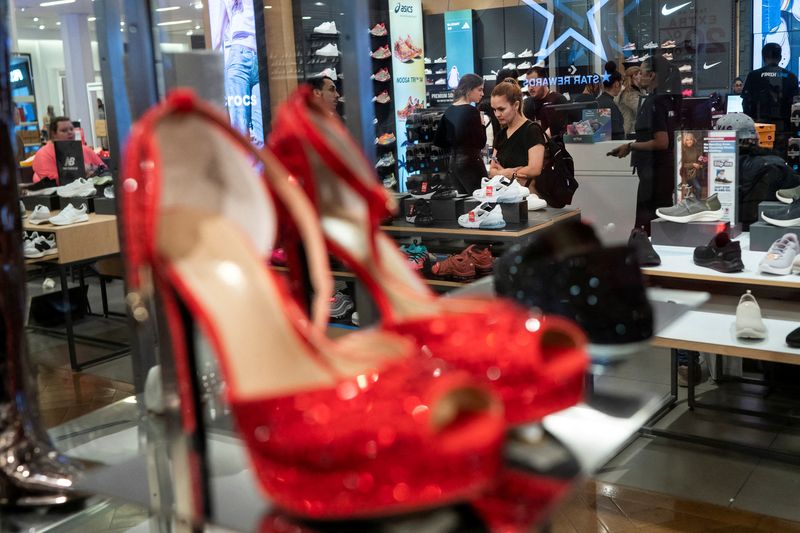
© Reuters. FILE PHOTO: People look for presents at the Macy’s flagship store during the holiday season in New York City, U.S., December 10, 2023. REUTERS/Eduardo Munoz/File Photo
2/2
By Mimosa Spencer
PARIS (Reuters) -Early holiday shopping season discounts from high-end fashion retailers like Bergdorf Goodman on New York’s Fifth Avenue raised concern that a lacklustre Christmas could lead to inventory gluts – potentially dragging labels into a discounting spiral that would cheapen their image.
The latest U.S. credit card data from Barclays released on Wednesday showed that spending on luxury goods remained negative in November, down 15% year-on-year after a decline of 14% in October.
That performance “doesn’t bring much optimism” for the fourth quarter, with the weak trends in the U.S. reason for caution about the performance of luxury brands over the period, Barclays analysts said.
Credit card data from Citi, also released on Wednesday, showed purchases of luxury fashion were down 9.6% year-on-year in November, after an 11.4% decline in October, with steeper declines in department stores and online, down 13% in November year-on-year.
Retailers entered the season with too much inventory, said Olivier Abtan, consultant with Alix Partners, noting that last year’s purchasing orders were made before the sector began to cool off after a months-long, post-pandemic splurge.
“They’ve already begun the season with overstock, compared to normal levels,” said Abtan.
Share prices of LVMH, Kering (EPA:) and Burberry were down 12%, 23% and 33%, respectively, since early August, while shares in e-commerce operator Farfetch (NYSE:) have lost the bulk of their value and were down 90%.
“We know that the U.S. consumer is going to keep being reasonable, and retailers have to adapt,” said Caroline Reyl Head of Premium Brands at Pictet Asset Management, which owns shares of LVMH.
Conflict in the Middle East added geopolitical uncertainty to a luxury industry outlook already clouded by inflation, with shoppers in the U.S. and Europe tightening their purse strings while expectations for a strong post-pandemic rebound in China were derailed by a property crisis.
The lower spending comes at the all-important end-of-year season, with November and December accounting for 25% of annual sales.
“It’s not going to be a good Christmas for luxury brands,” said Abtan.
But department stores could feel the pinch from slowing demand for the next six to 12 months, predicted Citi analysts, a potential challenge for luxury brands generating a significant amount of sales outside of their own networks of boutiques.
Department stores — particularly in the U.S. — are known for aggressive discounting, drawing shoppers to stores, but offering lower prices can erode the attractiveness of fashion brands and encourage people to hold back for future deals.
Leading global brands like Hermes, privately owned Chanel and LVMH’s Louis Vuitton and Dior maintain a tight grip on retail operations, selling mainly through their own stores which allows them to avoid discounts and fully control their brand image.
Such direct-to-consumer sales by high-end labels have increased from 40% of the personal luxury goods market in 2019 to 52% in 2023, according to Bain.
Analysts say fashion houses are overall much better equipped than during the crisis of 2008 and 2009, when the spending slowdown was sudden.
Since the previous crisis, labels have applied artificial intelligence to predict sales volumes and adjust production, while they have also fine-tuned their proportion of seasonal and more permanent styles.
The end of this year will be “a season for bargain seekers but not the markdown season of the century,” predicted luxury consultant Mario Ortelli.
Technology has played a “decisive role” to avoid overstock issues, said Mathilde Haemmerle, partner at Bain. She cites macro indicators, historical sales of similar products, trends scraping on social networks as variables examined through AI to better anticipate sales volumes.
The bigger labels are also more agile, having cut their development time in half over the past 15 years by streamlining production and regrouping certain stages of production, according to Abtan.
“That’s a game changer,” said Abtan.
