
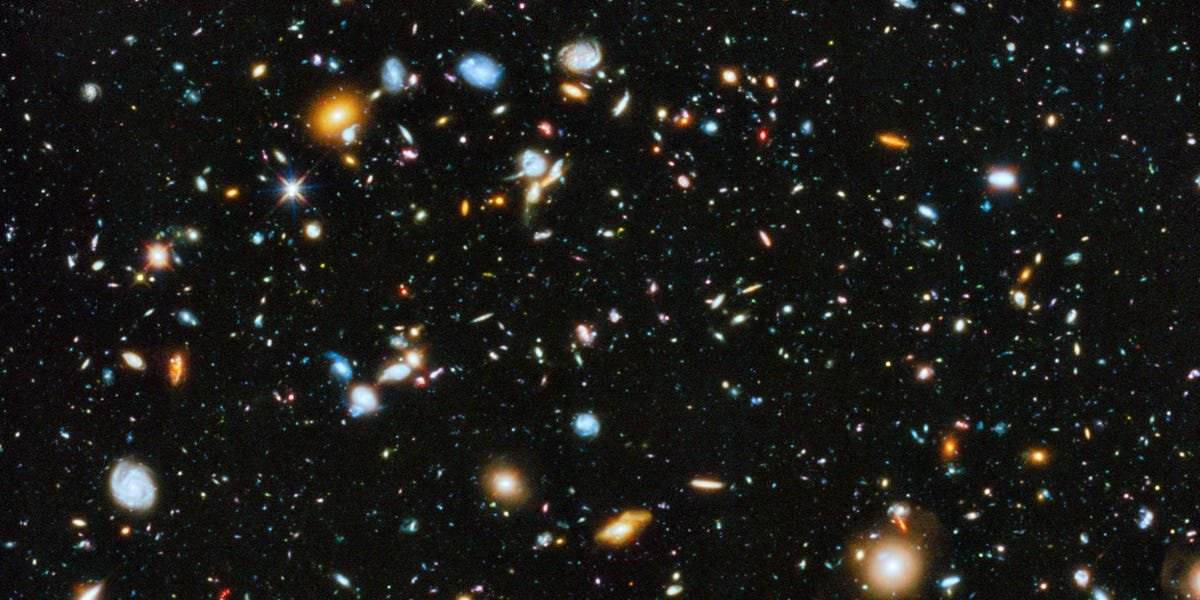
Scientists have constructed the largest 3-D map of our universe to date, and it’s come with a couple of interesting surprises.
“So far, we’re seeing basic agreement with our best model of the universe, but we’re also seeing some potentially interesting differences,” Michael Levi said in a statement released by the Lawrence Berkeley National Laboratory on Thursday.
Levi is the director for the Dark Energy Spectroscopic Instrument, DESI, which produced the new map. The instrument consists of 5,000 tiny robots attached to a telescope in Arizona that collects light from various stages of our universe.
NOIRLab/NSF/AURA/P. Marenfeld and DESI collaboration
Astronomers use DESI to look back in time, billions of years ago, to understand how our universe has changed and evolved. One of the driving forces behind that evolution is also one of our age’s biggest mysteries in physics: dark energy.
Dark energy is the name astronomers have given to the unknown force that is driving our universe to expand faster and faster over time. But since its discovery in 1998, dark energy has eluded scientists, who know little about what it is or why it behaves the way it does.
DESI’s detailed map could change that. It suggests that dark energy may be completely different than scientists thought, shaking a foundational pillar of our understanding of the universe.
Dark energy may not be Einstein’s constant after all
Claire Lamman/DESI collaboration
Dark energy, as we understand it right now, is terrifying to think about because it means our universe is expanding faster and faster until one day galaxies will be moving away from us so quickly that their points of light in our night sky will wink out of existence.
That’s the future we’re headed for if dark energy continues at the rate it’s going. And until Thursday, that’s what many astronomers thought: that dark energy was a constant, unchanging force.
That’s why astronomers have thought that dark energy could be the same thing as Albert Einstein’s “cosmological constant,” which was an extension of his theory of general relativity. Einstein abandoned the idea as his “greatest blunder” in the 1930s, as astrophysicist Ethan Siegal explains, but a constant dark energy would have vindicated him.
However, this mysterious force may not be so constant, after all.
Ernst Haas / Contributor
Preliminary estimates from DESI’s new data suggest dark energy may be evolving and weakening. That’s the new revelation scientists announced at a meeting of the American Physical Society this week.
“If true, it would be the first real clue we have gotten about the nature of dark energy in 25 years,” Adam Riess, a Nobel laureate for his co-discovery of dark energy, told Quanta Magazine.
For now, this is just a hint. The data is not strong enough to be sure or to claim a discovery, Quanta reported. But the hint is enticing.
“The idea that dark energy is varying is very natural,” Paul Steinhardt, a Princeton University cosmologist, told the magazine. If it were constant, “it would be the only form of energy we know which is absolutely constant in space and time.”
If later data confirms these early hints of inconstant dark energy to be true, that would change what we know about the makeup and future of the universe. It would also bring scientists closer to solving the mystery of the universe’s accelerating expansion.
NASA
“If this holds up, it could light the way to a new, potentially deeper understanding of the universe,” Riess said. “The next few years should be very revealing.”
The ‘golden era of cosmology’
DESI measured the most distant part of the universe, 8-11 billion years ago, with record precision.
Other major universe-mapping observatories are hitting the skies in the coming years. The Vera C. Rubin Observatory is about to get outfitted with the world’s largest digital camera, which will allow it to map the entire southern sky over a decade, including more than 20 billion galaxies.
Jacqueline Ramseyer Orrell/SLAC National Accelerator Laboratory
The European Space Agency’s Euclid telescope is already in space, where its mission is to study dark energy. NASA’s Nancy Grace Roman Space Telescope is expected to launch in 2027 and conduct its own inquiry on the issue.
For its part, DESI aims to map 37 million galaxies by the end of its survey.
“We are in the golden era of cosmology, with large-scale surveys ongoing and about to be started, and new techniques being developed to make the best use of these datasets,” Arnaud de Mattia, a researcher with the French Alternative Energies and Atomic Energy Commission (CEA) and co-leader of the DESI team that interprets its cosmological data, said in the press release.
“We’re all really motivated to see whether new data will confirm the features we saw in our first-year sample and build a better understanding of the dynamics of our universe,” Mattia said.
