
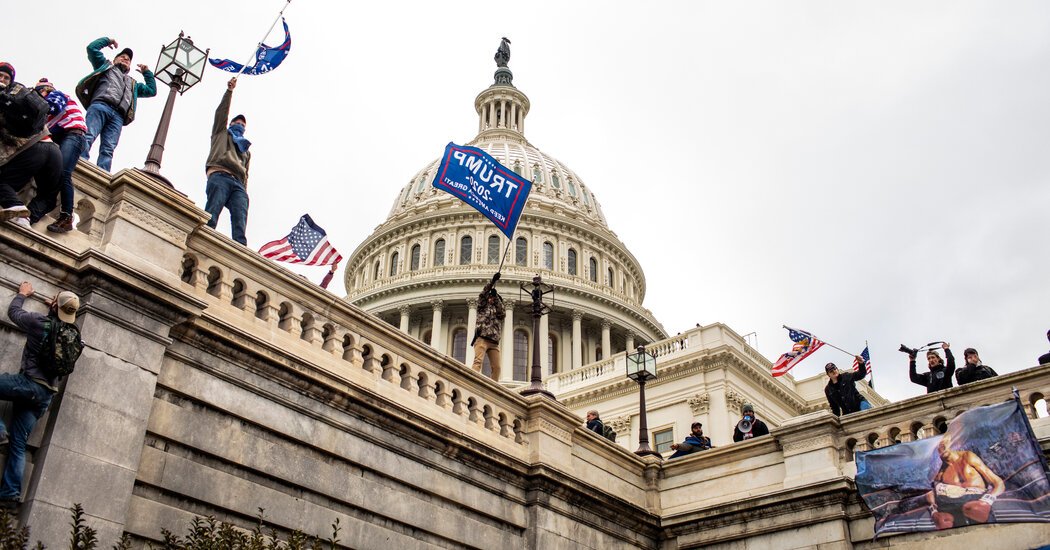
The Supreme Court agreed on Wednesday to decide a question at the heart of the federal election-interference case against former President Donald J. Trump and hundreds of prosecutions arising from the assault on the Capitol on Jan. 6, 2021. Can the government charge defendants in those cases under a federal law that makes it a crime to corruptly obstruct an official congressional proceeding?
The decision to hear the case will complicate and perhaps delay the start of Mr. Trump’s trial, now scheduled to take place in Washington in March. The Supreme Court’s ultimate ruling, which may not arrive until June, is likely to address the viability of two of the main counts against Mr. Trump. It could severely limit efforts by the special counsel, Jack Smith, to hold the former president accountable for the violence of his supporters at the Capitol.
The court’s eventual decision could also invalidate convictions that have already been secured against scores of Mr. Trump’s followers who took part in the assault. That would be an enormous blow to the government’s prosecutions of the Jan. 6 riot cases.
The case the court agreed to hear involves Joseph Fischer, who was indicted on seven charges for his role in the Capitol attack. Prosecutors say he assaulted the police as Congress met to certify the results of the 2020 election. Like hundreds of other rioters whose actions disrupted the certification proceeding in the Capitol, Mr. Fischer was charged with the obstruction count, formally known as 18 U.S.C. 1512.
Mr. Fischer sought dismissal of a portion of the indictment brought under the obstruction law, which was passed as part of the Sarbanes-Oxley Act of 2002, a statute aimed primarily at white-collar crime. Prosecutors have routinely used the obstruction charge, in lieu of more politically contentious counts like insurrection or seditious conspiracy, to describe how members of the pro-Trump mob disrupted the peaceful transfer of presidential power.
Judge Carl J. Nichols of the Federal District Court in Washington granted Mr. Fischer’s motion to dismiss, saying that the law required defendants to take “some action with respect to a document, record or other object” — something he said was missing from Mr. Fischer’s conduct at the Capitol.
A divided three-judge panel on the U.S. Court of Appeals for the District of Columbia Circuit reversed Judge Nichols’s decision, ruling that the law “applies to all forms of corrupt obstruction of an official proceeding.” Three Jan. 6 defendants, including Mr. Fischer, ultimately asked the Supreme Court to decide whether the law had been properly applied to the Capitol attack.
The obstruction charge was never an easy fit in the cases stemming from the storming of the Capitol. When it was passed in the early 2000s, the law was aimed at curbing corporate malfeasance by outlawing things like destroying documents or tampering with witnesses or evidence.
Defense lawyers representing Jan. 6 rioters argued that federal prosecutors improperly stretched its scope to cover the violence that erupted at the Capitol and interfered with the proceeding in which lawmakers had gathered to certify the results of the election.
The lawyers also took issue with using the charge against people who stormed the Capitol, saying that many were not acting “corruptly,” as the law requires, because they believed they were protesting a stolen election.
“The statute has been used to over-criminalize the Jan. 6 cases,” said Norm Pattis, a lawyer for Jake Lang, one of the three defendants who appealed to the Supreme Court. “Congress never intended that.”
Mr. Pattis said the Supreme Court’s review was “significant” in hundreds of criminal cases stemming from the Capitol riot and was also “yet another reason the 2024 case against Donald Trump should be delayed.”
Two of the four counts in the federal election interference indictment against Mr. Trump are based on the obstruction charge. He has been accused of personally obstructing the certification proceeding at the Capitol on Jan. 6 and faces a separate count of conspiring with others to obstruct the proceeding.
The Supreme Court’s review, while potentially damaging to the indictment, would not affect the other two charges against Mr. Trump. One accuses him of conspiring to defraud the United States by using relentless lies that the election had been stolen from him in an effort to reverse his defeat. The other charges him with plotting to deprive millions of Americans of the right to have their votes counted.
Still, if the Supreme Court finds that the obstruction law does not apply to the mob attack at the Capitol, it could cripple plans by Mr. Smith to pin the violence on Mr. Trump.
Recent court papers in the election case have strongly suggested that prosecutors were planning to use the obstruction charge as a way to show the jury graphic videos of the Capitol attack and perhaps even introduce testimony from rioters claiming that they stormed the building on Mr. Trump’s instructions.
The possibility that the Supreme Court could review — and one day invalidate — the obstruction count has been looming over Mr. Trump’s election case for months. But the court’s decision to act on Wednesday came at a particularly delicate moment: two days after Mr. Smith asked the justices to fast-track an appeal of Mr. Trump’s separate attempts to have the case tossed out on broad claims of presidential immunity.
While the Supreme Court has not yet decided whether to consider Mr. Trump’s immunity arguments, it has — in the span of a week — become deeply entangled in the election interference proceeding. Its decisions on the obstruction charge and on immunity could radically alter the shape, scope and timing of the case, which has long seemed as though it would be the first of the four indictments Mr. Trump is facing to go in front of a jury.
Solicitor General Elizabeth B. Prelogar had urged the justices to deny review in the case, saying the law was broad enough to cover Mr. Fischer’s actions even if no documents or other objects were affected.
“A defendant obstructs an official proceeding by physically blocking it from occurring — as happened here when petitioners and others violently occupied the Capitol for several hours and thereby prevented the joint session of Congress from doing its work,” she wrote.
She added that documents were at issue in the case in any event.
“Preventing the members of Congress from validating the state certificates thus constitutes evidence-focused obstruction,” she wrote, adding that review was premature. “At a minimum, the government should be permitted to present its case to a jury and prove that petitioners obstructed a proceeding by (in part) preventing the relevant decision makers from viewing the evidence at the time and place specified for that purpose.”
Regardless of how the Supreme Court ultimately rules, Mr. Trump’s lawyers are likely to use its decision to review the obstruction charge to bolster their arguments that the trial in Washington should be postponed, perhaps until after the 2024 presidential race is decided.
From the start of the case, Mr. Trump has pursued a persistent strategy of delay. If he can push the trial until after the election and win the race, he would be in a position to simply order the charges against him to be dropped.
