
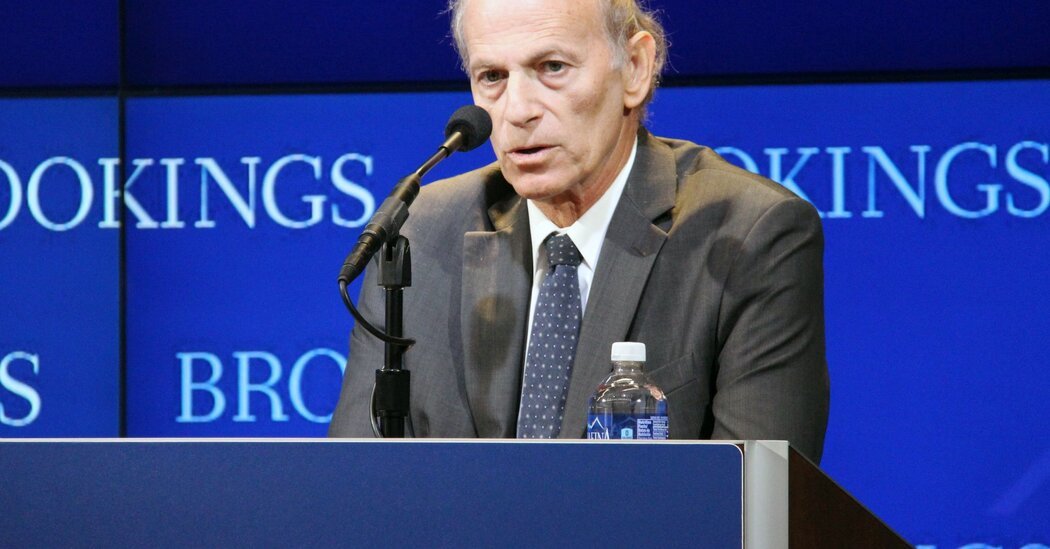
Jeffrey A. Bader, one of the country’s leading experts on China and an architect of President Barack Obama’s so-called pivot to the Pacific during his first administration, died on Oct. 22 in Los Angeles. He was 78.
His death, at a hospice facility, resulted from complications of pancreatic cancer, said his wife, Rohini Talalla. He lived in the Venice Beach section of Los Angeles.
In a statement, Secretary of State Antony J. Blinken called Mr. Bader “one of the most knowledgeable and insightful East Asia hands of his generation, and his intellect was matched only by his heart and his decency.”
Few Americans had as much diplomatic or policymaking experience in China as Mr. Bader did. His engagement with the country went back to 1977, when, as a young Foreign Service officer, he was enlisted to help President Jimmy Carter’s administration implement formal relations with Beijing.
The work put him deep within the machinery of American diplomacy, training that gave him keen insight into how foreign relations actually works — not through grand ideologies and statements, but through the day-to-day grind of person-to-person contact.
In the late 1990s, Mr. Bader led the East Asia portfolio for the National Security Council under President Bill Clinton, a role he reprised a decade later under Mr. Obama.
“He really was the quintessential effective diplomat,” Susan Shirk, a political scientist at the University of California, San Diego, who worked alongside him in the Clinton administration, said in a phone interview. “He was the sharpest operations person.”
Mr. Bader advised both Mr. Clinton and Mr. Obama to take a pragmatic, cleareyed view of China. He largely rejected both the sentimental view, that China was on a path toward greater openness and democracy, and the hawkish pessimism that predicted an inevitable clash between the two powers.
“U.S. policy toward a rising China could not rely solely on military muscle, economic blandishments and pressure and sanctions on human rights,” he wrote in his memoir, “Obama and China’s Rise: An Insider’s Account of America’s Asia Strategy” (2012). “At the same time, a policy of indulgence and accommodation of assertive Chinese conduct, or indifference to its internal evolution, could embolden bad behavior.”
After serving as a close adviser to Mr. Obama during his 2008 campaign, Mr. Bader helped oversee what the president called his “pivot” to Asia — a term that Mr. Bader shied from, finding it overly militaristic (though the policy shift did have a strong military component).
He preferred to call it a “rebalancing,” a term that recognized the growing importance of China to America’s future and the need to dedicate more resources to managing bilateral relations. He recommended a nuanced approach, recognizing that China was an emerging global power that needed to be addressed but not confronted.
“He was not naïve about China, but he saw the importance of a constructive relationship,” said former Gov. Jerry Brown of California, who now serves as chairman of the California-China Climate Institute at the University of California, Berkeley, and who relied on Mr. Bader for advice in recent years. “He had a view that was more realistic and optimistic.”
Jeffrey Allen Bader was born in New York City on July 1, 1945, to Samuel Bader, a lawyer, and Grace (Rosenbloom) Bader, a lawyer and homemaker.
He graduated with a degree in history from Yale in 1967 and a doctorate in the same subject from Columbia in 1975, the same year he joined the State Department.
He married Ms. Talalla, a documentary filmmaker and advocate for Indigenous development, in 1995. Along with her, he is survived by his brother, Lawrence.
Mr. Bader did not start his diplomatic career aspiring to be a China hand. He had studied European history, spoke French and spent his first two years at the U.S. embassy in Kinshasa, the capital of present-day Democratic Republic of Congo.
But in 1977, Richard Holbrooke, the new assistant secretary of state for East Asian and Pacific affairs, was on the hunt for smart, young officers to help with the enormous efforts underway around U.S.-China relations. He plucked out Mr. Bader and set him on the task.
There was much to cover: trade, nuclear weapons, human rights and America’s complicated relationship with Taiwan. There wasn’t even a U.S. embassy in Beijing.
Mr. Bader lived in Beijing for several years, an experience he often described in detail to explain how far the country had come.
“The city itself was a pretty dreary, dismal place,” he said in a 2022 podcast interview with The China Project, a news and information website. “There were no restaurants, no publicly available restaurants at all. I had every meal essentially in the Peking Hotel for two years, which is a fate I wouldn’t wish on anyone.”
He left in 1983 but returned four years later to find clear signs of the modern consumer economy the country would become.
He also saw the dangers in China’s rise. Mr. Bader was central to framing America’s response to the Tiananmen Square massacre of 1989, and to the sudden tensions that arose after China carried out a series of missile tests near Taiwan in 1996.
He left the China beat in 1999 to serve for two years as the U.S. ambassador to Namibia, but returned to it in 2001 as an assistant U.S. trade representative, helping to finalize China’s ascension into the World Trade Organization.
Mr. Bader left government in 2002 to become a senior scholar at the Washington-based Brookings Institution. Then, in 2005, Mr. Obama, at the time a freshman senator from Illinois, asked him for a briefing about China.
The two spent three hours in the senator’s office, eating takeout Thai food and discussing policy. Mr. Bader left their meeting convinced that if Mr. Obama ran for president, he would win — and that he would want to be a part of an Obama administration.
The Obama White House, especially in its first term, was preoccupied with China. The global recession had set America back but had relatively spared China, which began to assert itself internationally.
Mr. Bader stayed with Mr. Obama for more than two years before returning to Brookings, long enough to see the pivot underway and to believe that America was on the right course. And while he later criticized Donald J. Trump’s administration for its protectionist approach to China, he was not alarmed. He remained convinced that the ebb and flow of tensions was simply part of great power relations.
“Over time, there are interests that overlap to some degree and differ to some degree,” he told The New York Times in 2012. “The relationship tends to move up and down over time, as if along a sine curve. But the recent story is mostly a positive one.”
