
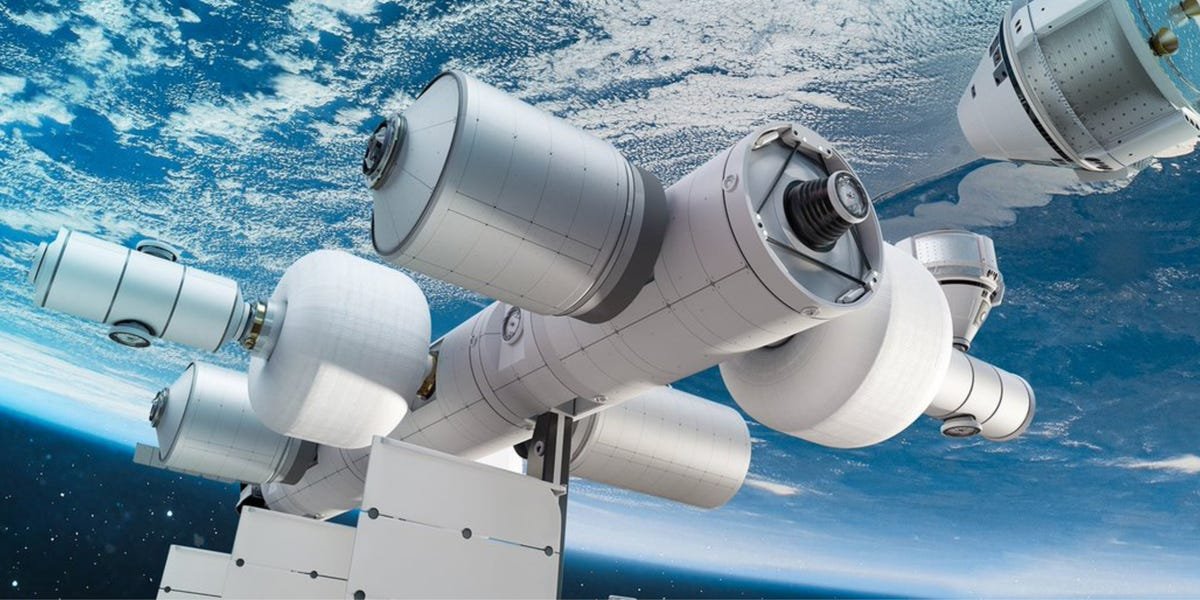
- NASA awarded Blue Origin $172 million to develop a space station for both astronauts and tourists.
- The space station, called Orbital Reef, will need to be able to support human life.
- Recently, Blue Origin passed four milestones in helping prove Orbital Reef is well on its way.

The International Space Station won’t be around forever, and NASA is pouring hundreds of millions of dollars into its potential replacements.
One promising candidate is Orbital Reef — a joint venture between Jeff Bezos’s space company Blue Origin and Sierra Space.
On Wednesday, NASA reported that Orbital Reef passed four key milestones for some of its most crucial technology, including a system to recycle future astronauts’ and tourists’ urine.
“These milestones are critical to ensuring that a commercial destination can support human life,” Angela Hart, manager of NASA’s Commercial Low Earth Orbit Development Program, said in NASA’s announcement.
The milestones involved passing a series of tests on Orbital Reef’s regenerative system. This system will provide clean air and water for humans to breathe and drink while on the space station.
Blue Origin
Some of the tests included the system’s ability to remove impurities from the air, recover urine for recycling, and maintain a water tank, NASA reported.
The ISS has a similar system that recycles water and oxygen from, as NASA puts it, “normal human activities” — a.k.a mostly breathing, sweating, and peeing. That’s right, the system turns pee into drinking water.
“Before you cringe at the thought of drinking your leftover wash water and your leftover urine, keep in mind that the water that we end up with is purer than most of the water that you drink on a daily basis at home,” said former ISS Commander Chris Hadfield in a 2013 video.
NASA
In fact, astronauts on the ISS have been drinking each other’s crystal-clean recycled urine for about 15 years, and for good reason. It helps reduce the amount of water NASA would need to launch into space to keep astronauts alive, thereby cutting launch costs and saving money.
Blue Origin’s future space station
NASA awarded Blue Origin and Sierra Space $172 million as part of its goal to develop commercialized, American-led space stations in low-Earth orbit that could replace the ISS after it retires.
These replacements will be a place where NASA can continue to send its astronauts, leasing its own quarters and laboratory space. However, because commercial companies would own the stations, they can also be open to space tourists.
“Think spacious modules with large windows to view Earth, our blue origin, while experiencing the thrill of weightlessness in complete comfort,” Blue Origin states on its website.
NASA is handing the next generation of space stations over to commercial companies because it has bigger priorities that need funding. It costs NASA about $3 billion per year to maintain the ISS program, right now.
Thomas Pesquet/ESA via NASA
“The agency is committed to continuing to work with industry with the goal having one or more stations in orbit to ensure competition, lower costs, and meet the demand of NASA and other customers,” Hart said in a NASA statement in January.
Without the ISS, that will free up NASA’s budget to focus its efforts on establishing a permanent human presence on the moon, including a space station in lunar orbit and a base on the lunar surface, via its Artemis missions.
“Overall, we projected that total Artemis costs will reach $93 billion between 2012 and 2025,” George Scott, NASA’s acting inspector general said during a government hearing in January adding that this didn’t include the cost of launches, which will be about $4.2 billion per launch for the first four Artemis missions.
Eventually, NASA hopes to channel its budget toward sending astronauts to Mars.
The ISS is on its way out already
NASA
It’s not just the money. The ISS is aging anyway. Cracks have appeared on one Russian module. Another section has been leaking air. In recent years the station has also experienced toilet failure, mysterious temperature variation, and an oxygen-supply system breakdown.
The Biden administration has committed to keep the ISS running through at least 2030. By then, NASA aims to already have made the transition to at least one privately owned space station. If all goes according to plan, the empty and decommissioned ISS will push itself into Earth’s atmosphere and burn up as it plummets toward the ocean.
So there’s still some time to save up to catch a ride to Orbital Reef. Ticket costs are not available, yet. For reference, a trip to skim the edge of space for just a few minutes via Blue Origin’s New Shepard rocket can cost tens of millions of dollars.
