
Spoilers ahead for “A Knight of the Seven Kingdoms” season one, episode six, “The Morrow,” and the book “The World of Ice & Fire.”
HBO’s “A Knight of the Seven Kingdoms” stuck the landing on Sunday after a highly praised first season.
The prequel show, which was meticulously adapted from George R. R. Martin’s “Tales of Dunk and Egg” series, managed to toe the line between faithfully bringing Martin’s characters to the screen and adding a few new twists.
That was especially true of the season one finale, “The Morrow,” which features several key scenes that don’t exist in Martin’s original novella “The Hedge Knight” — two of which have major implications for the show’s plucky duo and their many adventures to come.
Dunk’s flashback scene implies that he’s lying about his knighthood
Steffan Hill/HBO
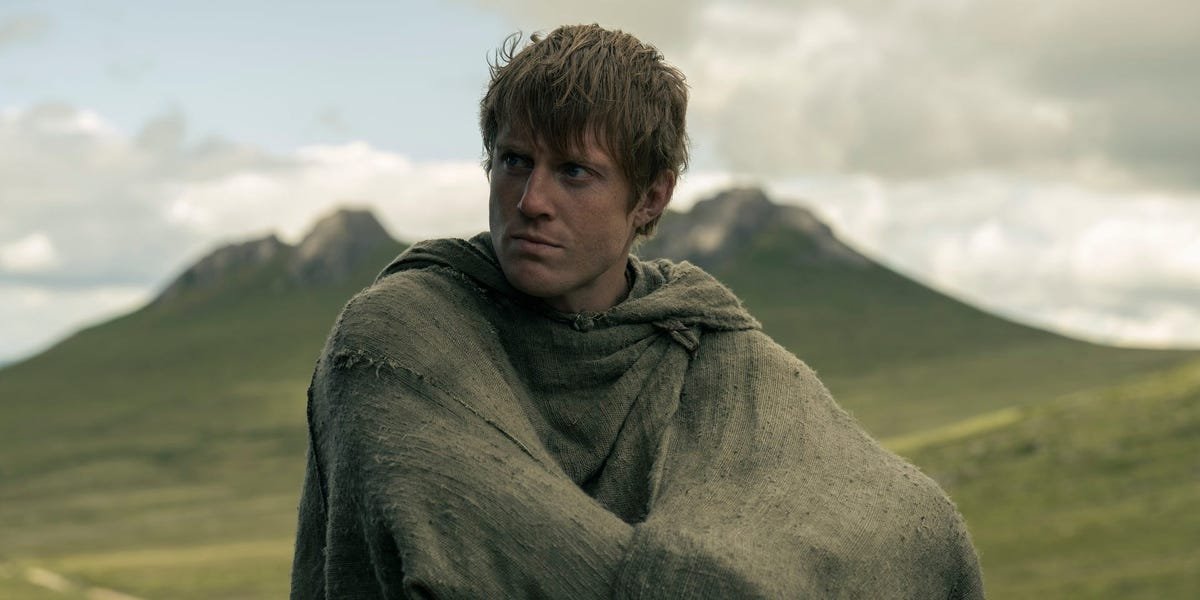
“The Morrow” includes a flashback to Dunk’s recent past, when he was a squire for Ser Arlan of Pennytree.
As Arlan is propped against a tree, pale and babbling and apparently dying, Dunk asks, “Why did you never knight me? Did you think I’d leave you? I wouldn’t have. Or was it something else?” He doesn’t get an answer.
The scene is filmed in the same place as the season opener — on the hillside where Dunk buries Arlan’s body.
Book readers have long suspected that Dunk is lying about his knighthood. He tells people that Arlan knighted him just before he died, with “only a robin, up in a thorn tree” to bear witness. When Dunk tries to enter the jousting tournament at Ashford Meadow, he’s told to find a lord or another knight to vouch for him, but no one can verify his claim. Hardly anyone even remembers that Arlan existed.
Privately, Dunk struggles with his identity and how he presents himself to the world. In “The Hedge Knight,” after it’s revealed that Egg is a Targaryen prince in disguise, Dunk is shocked and embarrassed for having been deceived, but he also feels a twinge of compassion and solidarity: “He knew what it was like to want something so badly that you would tell a monstrous lie just to get near it.”
“A Knight of the Seven Kingdoms” showrunner Ira Parker told Business Insider that he wanted the scene to be up for interpretation.
“A lot of the exposition around whether or not Dunk was knighted is internal thoughts in his head. And we get pretty, pretty close to him coming out and just saying it. It’s just like, what else could he be thinking of? What else could he mean by this?” Parker explained. “But it’s not said in black and white.”
Steffan Hill/HBO
Throughout season one, “A Knight of the Seven Kingdoms” drops subtle hints that Dunk was only ever a squire — that he’s lying to give himself a fighting chance at a better future. When he meets Egg in the premiere, the boy tells him plainly, “You don’t look to be a knight.” In episode four, Dunk hesitates when Raymun Fossoway asks to be knighted so he can fight in Dunk’s Trial of Seven.
“Go on, Ser Duncan,” Lyonel Baratheon urges. “Any knight can make a knight.”
Still, Dunk doesn’t draw his sword to fulfill the request. Is that because he doesn’t want his friend to die in a dangerous trial by combat? Or because he doesn’t know the words to recite if he never heard them himself? (“In the name of the warrior, I charge you to be brave. In the name of the father, I charge you to be just,” etc.) It’s also possible that Dunk doesn’t want to risk Raymun’s honor with a knighting ceremony by a fake knight.
During his loaded pause, Lyonel gives Dunk a searching look, but these questions remain unasked.
Parker said he made sure to preserve the ambiguity surrounding Dunk’s knighthood, which is “100% the way George would like it.”
In the finale’s flashback scene, just when it seems like Arlan is gone forever, he startles awake. We never actually watch the old man die, so it’s still possible that he knighted Dunk offscreen.
“It is just as wide open as it ever was,” Parker said. “So that was very important to maintain, but also — it’s just fun. And I know fans of the book are going to be thinking about that question, so we’re just trying to enjoy ourselves as much as possible with it. And it’s a little bit of a tease.”
The irony, of course, is that Dunk is a truer knight than most, even if he never took the sacred vows. He’s brave and just, and he risks his own life to protect the innocent — quite unlike the dishonesty and bloodthirst of his Trial of Seven opponents. These characters ask us to consider what real honor looks like in a place like Westeros, and to question the substance of titles like “ser,” “lord,” and even “prince.”
In turn, Egg lies about getting his father’s blessing to travel with Dunk
Steffan Hill/HBO
After the Trial of Seven is over, Egg’s father, Maekar, asks Dunk to pledge himself to House Targaryen and return with their family to Summerhall. He says that Egg has grown fond of Dunk and wishes to serve as his squire.
Dunk offers instead to bring Egg on his travels. He believes that growing up among smallfolk rather than servants will help Egg learn compassion and humility.
Naturally, Maekar says no. He’s not about to let his youngest son, the latest in a long line of royal Aegons, wander around Westeros with only a hedge knight to protect him. “Princes are not made for sleeping in ditches and eating hard salt beef,” he tells Dunk in the book.
Dunk counters that Egg’s older brothers, who are known as Daeron the Drunken and Aerion the Monstrous, never slept beneath the stars or ate less-than-perfect food. Maekar leaves without saying another word.
Then, as Dunk is readying his horses to leave Ashford, Egg suddenly reappears.
“My lord father says I am to serve you,” Egg says, and they ride off together, heading south toward Dorne.
Why and when does Maekar have a change of heart? In the book, it remains a mystery, but the show offers a plainer explanation: He didn’t.
Steffan Hill/HBO
The final scene of the episode shows Maekar riding away from Ashford with the rest of the Targaryens. When he realizes Egg is nowhere to be seen, he begins panicking and shouting for his son.
Parker said he created the scene because it makes sense for the character of Egg. “[The story] started by him sneaking off and getting into trouble. And of course, he just goes and he does the same thing, because we all make the same mistakes over and over and over again, and then we die.”
As for Maekar, the added scene reflects his stubbornness as a father and his pride as a Targaryen.
“He’s just a curmudgeon, and probably a shitty father, but I actually do think he really does love his children. I do think he cares about them, even though he’s not able to raise them well, he still wants to,” Parker said of Maekar. “The idea of letting Egg go off with someone else just felt like too much for me. It felt like he could reasonably say no in this moment, even though he knows it would be better for Egg.”
Although the show’s version of events doesn’t directly contradict the book, it does add a troubling wrinkle to Egg’s family lore. Maekar eventually becomes king of Westeros, and he may not take kindly to Dunk’s absconding with his heir. He may even misinterpret the event as a treasonous kidnapping.
“We’ll never be in Maekar’s POV, but this will rear its head at some point,” Parker hinted for future seasons. “Many ways were discussed about how to deal with this. Hopefully, people like the way we’ve chosen.”
The second season of “A Knight of the Seven Kingdoms,” adapted from Martin’s “The Sworn Sword,” is slated for a 2027 release.
