
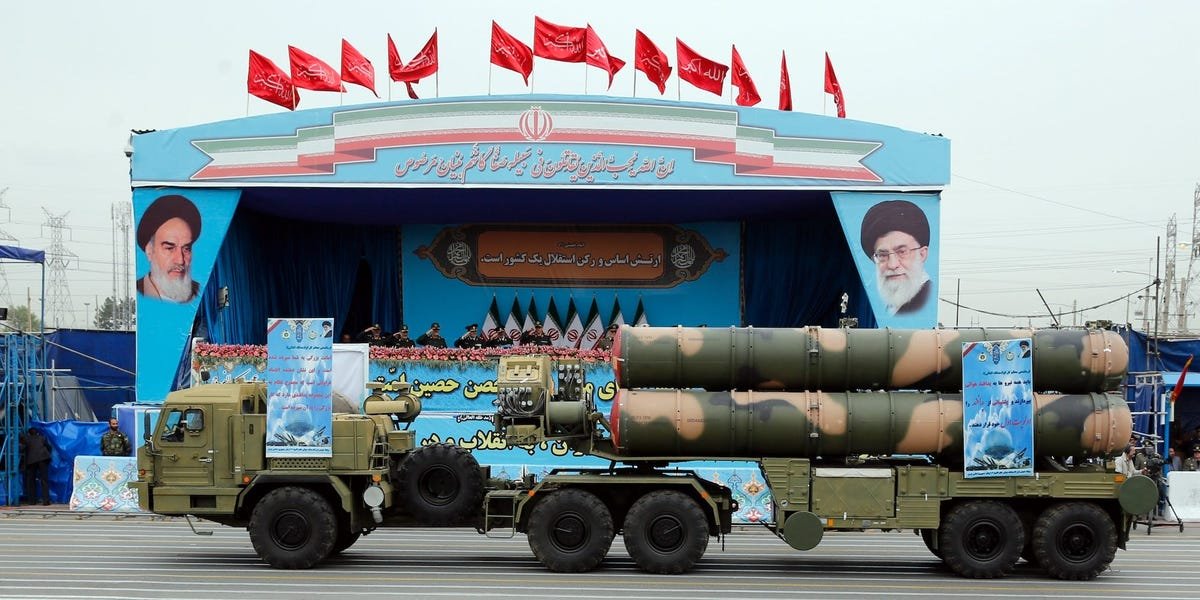
- Israel’s latest airstrikes on Iran appear to have battered Tehran’s most advanced air defenses.
- Russia has been slow to provide Iran with more advanced systems.
- Russian requirements for its Ukraine invasion make an imminent provision to Iran unlikely.

Iran has acquired and developed some advanced air defenses in recent years. At the same time, it has still prioritized building offensive ballistic missiles to deter and strike its adversaries. Tehran’s bet on this latter capability is now facing its greatest test.
Israel’s October 26 air and missile strikes on Iran appear to have battered Tehran’s most advanced air defenses, leaving Iran deeply vulnerable if it chooses to initiate a third missile attack on Israel. “Iran is essentially naked,” President Joe Biden’s Middle East envoy Amos Hochstein was quoted saying. An Israeli official said the operation “accurately targeted” Iranian air defense, leaving Tehran at a “disadvantage.”
Several reports go so far as to report that Iran’s entire arsenal of Russian-built S-300 air defense systems was hit.
“Iran’s domestic air defense operated reasonably well but they are no replacement for S-300 or, more importantly, the S-400 that Iran badly needs and hasn’t gotten,” Arash Azizi, visiting fellow at Boston University’s Frederick S. Pardee Center for the Study of the Longer-Range Future, and author of “The Shadow Commander: Soleimani, the US, and Iran’s Global Ambitions,” told Business Insider.
Iran has built indigenous air defense systems like the Bavar 373 and 3rd Khordad, which it claims are in the same league as the S-300.
There are reasons to be skeptical about the extent of damage to Iran’s air defenses.
Russian-built S-300s consist of multiple parts. If some components from each system survived, it’s conceivable that Iran could “mix and match” an operational battery or two together, said James Devine, associate professor in the Department of Politics and International Relations at Mount Allison University. However, he emphasized that there aren’t enough publicly available details to know for sure.
Israel’s attack was retaliation for Iran’s enormous October 1 ballistic missile strike. For decades, Tehran has invested heavily in its ballistic missile arsenal, invariably improving the accuracy and range of its arsenal. Unlike its foe Israel, which has built one of the world’s most advanced air defense systems, Iran has focused on developing strike missiles. While it sought air defenses from Russia, Moscow has been slow to provide them. Iranian air defenses are a patchwork of Russian systems, some indigenous ones, and antiquated systems that pre-date the 1979 Iranian revolution.
Farzin Nadimi, a defense and security analyst and senior fellow of the Washington Institute for Near East Policy, noted that post-revolutionary Iran started developing ballistic missiles during its long war with Iraq in the 1980s. Tehran developed them to support its “aggressive ideological objectives” and defeat Israel.
“While these missiles can obviously serve defensive purposes, I don’t believe, if you consider their range alone, they were ever originally intended for defending Iran,” Nadimi told BI.
During the reign of the last Shah, when Tehran was America’s ally, Iran bought a fleet of F-14A Tomcat fighters — armed with long-range AIM-54 Phoenix missiles — and surface-to-air MIM-23 Hawk missiles. Post-revolutionary Iran bought S-200s and MiG-29A Fulcrum fighters from the Soviet Union and later ordered S-300s in 2007 but didn’t receive any until 2016.
“Iran’s most important neglect is that it hasn’t been able to develop an air force,” Azizi said. “It largely relies on US-made aircraft it purchased during the Shah’s time.”
In recent years, Iran sought Su-35 Flanker fighter jets and S-400s from Russia but hasn’t received either to date. Russia’s requirements for its Ukraine invasion make an imminent supply unlikely.
“Moscow is quite careful in its military ties with Iran despite their impressive extent,” Azizi said. “We should remember that it has traditionally also had good ties with Israel and it won’t risk that by giving Iran too much.”
Devine noted that Iran has been “opportunistic” when it comes to its defense. It has based its ballistic missile program and air defenses on modifying, reverse-engineering, and upgrading foreign systems. For example, Iran developed its Mershad system from American Hawk missiles, which entered US service in 1959.
“They have heavily modified the S-200s they got from Russia before the S-300s and Iran certainly has lots of air defense systems layered together and a huge number of missiles,” Devine said. “It is not clear to me that one system has been expanded at the expense of the other or that there was clear neglect of air defense.”
“Tehran’s progress may have been slower on air defense simply because they have had less to work with.”
Faced with extensive arms embargoes, post-revolutionary Iran had to buy less advanced weaponry from Russia, China, and North Korea and develop weapons locally to avoid becoming dependent on any outside supplier.
“Without traditional military power being a real option, Tehran also turned to asymmetric capabilities to both provide deterrence and project its influence. Tehran turned its weakness into a strength,” Devine said. “The limits of the strategy are becoming clear at this point, but there were not many other options open to Tehran.”
“Unfortunately, if its current strategy continues to fail, the next logical step for Iran is a nuclear weapon.”
