

On November 12, Coinbase announced that it had filed with the U.S. Securities and Exchange Commission to reincorporate in Texas, with Foley & Lardner LLP serving as Texas counsel.
After an interview with Foley & Lardner partners Christopher Babcock and Christopher Converse, the reasons Texas is gaining appeal as a corporate domicile come into clear focus.
Texas’s draw, the partners stressed, centers on predictability, specialized adjudication for corporate disputes, and new statutory tools that companies can adopt through their governance documents, rather than any single company’s motives, which Coinbase has addressed separately in its own materials.
Texas as an Active Incorporation Choice
Babcock and Converse are the co-chairs of the firm’s Texas Corporate Governance Team. Babcock described a shift from default choices to deliberation about governing law, emphasizing that the venue question is now competitive across states and consequential for both management and investors.
“What we have begun to see is a legal environment where choice of incorporation is a real issue and a discussion,” said Babcock. “Companies need to be thoughtful about and understand the legal frameworks that work for their management, for their investors, and for their other constituencies.”
He framed Texas’s approach as the product of a long policy arc rather than a single reform. “Texas has been undergoing what I’ll call a two-decade, maybe three-decade project to really become a leader at a good space to do business in,” he said.

“It wants to be a place where there are rules. The rules are known, people can follow them, and people can deploy capital and feel good about their economic enterprise,” Babcock added.
Babcock noted that Delaware and Nevada remain part of companies’ comparison sets, while the point in Texas is clarity around roles, remedies, and venues so boards can operate and investors can rely on enforceable protections.
Business Court and Derivative Threshold
Recent changes include the Texas Business Court, which channels internal entity claims to judges with transactional experience, and an opt-in codification of the business judgment rule that shows the line between policing misconduct and second-guessing business choices.
“We made it very clear that if you have a dispute about how the company is governed or the rights of shareholders vis-à-vis the company, the company can establish that to be heard within the business court, which is a specialty court. It’s got judges who have a lot of transactional and other significant experience,” Babcock said.
He added that the statute provides statewide parameters for judicial deference to board decisions while preserving recourse for fraud or conflicts.
“Directors have a better sense of their mission than courts do. And so we don’t want courts to second-guess the business decisions of directors. We want courts to make sure the directors don’t have an inappropriate interest,” he explained.
In addition, Texas now permits companies, through bylaws, to require a minimum ownership threshold for bringing derivative claims, capped at 3% and expressly aggregable, which is designed to deter suits filed by minimal holders while preserving viable claims when shareholders coordinate.
“Texas created a rule that a company can, in its bylaws, adopt an ownership threshold that can be met by one or multiple shareholders acting together to bring a derivative claim,” Babcock said. “It can’t exceed 3% of the company… and it has to, by statute, be something that can be met by multiple shareholders acting together.”
He also pointed to a mechanism for pre-clearing independent committees before conflicted transactions proceed, so independence is vetted up front rather than litigated only after capital has been deployed.
Coinbase, Foley, and Texas: Counsel Mandate and Next Steps
Discussing the working relationship between Foley & Lardner and Coinbase, Babcock described a mandate centered on Texas-law guidance that supported the reincorporation process and sets parameters for future work, saying, “Our engagement was to help review and consider and help walk the company through the implications of Texas law, the pros and the cons, and help them think through those issues to support what ultimately became the decision to reincorporate.”
Converse framed the ongoing dynamic in practical terms tied to corporate status: “[The service is] for this reincorporation. But now that they’re, or presuming that they will be a Texas corporation in the future, we would serve as Texas counsel for them in the future.”
Babcock also offered a general view on digital-asset companies considering their options, noting existing mining activity, a state digital-asset reserve, and the broader push to pair guardrails with operating latitude. “I think Texas is a very attractive state for digital assets,” he said.
In a separate note made in his individual capacity, Foley & Lardner partner Patrick Daugherty, who leads the Blockchain and Digital Assets practice at the firm and serves as an adjunct professor at Northwestern University Pritzker School of Law, also explains what makes Texas a prime state for digital assets.
“Thanks to the Texas Blockchain Council and other industry advocates, regulatory clarity in Texas on crypto is favorable for the industry and consumers and is improving. Crypto is welcome in Texas, unlike New York, California, and Illinois, which have adopted onerous laws and regulations deterring business expansion,” said Daugherty.
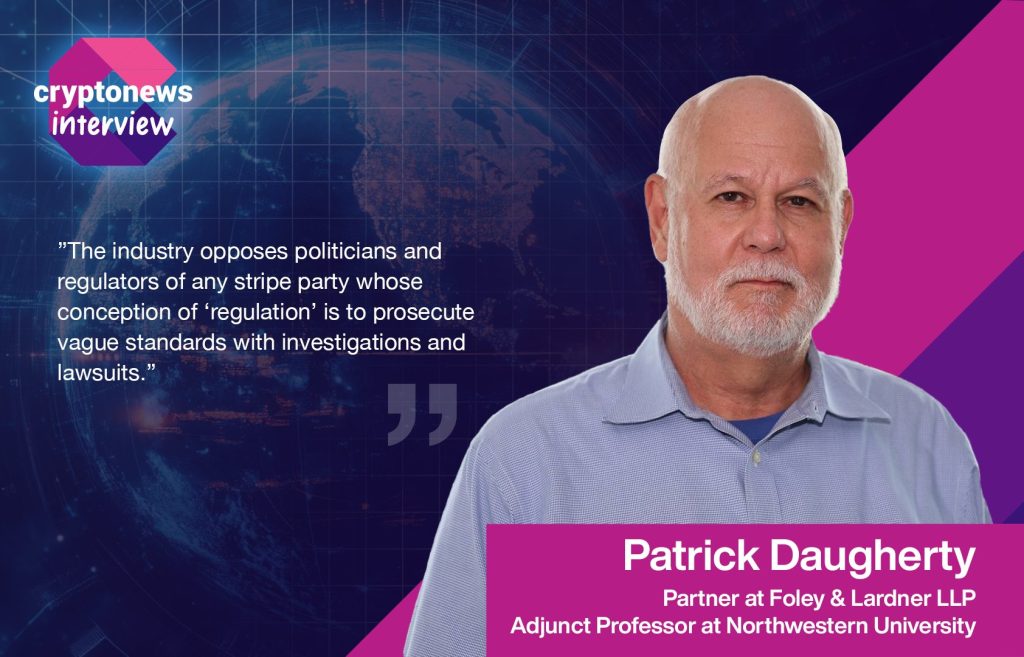
“The industry backs politicians and regulators of every stripe—Republicans, Democrats, and independents alike—who favor clear legal requirements. The industry opposes politicians and regulators of any stripe party whose conception of ‘regulation’ is to prosecute vague standards with investigations and lawsuits,” he concluded.
The post Inside Coinbase’s Texas Reincorporation: Business Courts, Derivative Hurdles and Crypto Policy appeared first on Cryptonews.
