
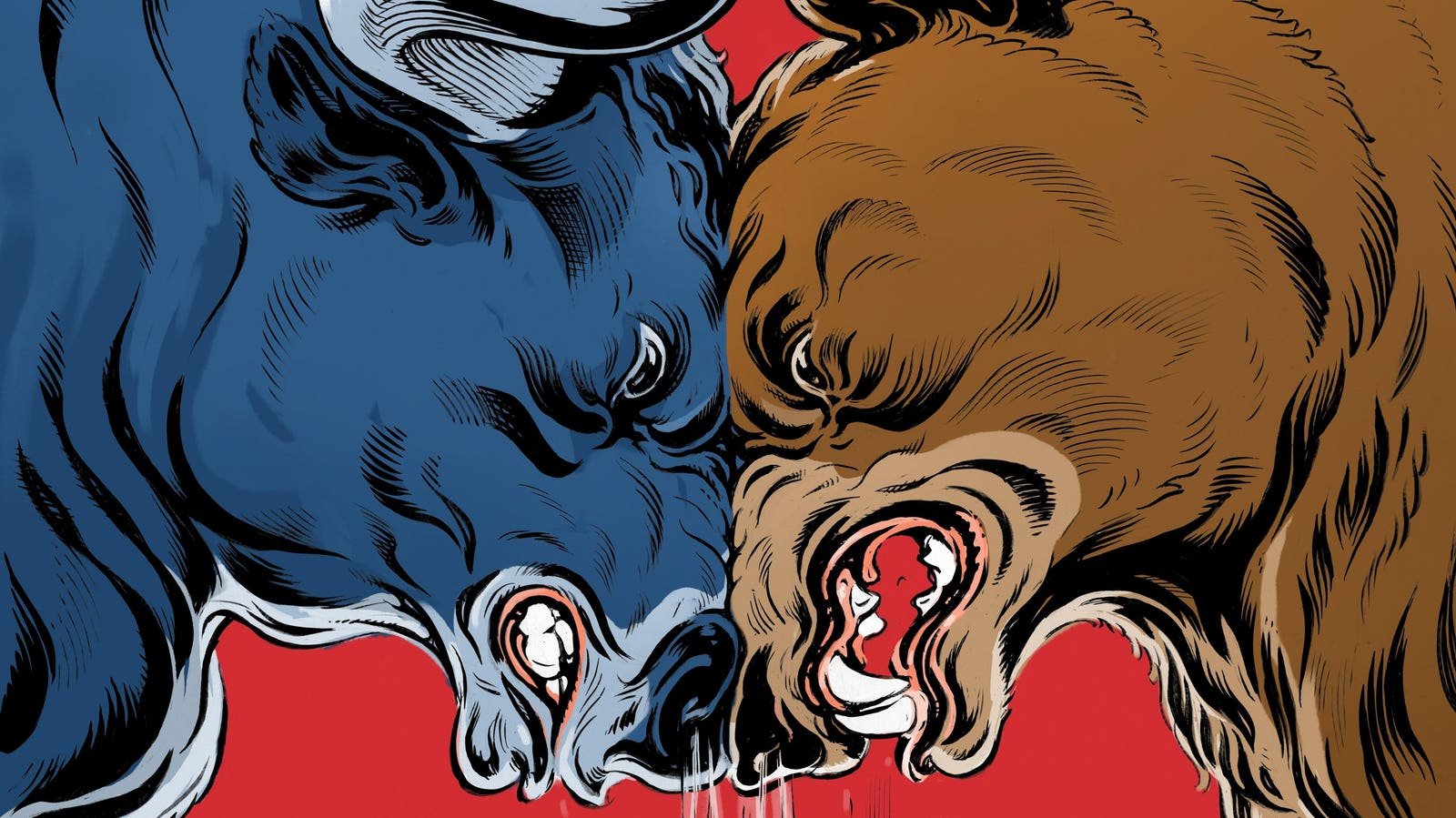
Two veteran rate watchers offer dramatically different takes on a risky security: the 30-year Treasury.
By William Baldwin, Senior Contributor
The bond bull market that lasted four decades came to a halt in 2020. The yield on long-dated government bonds has quadrupled. Now what?
Facing off on this question are two extremists, both longtime analysts of the yield curve, both stubbornly sticking to views they have long held. One, a bull on bonds, was spectacularly right for 38 years and then just as spectacularly wrong. The other has a track record that is almost a mirror image.
The bull is Gary Shilling, a Ph.D. economist whose A. Gary Shilling’s Insight newsletter is aimed at corporate treasurers and money managers. In 1982 he made the very contrarian argument that inflation was destined to recede, meaning you’d do well to own long-dated Treasury bonds whose coupons were fat in anticipation of high inflation. He’s making the same argument today. In the portfolios he manages he’s long the long bond and long the U.S. dollar.
James Grant, publisher of Grant’s Interest Rate Observer, is the bear, sour on both government bonds and the dollars with which they will be redeemed. For a long time, his letter has offered acerbic comments about the “Ph.D. standard of monetary management,” by which Grant means the Federal Reserve’s theories about why it’s a good idea to print money with abandon. He thinks gold is a better store of value than a greenback.
When, Forbes asks Grant, did you first become skeptical about fiat currency—in grade school? Deflecting the question, he notes that he recently confessed to his readers that his recommendation to get out of bonds was a bit early. It came in 2004, 16 years before their prices peaked.
These polar opposites have a few things in common. They were both, in the 20th century, columnists for Forbes magazine. They both think a recession is likely, albeit for very different reasons: Shilling, because an inverted yield curve and other statistics indicate that; Grant, because a decade of artificially suppressed interest rates has created so much financial mischief. They both have agrarian instincts. Shilling collects honey from 60 beehives near his Springfield, New Jersey, office. Grant presides over 250 acres of cropland, timber and pasture a few hours north of his Manhattan office.
Shilling advances several arguments for the proposition that inflation will subside. First is that inflation is not so much a monetary phenomenon as the consequence of excess demand. The U.S. experiences that in times of war or pandemic but is not experiencing it now.
Next is that technology depresses costs, albeit after a lag: “The American industrial revolution started in New England in the 1700s and only after the Civil War became important. Railroads took 50 years before they became important.” He expects something good to come from artificial intelligence, even if people expecting an immediate boost to productivity are disappointed.
Finally there’s Shilling’s belief that the price-depressing effect of globalization is not over. Western technology married to Chinese labor made goods cheap; now India will make services cheap. Software can be offshored. Perhaps medicine, accounting and money management will follow.
How would an investor have fared by doggedly holding long-dated bonds? Surprisingly well, at least on paper. Shilling says that a hypothetical portfolio of zero-coupon Treasuries, created in October 1981 and rolled over every year to keep its maturity at 25 years, would have beaten an investment in the S&P 500. This despite the ferocious crash in bond prices over the past three years.
Grant’s debating points start with this: Politicians are profligate. The October 27 issue of Interest Rate Observer spotlights economist Charles Calomiris, who posits a gloomy scenario in which Congress, unwilling to raise taxes or cut spending, counts on the Fed and financial regulation to make ends meet by effectively imposing an 8% inflation tax on currency and bank deposits.
Grant, author of books recounting economic events from a century or more ago, has good reason to be pessimistic about paper money. The dollar that bought 1,500 milligrams of gold in 1923 buys only 16 milligrams today. Such decadence suggests that the 30-year Treasury bond now yielding 4.6% will leave you with a 0% return in metal.
One more thing to give bond buyers pause comes from the charts. Grant notes that swings up and down in interest rates have historically stretched over long periods. Perhaps each new generation needs to relearn history. The half of the country that wasn’t alive in Paul Volcker’s heyday was quite unprepared for what happened to interest rates recently.
The previous bear market in bonds lasted from 1946 to 1981, at which point, Shilling recollects, “everybody thought that inflation was going to remain in double digits forever.” It was a great time to buy bonds. If the pattern repeats, the next buying opportunity will occur in 2055.
Grant isn’t willing to predict that the current bear market will last another 32 years, but he wants investors to be cautious: “I’m a ‘yes, but’ guy in a ‘gee whiz’ world.” If interest rates continue their upward march, he says, bondholders can at least recoup some lost ground by reinvesting coupons at better rates. He counsels fixed-income investors to supplement their positions with bullion.
Shilling is no fan of hard assets. “Human ingenuity has always beaten shortages,” he says, adding that he has taken a short position in copper futures.
A two-point decline in rates would take a 25-year zero now trading at 31 cents on the dollar to 50. Just as plausibly, gold could shoot to $3,000.
Shilling, at 86, still works full-time. Grant, 77, has no retirement plans. There is time for one of these Wall Street veterans to get a last hurrah.
MORE FROM FORBES
