
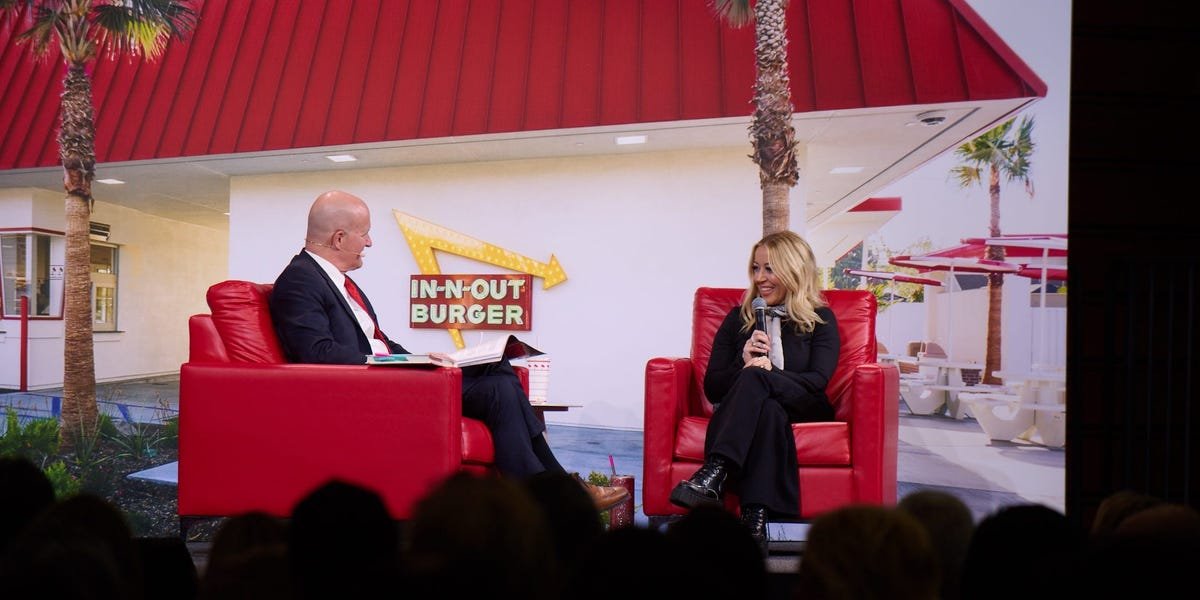
Lynsi Snyder-Ellingson says In-N-Out Burger is sticking to the status quo.
In a conversation hosted by Pepperdine University in late March, the burger chain owner said she has no interest in private equity money, delivery apps, or mobile ordering as other restaurant brands chase speed, scale, and outside capital.
For Snyder-Ellingson, the refusal is part of a larger mission: to preserve the family company’s quality, culture, and personal touch.
“I know that that’s just not an option for me,” she said of partnering with private equity firms. “There’s nothing I would gain that would be tied to anything that I’m doing.”
Snyder-Ellingson said her goal is to “preserve and continue” the company and honor her family’s legacy, not trade control for growth.
In-N-Out, a classic California chain, has been slowly pushing farther east, with Tennessee becoming the chain’s 10th state and its furthest-east outpost to date. The company first said in 2023 that it would build an Eastern territory office in Franklin as part of its Tennessee expansion, and by late 2025, it had opened its first stores in Lebanon, Antioch, and Murfreesboro.
In February, In-N-Out opened in Franklin as well, extending the brand’s footprint in a market the company now uses as a foothold for its next phase of growth.
That expansion still fits the chain’s deliberately slow, controlled playbook. In-N-Out says it only builds stores close enough to its patty plants so that fresh ingredients arrive within a single day. Its current map stretches across California, Nevada, Arizona, Utah, Oregon, Texas, Colorado, Idaho, Washington, and Tennessee, with New Mexico next in line.
In other words, the Tennessee push is real growth — just growth on In-N-Out’s terms.
“We don’t want to be in every state,” Snyder-Ellingson said last year, when she appeared on the “Relatable” podcast discussing her decision to move her family out of California as the Tennessee office was being built. “We don’t want to ever compromise our values and standards and the cornerstones that my grandparents laid down, so it’s really just keeping those priorities at the forefront when we make decisions.”
That same thinking explains why In-N-Out has resisted delivery and mobile ordering, she said while speaking at Pepperdine. The company has been asked about both, but has decided those paths would strip away what makes the chain distinctive.
“Part of what makes In-N-Out and the experience so special is the interaction and the customer service that we’re able to give,” she said, speaking to Pepperdine University President Jim Gash. Mobile ordering, she added, would “take a piece of that away.” Delivery also fails a basic test: its iconic burgers would not arrive as intended, she said.
Instead, Snyder-Ellingson said the company’s edge is consistency.
“We won’t compromise our quality,” she said, adding that In-N-Out will not take “the quicker, easier way” simply because it is easier for the business. The company’s guiding principle, she said, is to do “what’s best for our customers.”
Her comments fit a broader message that ran through the event: In-N-Out is still a family business shaped by faith, simplicity, and a refusal to change for change’s sake. Snyder-Ellingson said she often asks what her grandfather or father would have done, and that question still anchors decisions about the menu, operations, and the company’s future.
“That’s who we are,” she said. “Why change it? And if it’s not broken, why fix it?”
