
In a fight against a formidable enemy, there’s no guarantee medical evacuation crews will be able to reach wounded troops. Facing this possibility, the US Army is looking at using ground robots instead to get injured troops off the battlefield.
The Army’s 2nd Cavalry Regiment is drawing hard-won lessons from the war in Ukraine, where drones and artillery have made any battlefield movements extremely high-risk.
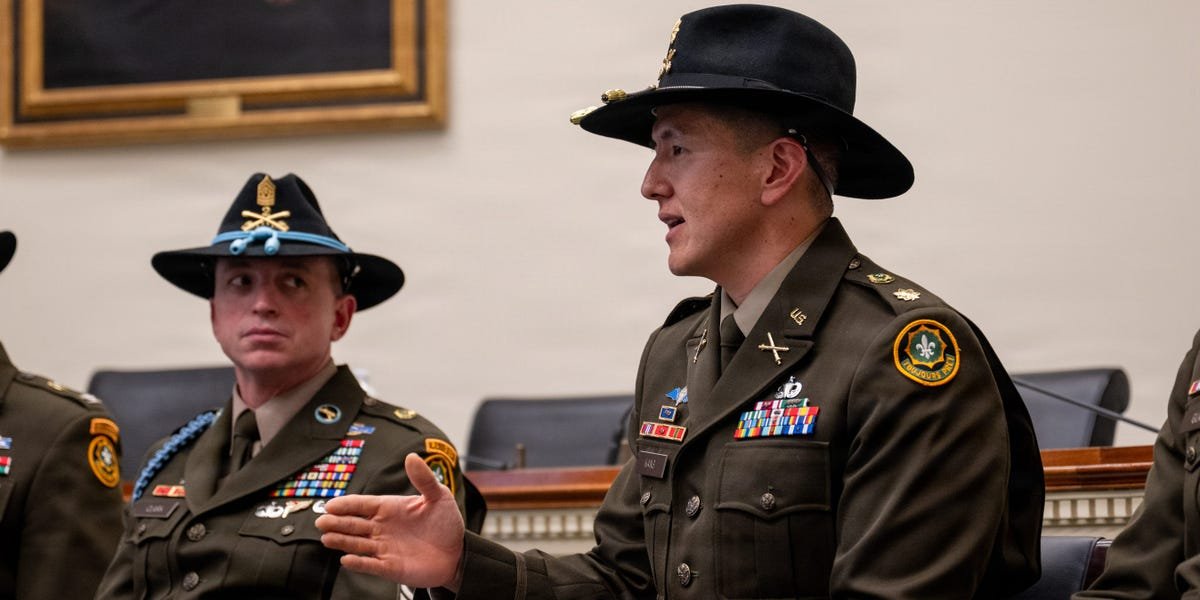
“When we’re looking at the conflict in Ukraine specifically, most of the use cases for unmanned ground vehicles have actually been in the sustainment and logistics,” said Maj. Andrew Kang, the fire support officer for the 2nd Cavalry Regiment.
That work includes casualty evacuations, Kang told reporters during a media roundtable last Friday, sharing that the regiment’s soldiers are providing industry partners with feedback during testing through the xTech innovation program.
The 2nd Cavalry Regiment, an Army Stryker brigade permanently based in Europe, would serve as a critical American combat force in a major conflict on the continent. The unit has been outfitting its soldiers with counter-drone systems through the Army’s Transformation in Contact 2.0 initiative, a force-wide push to more quickly adopt new technologies, and leaning into using uncrewed systems to its advantage.
The unit has trained Ukrainian troops cycling on/off the battlefield on American equipment, but concurrently with the training, the unit has become a sort of test bed for helping senior US leaders understand what troops will need in a future fight, experimenting with new technologies and tactics.
“During the training,” Col. Donald Neal, the 2nd Cavalry Regiment commander, said, “we learned a lot about their use of what we refer to as the triad: Unmanned Aerial Systems (UAS), counter-UAS operations, electronic warfare, and the network that enables all of it.” Those, however, aren’t the only lessons.
The Ukrainian battlefield has proven to be exceptionally grueling for casualty evacuations, a stark contrast to the quick evacuations on which American troops could rely during the wars in Iraq and Afghanistan. In Ukraine, helicopters are vulnerable to short-range air defenses, while medical teams and vehicles are haunted by drones.
That’s where the robots come in.
Ukrainian soldiers have been using uncrewed ground vehicles, or UGVs, for offensive missions. These operate like rugged flatbed trucks without a driver, and Ukraine has mounted machine guns and other weapons on them to attack Russian forces. Ukrainian troops also use them as mine-layers, scouts, and vehicle-borne improvised explosive devices.
Casualty evacuations, though, are proving to be a particularly critical area where these robots can help mitigate risk to medics.
U.S. Army photo by Sgt. Tien Dat Ngo
While aerial drones have been revolutionary for warfare, a trend that is continuing to expand abroad in the new US war in Iran, the uncrewed ground vehicles have been slower to proliferate.
Of the hundreds of thousands of Ukrainian drone missions that were executed last year, only 2,000 were UGVs. It’s more difficult to remotely drive them across varied terrain, but they offer the ability to move much larger payloads. For casualty evacuation and logistics, the ability to carry more is invaluable.
Rather than risk more injuries by sending medics forward, soldiers can send a UGV to pick up a wounded soldier. It’s an imperfect solution, as a wounded soldier has to be able to pull themselves onto the vehicle. Many UGVs are also susceptible to electronic interference and simple drone-spotting. These systems have, however, proven effective at getting troops off the battlefield, even surviving attempts to eliminate them by enemy forces. It’s another tool in the kit.
UGVs may also prove useful as decoys or sensors in areas too risky for troops, Neal said during Friday’s roundtable, and for boosting communications networks as mobile relays.
“Potentially, we see the biggest bang for our buck in utilizing them for things like breaching,” Kang added.
Breaching fortified enemy positions is one of the most dangerous jobs on the battlefield, requiring specialized combat vehicles to clear mines and cross obstacles while under fire. In Ukraine, breach operations have proven costly, with delays hindering breakthroughs and preventing armored formations from moving forward.
“Now, instead of having a manned formation go to the breach point, we could potentially load an explosive on a [remote-control] car-type platform and drive,” Kang said. The vehicle could blast a path forward for combat vehicles like 2nd Cavalry’s Strykers, wheeled armored fighting vehicles equipped with a mix of armaments.
One of the biggest challenges for the Army as it explores UGVs is the high price tag for some systems, Kang said. The platforms vary dramatically in cost, he said. While some more expendable versions are under $1,000,some cost almost $1 million.
“The cheaper the better,” Neal said of the affordability of ground robots. “In most uses for unmanned ground vehicles, we know we’re going to put them in a position where we’re not going to recover them, or they’ll be destroyed.”
