
Furnace Creek and Stovepipe Wells are among the roadside outposts inside Death Valley National Park, while Dante’s View draws tourists at sunset and Hell’s Gate greets visitors arriving from the east.
In the summer, it is so hot here, along California’s southeastern spine, that some of the roughly 800 residents — nearly all of them park employees — bake brownies in their cars. A large, unofficial thermometer in recent years has ticked up to 130 degrees, making it a destination for travelers, and the park has endured some of the highest temperatures ever recorded on Earth.
But none of that is what prompted Lata Kini, 59, and her husband, Ramanand, 61, to pack their bags and drive about seven hours to get here on a whim this month. They were drawn instead by the mystique of another natural force.
“I’m here because of the water,” Ms. Kini, said at Zabriskie Point, a popular vista, as she watched the rising sun paint the undulating stone peaks in shades of pink and deep purple.
In the distance gleamed the white salt flats of Badwater Basin, the lowest place in North America, almost 300 feet below sea level. It was there, in the midst of salt-covered land, that a vast lake had appeared almost overnight, highlighting the ways in which a changing climate is altering life in one of the nation’s most remote landscapes.
On Aug. 20, cities across Southern California braced for a deluge from Tropical Storm Hilary, whose landfall in California was an exceptional occurrence. Many regions escaped with little damage. Not Death Valley.
Throughout the park, rangers found that water rushing down from the mountains had damaged every road, making many of them impassable. That day, the park recorded 2.2 inches of rain — more than a year’s worth, and the most that had ever fallen in a single day in Death Valley. The previous record was set just over a year before, when flooding stranded 1,000 people in the park.
Afterward, the park had its longest closure ever — lasting nearly two months — reopening to visitors on Oct. 15.
Out West, many state and national parks are of a scale that can be hard to comprehend without visiting them. Death Valley is the size of Connecticut and the largest national park in the contiguous United States. It became a national monument in 1933 under President Herbert Hoover in part to protect two million acres from mining. (The park is dotted with sites tracing the boom-and-bust history of borax mining in the area, as well as mostly unsuccessful efforts to mine gold and silver.) The land was not designated a national park until 1994 and today encompasses 3.4 million acres.
The park now draws more than a million visitors a year, many stopping on their way from Las Vegas to see other, perhaps more conventionally photogenic national parks like Yosemite. Still, Death Valley might look familiar to newcomers; the sand dunes and rock formations here served as the landscape of Tatooine in the original “Star Wars” movie.
Park officials said the recent weekslong closure underscored the necessity of adapting to a future in which the weather is ever more extreme and less predictable.
“All the climate change models say that this area of the country is expected to have more frequent, large storms,” said Abby Wines, a park ranger who manages safety and public affairs.
Though few people associate the park with water, flash floods have always shaped Death Valley’s terrain, with debris washing out of canyon mouths to create fan-shaped accumulations of sediment. But today, floods wreak more havoc for the region’s human inhabitants and visitors, because roads damaged in an instant by waters can take many months to repair.
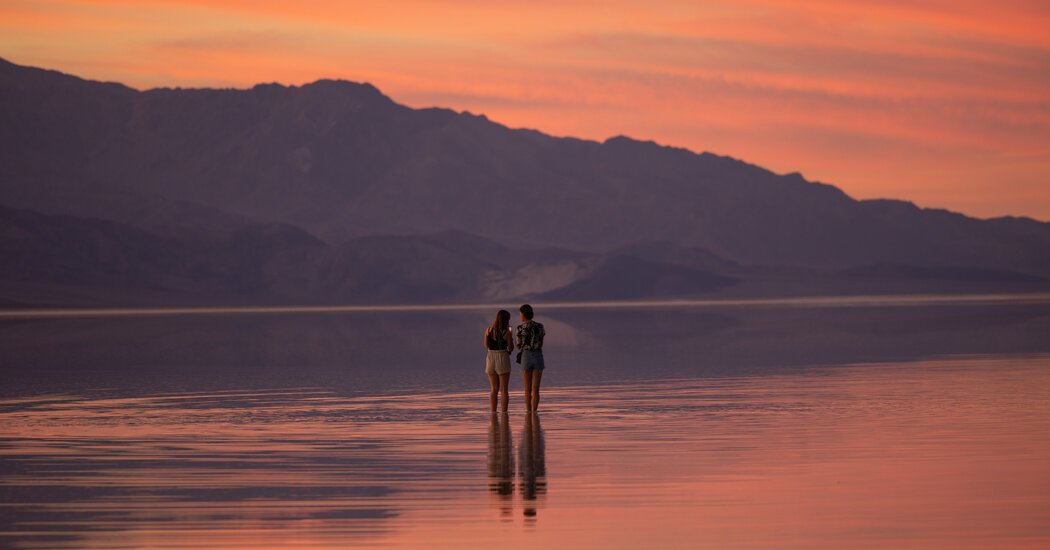
Badwater Basin normally consists of hard-packed earth covered in what is essentially table salt, left behind by water that coursed down from adjacent mountains and hillsides over millenniums and evaporated in the scorching heat. But when Death Valley reopened this fall, visitors were greeted by a miraculous sight: a mirror-smooth body of water.
It was the first time a lake had formed here in nearly 20 years — the last time was during the winter of 2005 — and this one is substantially larger.
At the Badwater Basin boardwalk, where busloads of tourists normally arrive to see the salt flats, families in November posed for selfies, their feet immersed in the saline water. A lone kayaker glided past. The sun warmed the air, creating an otherworldly dissonance with the crunch of salt underfoot, which felt like weeks-old snow.
“The earth is in constant change,” said Katharina Riedl, 50, as she gazed out at the bare hills, striped with minerals, reflecting off the water.
“It’s a little bit overwhelming and a little bit strange,” she said with a laugh.
Ms. Riedl and her husband had traveled here from Austria in part to see the starting point of a 135-mile ultramarathon that takes place each July in Death Valley.
The lake was a particularly welcome sight for Mandi Campbell, the historic preservation officer for the Timbisha Shoshone tribe, which has made the valley its home for centuries. Its emergence signaled a reprieve for the land, desiccated by prolonged periods without rain.
But the lake was also a reminder of what her community has lost.
She paused to chat outside the small, unoccupied adobe house where she lived with her grandmother decades ago.
The adobe houses were built in 1930, when tribal members were forced to move about a mile and a half from the land that now houses the Furnace Creek Visitors Center in the national park. It was one of multiple times that the federal government displaced the Timbisha Shoshone tribe over the years.
Now, the village is home to a few dozen people, mostly elders, who live in worn trailers that are spread across a barren stretch of land tucked off the highway. Their swamp coolers are increasingly outmatched by the rising summer temperatures.
When Ms. Campbell, 49, was a child, the honey mesquite bushes dotting the desert soaked up groundwater and sporadic rain, producing a bounty of beans. She recalled using the bushes as shade huts during hot summers. She would play in the dunes, digging her bare toes into the sand to cool them.
Now, when rains come, they overwhelm the parched land. Thirsty, invasive tamarisk trees, which were planted in the village by the federal government, are green, while the honey mesquite have turned thorny and fruitless. Many are dying.
Ms. Campbell said that while she has a good relationship with park officials today, the park’s closure served as a respite — a window into the valley’s past.
“I think Mother Nature needed a break. The valley needed a break,” she said. “Every time it floods, the roads get worse, you know, and it’s quiet. It’s peaceful.”
