
Stay informed with free updates
Simply sign up to the War in Ukraine myFT Digest — delivered directly to your inbox.
This article is an on-site version of our Europe Express newsletter. Sign up here to get the newsletter sent straight to your inbox every weekday and Saturday morning
Good morning. So, whether it was 26 united stony-faced colleagues, weeks of diplomatic pressure, a bad night’s sleep or a realisation that the stability of his economy depended on Brussels’ continued financial support, Viktor Orbán caved on his pledge to block a €50bn financial aid package for Ukraine.
Here, we explain what the next steps are to actually get the promised cash to Kyiv, and the final approval of the EU’s landmark regulation of artificial intelligence technology.
After Viktor’s drama
After Hungarian Prime Minister Viktor Orbán dropped his veto over a €50bn funding package to help Ukraine fight Russia at an emergency summit yesterday, attention has moved to the next hurdle before Kyiv gets its money: the European parliament, writes Andy Bounds.
Context: The 27 member states agreed a €65bn top-up for the EU budget over the next four years, including €50bn in grants and loans for Ukraine. Now, European lawmakers must also approve the deal.
Parliament has been a strong advocate of money to Ukraine. But it also wants more money overall. In a vote in October, it endorsed an extra €10bn on top of what member states agreed.
The budget approved by EU leaders involves redistribution of money from some areas to others — in other words, cuts — to compensate for increases in borrowing costs.
Now MEPs have an invidious choice of waving through those cuts, or delaying money to Ukraine.
Among the things demanded by parliament are an additional €3bn for the new €1.5bn Strategic Technologies for Europe Platform (Step), aimed at funding clean technology, and €5bn more for a crisis reserve to tackle floods and other emergencies.
Roberta Metsola, president of the parliament, yesterday told reporters that Kyiv “needs the money yesterday”. She hoped the parliament could vote in the last week of February to approve the deal, after several rounds of talks with member states.
But she also criticised governments for holding up the package so long that the parliament had little chance to influence it, and condemned proposed cuts to areas like the EU’s research programme Horizon.
Rasmus Andresen, the MEP who speaks for the Greens on the multiannual budget, said: “It’s disappointing and not fit for purpose. Europe will not be back on track, losing competitiveness and even the climate goals are in danger because of too little investment.”
Other political groups were likely to fight for more money but ultimately grit their teeth and accept the fait accompli, officials told the FT.
Kyiv would then get its first payment in April.
Chart du jour: Radioactive
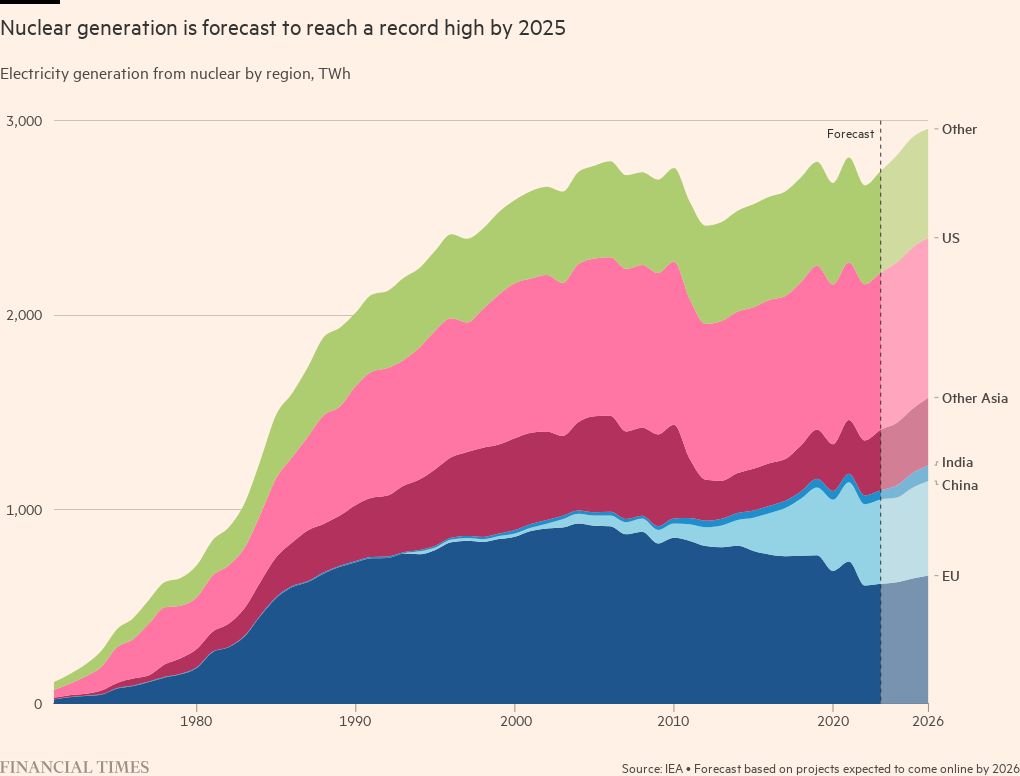
Nuclear power is back in vogue. Government targets on net zero along with a desire for greater energy security after Russia’s invasion of Ukraine have led to a surge in new projects around the world in recent years. But increasing nuclear energy capacity is not easy.
Acting on AI
EU member states are set to approve the bloc’s new rules on artificial intelligence today, following weeks of bickering that sparked fears the landmark regulation could fail on the last stretch, writes Javier Espinoza.
Context: The AI Act would be the first legislation worldwide reining in artificial intelligence and imposing safeguards on its use in Europe. Although it was in principle agreed in December, France and Germany raised last-minute opposition over concerns that it could undermine innovation and European start-ups.
But their anxieties were finally quelled.
Paris negotiated concessions including the introduction of a code of practice to make it easier for companies to comply with transparency obligations on so-called foundation models.
“A light set of new requirements for AI start-ups made the French more comfortable,” said a person with intimate knowledge of the discussions. Last night, France signalled it would back the rules, people briefed on the talk said.
Berlin also was comfortable with the rules after days of deliberation between the country’s three-party coalition. Particularly the liberal FDP, the junior coalition partner, worried that start-ups looking to develop new AI technology would be caught in the new rules, but the text now exempts those still working on research and development from burdensome regulation.
“Before you go to market, you don’t exist,” said one of the key drafters of the new law.
People briefed on the negotiations expect no major upsets — barring a last-minute about-face by the French. Then, the European parliament is due to approve the rules in a final vote, before they become law in May.
But owing to a gradual phase-in, they will only be fully in force years from now.
What to watch today
-
Informal meeting of EU foreign ministers in Brussels.
-
Indo-Pacific ministerial meeting, followed by EU-ASEAN meeting hosted by chief diplomat Josep Borrell.
Now read these
-
Don’t touch the money tree: Euroclear earned €4.4bn on frozen Russian assets last year. But under planned EU rules, that money likely won’t go to Ukraine.
-
Shipped off: European manufacturers have to deal with longer delivery times owing to trade disruptions caused by Houthi militants’ attacks in the Red Sea.
-
Germany, again: Bickering among Germany’s ruling coalition threatens to undo EU legislation to punish companies for environmental and human rights abuses.
Recommended newsletters for you
Britain after Brexit — Keep up to date with the latest developments as the UK economy adjusts to life outside the EU. Sign up here
Chris Giles on Central Banks — Your essential guide to money, interest rates, inflation and what central banks are thinking. Sign up here
Are you enjoying Europe Express? Sign up here to have it delivered straight to your inbox every workday at 7am CET and on Saturdays at noon CET. Do tell us what you think, we love to hear from you: europe.express@ft.com. Keep up with the latest European stories @FT Europe
