
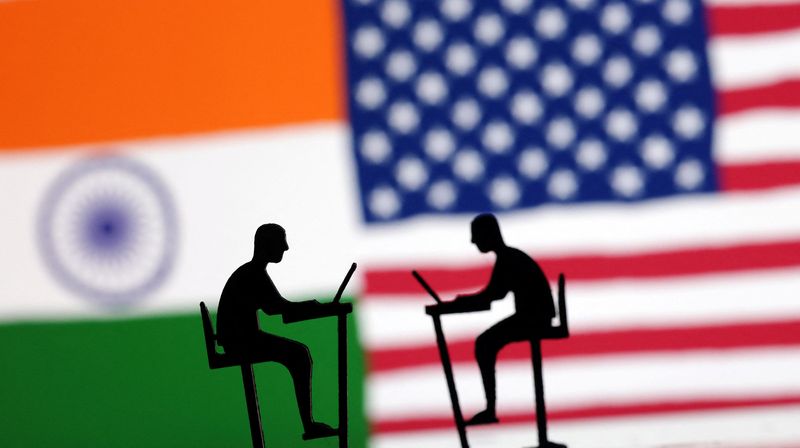
© Reuters. The Indian flag, the U.S. flag and people miniatures with laptops are seen in this illustration taken March 10, 2024. REUTERS/Dado Ruvic/Illustration
By Aditya Kalra, David Lawder and Shivangi Acharya
NEW DELHI/WASHINGTON (Reuters) – India reversed a laptop licensing policy after behind-the-scenes lobbying by U.S. officials, who however remain concerned about New Delhi’s compliance with WTO obligations and new rules it may issue, according to U.S. trade officials and government emails seen by Reuters.
In August, India imposed rules requiring firms like Apple (NASDAQ:), Dell (NYSE:) and HP (NYSE:) to obtain licences for all shipments of imported laptops, tablets, personal computers and servers, raising fears that the process could slow down sales. But New Delhi rolled back the policy within weeks, saying it will only monitor the imports and decide on next steps a year later.
The U.S. government emails – obtained under a U.S. open records request – underline the level of alarm the Indian curbs caused in Washington, and how the U.S. scored a rare lobbying win by persuading Prime Minister Narendra Modi’s usually inflexible government to reverse policy.
U.S. officials have often been concerned about India’s sudden policy changes which they say create an uncertain business environment. India maintains it announces policies in the interest of all stakeholders and encourages foreign investments, even though it often promotes local players over foreign ones.
Some of the language in the documents was blunt, despite the bonhomie often displayed by both sides in public. U.S. officials were upset India’s changes to laptop imports came “out of the blue”, without notice or consultation, and were “incredibly problematic” for the business climate and $500 million worth of annual U.S. exports, the documents and emails showed.
Research firm Counterpoint estimates India’s laptop and personal computer market to be worth $8 billion annually.
U.S. Trade Representative Katherine Tai met Indian Commerce Minister Piyush Goyal in New Delhi on Aug. 26, soon after the policy was announced. Although the USTR’s public readout said Tai “raised concerns” about the policy and “noted” that stakeholders needed to be consulted, she privately told Goyal during the meeting that the U.S. wanted India to “rescind the requirement”, a USTR briefing paper showed.
India’s “surprise” announcement “prompts U.S. and other firms to think twice about doing business in India,” stated the “talking points” of her briefing paper.
Around the same time, a U.S. diplomat for trade in New Delhi, Travis Coberly, told his USTR colleagues that Indian officials had conceded the sudden rollout of the laptop licensing policy was a mistake.
India’s IT ministry “understands they (India) screwed up. They admitted as much. American companies here have been hammering them about this,” he wrote.
Coberly did not immediately respond to a request for comment. The U.S. Embassy in New Delhi declined to comment on “private diplomatic communications”, redirecting queries to the Indian government.
India’s IT ministry did not respond to a request for comment.
TRACKING INDIA’S POLICY
In response to Reuters queries, Brendan Lynch, acting Assistant U.S. Trade Representative for South and Central Asia, said the USTR was satisfied that the current monitoring system so far had a minimal impact on trade but it was still closely tracking India’s scrutiny of imported devices to make sure it was implemented in line with WTO obligations and was “not having a real negative impact on the trade relationship.”
Goyal’s Commerce Ministry said in a statement to Reuters that Tai “did raise some concerns” during their August meeting and New Delhi had “conveyed India’s security concerns” at the time. It did not elaborate on why it reversed its decision or on the U.S. emails.
Three Indian officials, including two from the Commerce Ministry who spoke on condition of anonymity since they were not authorised to comment, said New Delhi did not reverse its policy under any U.S. pressure and took the call as it realized local manufacturing of laptops and tablets wasn’t significant at this stage.
While Tai was on her New Delhi visit, a U.S. embassy press officer in New Delhi wrote an email to colleagues flagging caution when U.S officials speak to the press – another sign of how sensitive New Delhi can be.
If asked about the laptops move, the U.S. government’s line is: “The (Indian) government has the right, and the responsibility, to design a trade policy that is responsive to the needs of the people of India”, the email said.
The U.S. State Department also expressed concerns about the policy.
“U.S. firms perceived the move as highly protectionist and out of sync with the progress India has made in improving the investment environment,” State Department official Timothy Wiley wrote in an email to USTR colleagues containing “talking points”.
“Some U.S. companies in India told us that they have been pushing their headquarters for greater manufacturing in India but were embarrassed by this unexpected measure.”
The State Department declined to comment.
Modi has taken several decisions that have hit American firms – like forcing Mastercard (NYSE:) and Visa (NYSE:) to store data locally and forcing Amazon (NASDAQ:) to comply with stringent rules for e-commerce which once disrupted its operations. But Indian authorities did not back off on such policies despite push back.
The emails reviewed by Reuters show HP told the USTR the laptop licensing “policy (and its goal)” is “very problematic”.
“Despite our very wide Made in India portfolio, this would have significant impact on HP sales in India,” its head of global policy and strategy, Amy Burke, wrote in an email.
HP did not respond to Reuters queries.
