
This article is an on-site version of our Europe Express newsletter. Premium subscribers can sign up here to get the newsletter delivered every weekday and Saturday morning. Standard subscribers can upgrade to Premium here, or explore all FT newsletters
Good morning. News to start: Nato’s military chief has warned banks, pension funds and rating agencies that they’re “stupid” to shun defence companies and ignore the massive return on investment offered by arms producers as Europe ramps up military spending.
Today, I have more from Admiral Rob Bauer on how European governments will be held to defence spending promises, and our climate correspondent reveals how many countries are set to break EU law by ignoring a deadline for updated green transition strategies.
‘Mud and blood’
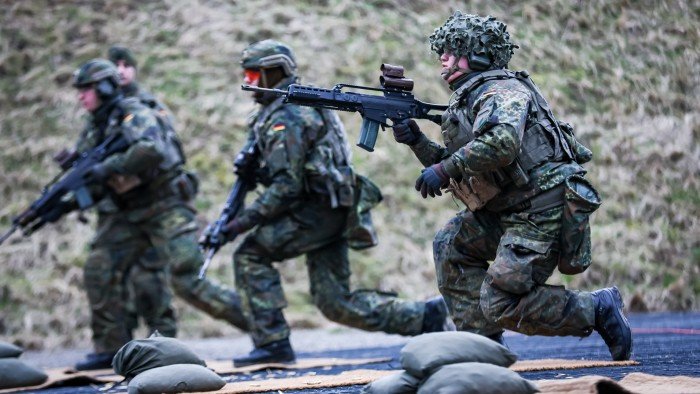
European Nato members will be given higher targets for acquiring critical military assets this year, the chair of Nato’s military committee has said, as pressure increases on laggards to spend more on defence.
Context: Russia’s war in Ukraine and Donald Trump’s election as US president has spurred fierce debate in Europe on increased defence spending to make the continent more self-reliant. Trump wants to increase Nato’s 2 per cent of GDP benchmark to 5 per cent. Most Nato members think at least 3 per cent is necessary.
Rob Bauer said one way to force capitals to spend more was to give them concrete targets for acquiring military capabilities that collectively are needed to defend the continent.
“There will be more capability targets given to European nations . . . capabilities that now only the US has,” Bauer said. “We haven’t done what we have promised for a very long time. And what happens now is that the new [US] administration basically says: I want it to happen. I want what was promised.”
“This is about the shield that we form together, the collective set of capabilities . . . to deter against the Russian threat,” Bauer said. “Now, if somebody doesn’t do what they have promised, there is a part of the shield not there, there’s a hole.”
“So suddenly it’s not only about your own security, but our collective security where all of us will say: ‘Hey, wait, this corner, Spain! Or whoever,” he said.
Spain, Italy and Belgium are among the nine Nato members that don’t meet the existing 2 per cent baseline.
“For a long time, nations thought they can decide how the next war will look: cyber and AI or quantum,” said Bauer. “Yeah, that’s there. But it’s still mud and blood as well.”
“And so you can’t say: ‘Infantry, mud and blood is for the Poles.’ That’s not how it works, because it’s not only burden sharing, it’s also risk sharing,” Bauer added. “And if we need to send soldiers to where the mud and blood is, you need to have the soldiers to be able to fight mud and blood fights. And if the enemy has a tank, it’s probably good to have a tank as well.”
Chart du jour: Sick pay

The level of sick pay varies wildly across Europe. How much is too much?
Missing homework
By law, EU governments should update their long-term strategies for meeting the bloc’s climate goals this year. But only a third appear likely to do so, writes Alice Hancock.
Context: the EU has set ambitious targets for cutting greenhouse gas emissions. Under the bloc’s climate law, member states are expected to report on their plans to meet those goals — including the presentation of a strategy with a “perspective of at least 30 years”.
Those strategies, the law says, should include expected progress on cutting emissions, work on increasing carbon sinks and a breakdown of likely emissions reductions in specific sectors.
They should be updated every five years: member states were first required to present one by January 2020, meaning it is number-crunching time again.
But, according to analysis by the NGO WWF, only eight of the 27 EU member states have said they are planning to update their long-term plans. Only two (Ireland and Lithuania) have already done it.
Six countries — Belgium, Germany, Denmark, Sweden, Austria and Slovenia — are simply not planning to update their plan. Poland — which is the chair of the EU’s rotating presidency for the next six months and consistently opposes the bloc’s climate goals — never submitted one in the first place.
The remaining member states did not respond to WWF’s inquiries.
The lack of enthusiasm does not bode well for a major milestone the EU must set this year: an emissions reduction target for 2040, which Brussels wants to enact as a 90 per cent cut, despite concerns about EU industries struggling to meet an existing 2030 goal.
The long-term strategies are separate from the shorter-term National Energy and Climate plans for which only 14 countries hit the submission deadline of June 30 2024.
“National ownership of the EU-wide climate targets is of the utmost importance,” said Michael Sicaud-Clyet, climate policy officer at WWF EU.
What to watch today
-
EU trade commissioner Maroš Šefčovič meets Ngozi Okonjo-Iweala, the director-general of the World Trade Organization, in Geneva.
Now read these
Recommended newsletters for you
Free Lunch — Your guide to the global economic policy debate. Sign up here
The State of Britain — Peter Foster’s guide to the UK’s economy, trade and investment in a changing world. Sign up here
Are you enjoying Europe Express? Sign up here to have it delivered straight to your inbox every workday at 7am CET and on Saturdays at noon CET. Do tell us what you think, we love to hear from you: europe.express@ft.com. Keep up with the latest European stories @FT Europe
