
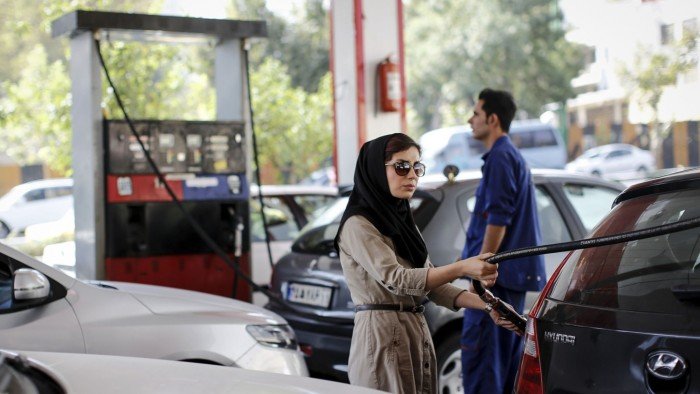
The start of rolling power blackouts in Iran this week amid critical fuel shortages has exposed the vulnerability of the oil-rich country to US sanctions and underscored the impact of years of under-investment.
Iran has the world’s third-largest oil reserves and second-largest natural gas reserves. And yet weary Iranians have in recent months had to grapple with painful energy shortages.
In the summer, fuel stations in some popular northern travel destinations ran dry, forcing vexed motorists to queue for hours. Now the two-hour daily power cuts come just as the chill of winter sets in. They have knocked out traffic lights, exacerbating congestion, and left residents of tall buildings fearful of being caught in lifts.
“Blackouts on top of everything else! What a shame for a country so rich in oil and gas, with huge solar and wind energy potential,” said Javad, a Tehran engineer who declined to give his full name. “This is the result of ineffective managers and officials who are all talk and no action.”
Chronic under-investment in infrastructure exacerbated by US sanctions as well as mismanagement and huge state subsidies — which encourage high fuel consumption and overburden the cash-strapped state — have left Iran with worsening shortages of electricity, gas and petrol.
The outages are the result of “a surge in household demand for gas at the start of the cold season, fuel shortages . . . and a decision to halt the burning of heavy fuel oil” at three power stations, according to the energy ministry.
So severe is the economic and energy crisis that President Masoud Pezeshkian acknowledged in September that the government was struggling to pay workers and was therefore tapping into the National Development Fund, a sovereign wealth fund that is supposed to guard current oil revenues for future generations.

Iranians are charged less than three US cents for a litre of petrol at the pump — vying with Libya and Venezuela to be ranked as the cheapest rates in the world. According to the IMF, Iran spent $163bn in explicit and implicit energy subsidies in 2022, which amounted to more than 27 per cent of GDP — the highest share of the economy of any country in the listing.
Pezeshkian has questioned “irrational” petrol subsidies when “we don’t have enough money to procure foodstuff and medications”, telling a recent news conference: “We pay loads of money to those who [lavishly] consume electricity, gas and petrol.”
This week, the government for the first time authorised the import and sale of high-grade petrol at unsubsidised rates, a move targeted at wealthy Iranians who drive expensive cars. For domestic energy, Iran has also in recent years adopted a progressive pricing system to discourage overconsumption of natural gas and electricity by affluent households.
But the need to cut subsidies more drastically conjures up fears of a repeat of events in 2019, when an overnight petrol price hike triggered deadly protests in Iranian cities. Increased fuel prices would also push up inflation across the economy. “A fuel price hike would have a knock-on effect on prices of goods and services,” said energy analyst Morteza Behrouzifar.

Subsidies are so large and have been in place for so long that many Iranians — suffering from high inflation, falling living standards and a sliding national currency — have come to feel they have a right to cheap energy.
“Fuel prices in Iran have remained unchanged for such a long time that the disparity between subsidised and actual prices has become extremely wide,” said Saeed Mirtorabi, an energy expert.
Official estimates suggest the country is facing a daily deficit of around 20mn litres of petrol, and last year it imported nearly $2bn worth of the fuel, the oil ministry says. At the same time, millions of litres are smuggled across the borders daily to neighbouring countries such as Pakistan and Afghanistan by traders profiting from the difference between market prices and the Iranian subsidised price.
For electricity, the national grid is facing a shortfall of more than 17,000MW of output, officials say, in part because power stations are old and need replacing.

Behrouzifar said lack of access to new technology as a result of sanctions was one of the factors contributing to the crisis, for example by limiting domestic refining capacity. “We have failed to increase output proportionate to national resources,” he said.
Fatemeh Mohajerani, government spokesperson, suggested on Tuesday that scheduled blackouts were the price to pay for protecting public health by reducing the burning of heavy fuel oil at power stations, which generates toxic emissions and high air pollution in winter.
Others are sceptical. “There is strong suspicion that this is not about air pollution. I suspect that we are also running out of heavy fuel oil,” said Hashem Oraee, chair of the Iran Energy Associations Syndicate, an industry group.

With sanctions taking such a toll on the Iranian economy, Pezeshkian, who took office as president in July, has signalled an openness to resuming negotiations with the west.
But after Donald Trump’s victory in the US elections, prospects for renewed talks are uncertain. The first Trump administration adopted a hawkish policy, pulling the US out of the 2015 nuclear deal with Iran and reinstating sanctions under a campaign of “maximum pressure” against Tehran.
The energy crunch also comes at a fraught time strategically for the Islamic republic, which has been in an escalating conflict with Israel in recent months involving direct attacks on each other’s territory.

Energy shortages at home are embarrassing for a country known to be one of the world’s biggest oil and gas producers. South Pars, the world’s largest natural gasfield, which Iran shares with Qatar, supplies over 70 per cent of the country’s gas needs. But production from the field on the Iranian side of the Gulf has been declining steeply.
“We have failed to properly invest in the upstream oil and gas industry. We are undergoing huge losses for failing to develop the South Pars gasfield, while Qatar is reaping the profits,” Behrouzifar said.
For now, the situation remains bleak. This winter, Iran is expected to face a daily shortfall of 260mn cubic meters of natural gas. “The imbalance will keep growing unless we resolve our problems with the world,” Behrouzifar said.
Data visualisation by Alan Smith
