Close Menu
    What's Hot

    I’m a Travel Writer. Puerto Vallarta Is My Home Base and I Feel Safe

    February 24, 2026

    WBD Considers Partnering With David Ellison, Paramount Over Netflix

    February 24, 2026

    $400 Million Suddenly Pulled From ETFs — Is Smart Money Quietly Exiting BTC?

    February 24, 2026
    Facebook X (Twitter) Instagram
    Hot Paths
    • Home
    • News
    • Politics
    • Money
    • Personal Finance
    • Business
    • Economy
    • Investing
    • Markets
      • Stocks
      • Futures & Commodities
      • Crypto
      • Forex
    • Technology
    Facebook X (Twitter) Instagram
    Hot Paths
    Home»Money»How Department Stores Have Changed: Photos
    Money

    How Department Stores Have Changed: Photos

    Press RoomBy Press RoomJanuary 15, 2026No Comments6 Mins Read
    Facebook Twitter Pinterest LinkedIn Tumblr Email
    Share
    Facebook Twitter LinkedIn Pinterest Email


    2026-01-15T20:01:32.055Z


    Copy link


    Email


    Facebook


    WhatsApp


    X


    LinkedIn


    Bluesky


    Threads

    lighning bolt icon An icon in the shape of a lightning bolt.


    Impact Link


    Save
    Saved


    Read in app

    This story is available exclusively to Business Insider
    subscribers. Become an Insider
    and start reading now.

    Have an account? .
    • Department stores have changed dramatically over the last 100 years.
    • Department stores once sold necessities. Now, many are struggling to remain in business.
    • While some classic chains cease to exist, other retailers have found ways to increase sales.

    In the early 1900s, department stores existed to sell necessities, including food, home goods, and apparel.

    Today, many luxury department stores are struggling to survive.

    The rise of the internet and surge in online sales have placed a major strain on department stores. Saks Global, the parent company of Saks Fifth Avenue, Bergdorf Goodman, and Neiman Marcus, became the latest department retailer to file for bankruptcy on Tuesday.

    Take a look at how department stores have changed over the last 100 years.

    In the early 1900s, department stores were focused on selling the necessities.


    Harrods Department Store

    A Harrods department store.

    Heritage Images/Getty Images

    Core products included clothing and home goods. During times of war, the necessities on sale included military jackets, coats, and accessories.

    That’s why Harrods, a famous department store in London, featured an in-house tailoring room throughout World War I. The space was utilized to alter used uniforms and sell new ones.

    Department stores still sell the basics, but novelty items are also typically present.


    Harrod's Department Store holidays

    A modern Harrods department store.

    Prisma by Dukas/Getty Images

    You can find everything from household tools and fashionable clothes to toys and knickknacks at modern department stores — they seem to sell everything, in an apparent bid to compete with online retailers.

    Harrods also sells store-branded items, including bags, stationery, and teddy bears.

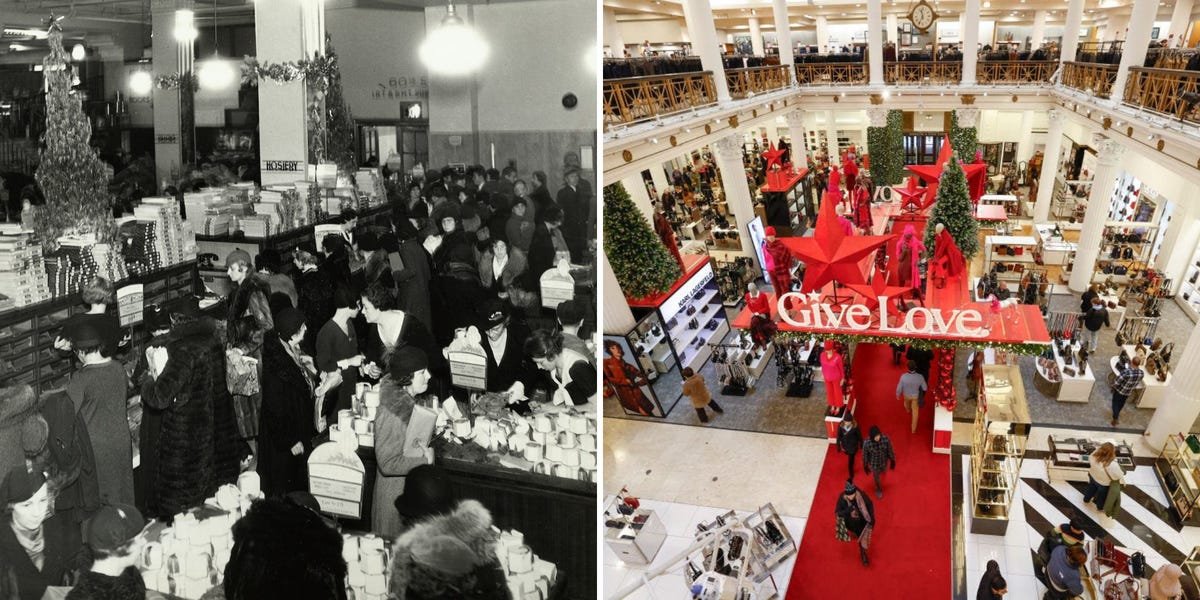
    Leading up to the 1930s, department stores were often crowded.


    An old photo of a crowded department store.

    A crowded department store.

    Bettmann/Getty Images

    Around 1929, people were encouraged to shop in order to help boost the nation’s sinking economy, Fortune reported.

    But that same year, the stock market crashed, and the Great Depression officially began. The period lasted for 10 years, causing major layoffs, failing banks, and mass poverty.

    Today’s department stores rarely see such large crowds, aside from major shopping events like Black Friday.


    Macy's on Black Friday/

    A Macy’s department store on Black Friday.

    Kamil Krzaczynski/Getty Images

    Even during major holiday sales, many modern shoppers still prefer to shop online from the comfort of their homes.

    In 2025, shoppers in the US were projected to spend a record $11.7 billion online on Black Friday, an 8.3% increase from 2024.

    It marked a contrast from the wild Black Friday scenes that could be seen in stores in the decade before the COVID-19 pandemic.

    In the 1920s, employees worked in department store basements to make change for cashiers upstairs.


    Making change for department store cashiers.

    The basement of a department store in the 1920s.

    Underwood Archives/Getty Images

    In large stores that existed across multiple floors, vacuum systems transported the change upstairs through tubes.

    None of those “tube rooms” are needed anymore, thanks to computers and credit cards.


    A Macy's cashier.

    A cashier at Macy’s.

    Kena Betancur/Getty Images

    Modern shoppers often don’t even have to interact with a cashier if they don’t want to. Instead, they can use touchscreen self-checkout machines to purchase products from many department stores.

    Starting in 1924, Macy’s celebrated the holidays with its first annual “Christmas Parade.”


    macy's first thanksgiving day parade

    A photo from the first parade was taken in 1924.


    Macy’s

    Live animals such as elephants were included in the early days of the Macy’s parade. Balloons depicting popular characters such as Mickey Mouse appeared a little later in the ’30s.

    The name has since been changed to the “Macy’s Thanksgiving Day Parade.”


    The Radio City Rockettes at the Macy's Thanksgiving Day Parade.

    The Radio City Rockettes at the Macy’s Thanksgiving Day Parade.

    Scott Gries/NBC via Getty Images

    Other aspects of the yearly tradition have also been changed. For example, live animals have been replaced with people dressed in costumes, and giant marching bands have become a staple. Tons of celebrities have also appeared on floats.

    Minimal merchandise was showcased in store window displays throughout the ’40s.


    department store display window

    A department store display window.

    Kirn Vintage Stock/Getty Images

    Beginning in the 1870s at Macy’s, some chain retailers in New York City have made it a tradition to decorate store-front windows each holiday season.

    There was some art to these displays, as props were placed alongside mannequins and merchandise to create a scene.

    Contemporary display windows are unlike anything of the past.


    A holiday display window at Macy's.

    A holiday display window at Macy’s.

    Nicolas Economou/NurPhoto

    Modern department stores often incorporate technology, moving props, and bright lights into window displays.

    As early as 1923, Barneys New York was a popular department store.


    barneys new york

    Barneys New York.

    Peter Morgan/AP

    Barneys New York was created by a man named Barney Pressman when he pawned his wife’s engagement ring and opened a shop on Seventh Avenue and 17th Street in New York City.

    By the ’60s, Barney’s son, Fred, had turned the location into a luxury store, and the company became a national sensation throughout the 1990s and 2000s. By 2019, there were 22 stores in the US.

    However, the chain faced difficulties and shuttered all stores in 2020.


    A closing sale at Barneys New York.

    A closing sale at Barneys New York.

    WWD/Penske Media via Getty Images

    Barneys New York filed for Chapter 11 bankruptcy in August 2019 and closed all remaining stores in February 2020.

    Bonwit Teller was once a prominent luxury department store with a flagship location in New York City.


    Bonwit Teller Department Store

    A Bonwit Teller department store.

    George Rinhart/Getty Images

    The store was known for selling a range of high-end women’s clothing inside a luxurious Art Deco building. It grew to more than a dozen locations across cities, including Chicago, Philadelphia, and Columbia, South Carolina.

    By 2000, every Bonwit Teller store had gone out of business.


    Bonwit Teller out of business

    Bonwit Teller’s closing sale.

    Barbara Alper/Getty Images

    In 1979, the Bonwit Teller company was sold from its original owners to outside corporations. Ten years later, in 1989, the store filed for bankruptcy and began shutting all of its stores, with its last location closing in 2000.

    While the flagship Bonwit Teller store would have been exempt from the closure, the building was purchased by Donald Trump in 1979, who demolished it to build Trump Tower.

    The Saks Fifth Avenue flagship store in New York City opened in 1924.


    Saks Fifth Avenue in New York City.

    Saks Fifth Avenue.

    Bettmann Archive/Getty Images

    Saks Fifth Avenue was once a bustling destination for luxury shoppers. At 650,000 square feet, the store spans an entire city block.

    Saks Global filed for bankruptcy on Tuesday.


    Saks Fifth Avenue.

    Saks Fifth Avenue in New York City.

    ANGELA WEISS/AFP via Getty Images

    Saks Global’s 2024 acquisition of Neiman Marcus for $2.7 billion left the company in debt and struggling to pay luxury vendors, some of whom have withheld inventory.

    Business Insider reporter Madeline Berg visited the Saks Fifth Avenue flagship store the day Saks Global announced it was filing for bankruptcy and found it to be “nearly empty” with little foot traffic.

    Share. Facebook Twitter Pinterest LinkedIn Tumblr Email
    Press Room

    Related Posts

    I’m a Travel Writer. Puerto Vallarta Is My Home Base and I Feel Safe

    February 24, 2026

    WBD Considers Partnering With David Ellison, Paramount Over Netflix

    February 24, 2026

    The Longest State of the Union Addresses in History, Ranked

    February 24, 2026
    Leave A Reply Cancel Reply

    LATEST NEWS

    I’m a Travel Writer. Puerto Vallarta Is My Home Base and I Feel Safe

    February 24, 2026

    WBD Considers Partnering With David Ellison, Paramount Over Netflix

    February 24, 2026

    $400 Million Suddenly Pulled From ETFs — Is Smart Money Quietly Exiting BTC?

    February 24, 2026

    The Longest State of the Union Addresses in History, Ranked

    February 24, 2026
    POPULAR
    Business

    The Business of Formula One

    May 27, 2023
    Business

    Weddings and divorce: the scourge of investment returns

    May 27, 2023
    Business

    How F1 found a secret fuel to accelerate media rights growth

    May 27, 2023
    Advertisement
    Load WordPress Sites in as fast as 37ms!

    Archives

    • February 2026
    • January 2026
    • December 2025
    • November 2025
    • October 2025
    • September 2025
    • August 2025
    • July 2025
    • June 2025
    • May 2025
    • April 2025
    • March 2025
    • February 2025
    • January 2025
    • December 2024
    • November 2024
    • April 2024
    • March 2024
    • February 2024
    • January 2024
    • December 2023
    • November 2023
    • October 2023
    • September 2023
    • May 2023

    Categories

    • Business
    • Crypto
    • Economy
    • Forex
    • Futures & Commodities
    • Investing
    • Market Data
    • Money
    • News
    • Personal Finance
    • Politics
    • Stocks
    • Technology

    Your source for the serious news. This demo is crafted specifically to exhibit the use of the theme as a news site. Visit our main page for more demos.

    We're social. Connect with us:

    Facebook X (Twitter) Instagram Pinterest YouTube

    Subscribe to Updates

    Get the latest creative news from FooBar about art, design and business.

    Facebook X (Twitter) Instagram Pinterest
    • Home
    • Buy Now
    © 2026 ThemeSphere. Designed by ThemeSphere.

    Type above and press Enter to search. Press Esc to cancel.