
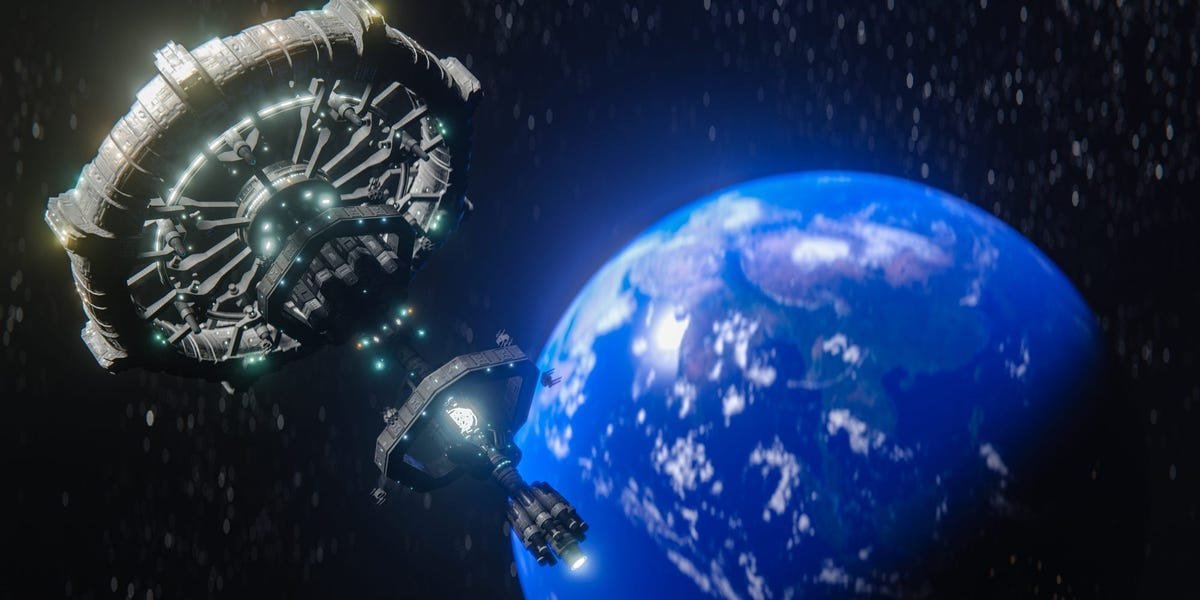
- Antimatter engines could be humanity’s ticket to interstellar travel.
- When antimatter particles come in contact with regular matter, it produces loads of energy.
- That energy, if we learn to harness it, could get us to Pluto in just a few weeks.

Interstellar travel is only something humanity has achieved in science fiction — like Star Trek’s USS Enterprise, which used antimatter engines to travel across star systems.
But antimatter isn’t just a sci-fi trope. Antimatter really exists.
Elon Musk has called antimatter power “the ticket for interstellar journeys,” and physicists like Ryan Weed are exploring how to harness it.
Antimatter is made up of particles almost exactly like regular matter but with opposite electric charge. That means when antimatter contacts regular matter, they both annihilate and can produce enormous amounts of energy.
“Annihilation of antimatter and matter converts mass directly into energy,” Weed, cofounder and CEO of Positron Dynamics, a company working to develop an antimatter propulsion system, told Business Insider.
Just one gram of antimatter could generate an explosion equivalent to a nuclear bomb. It’s that kind of energy, some say, that could boldly take us where no one has gone before at record speed.
Space travel at record speed
European Southern Observatory
The benefit of all that energy is that it can be used to either accelerate or decelerate spacecraft at break-neck speeds.
For example, let’s take a trip to our nearest star system, Proxima, about 4.2 light years away.
An antimatter engine could theoretically accelerate a spacecraft at 1g (9.8 meters per second squared) getting us to Proxima in just five years, Weed said in 2016. That’s 8,000 times faster than it would take Voyager 1 — one of the fastest spacecraft in history — to travel about half the distance, according to NASA.
Even within our own solar system, an antimatter-powered spacecraft could reach Pluto in 3.5 weeks compared to the 9.5 years it took NASA’s New Horizons probe to arrive, Weed said.
Why we don’t have antimatter engines
Brice, Maximilien/CERN
The reason we don’t have antimatter engines, despite their tremendous capabilities, comes down to cost, not tech.
Gerald Jackson, an accelerator physicist who worked on antimatter projects at Fermilab, told Forbes in 2016 that with enough funding, we could have an antimatter spacecraft prototype within a decade.
The basic technology is there. Physicists armed with the world’s most powerful particle accelerators have made antiprotons and antihydrogen atoms.
The issue is that this type of antimatter is incredibly expensive to make. It’s considered the most expensive substance on Earth. Jackson gave us an idea of just how much an antimatter machine would cost to build and maintain.
Jackson is the founder, president, and CEO of Hbar Technologies, which is working on a concept for an antimatter space sail to decelerate spacecraft traveling 1% to 10% the speed of light — a useful design for entering into orbit around a distant star, planet, or moon that you want to study.
Jackson said he’s designed an asymmetric proton collider that could produce 20 grams of antimatter per year.
“For a 10-kilogram scientific package traveling at 2% of the speed of light, 35 grams of antimatter is needed to decelerate the spacecraft down and inject it into orbit around Proxima Centauri,” Jackson told BI.
He said it would take $8 billion to build a solar power plant for the enormous energy needs of antimatter production and cost $670 million per year to operate.
The idea is just that, for now. “There is currently no serious funding for advanced space propulsion concepts,” Jackson said.
However, there are other ways to produce antimatter. That’s where Weed focused his work.
Weed’s concept involves positrons, the antimatter version of an electron.
A different kind of antimatter engine
NASA
Positrons “are several thousand times lighter than antiprotons and don’t pack quite as much punch when annihilating,” Weed said.
The advantage, however, is that they occur naturally and don’t need a giant accelerator and billions of dollars to make.
Weed’s antimatter propulsion system is designed to use krypton-79 — a form of the element krypton that naturally emits positrons.
The engine system would first gather high-energy positrons from krypton-79 and then direct them toward a layer of regular matter, producing annihilation energy. That energy would then trigger a powerful fusion reaction to generate thrust for the spacecraft.
While positrons may be less expensive to obtain than more powerful forms of antimatter, they are difficult to harness because they are highly energetic and need to be slowed down, or “moderated.” So building a prototype to test in space is still beyond reach, cost-wise, Weed said.
Such is the case for all antimatter propulsion designs. Over the decades, scientists have proposed dozens of concepts, none of which have come to fruition.
For example, in 1953, Austrian physicist Eugen Sänger proposed a “photon rocket” that would run on positron annihilation energy. And since the ’80s, there’s been talk of thermal antimatter engines, which would use antimatter to heat liquid, gas, or plasma to provide thrust.
“It’s not sci-fi, but we aren’t going to see it flying until there is a significant ‘mission-pull,'” Weed said about his engine concept.
Can it work?
All About Space Magazine / Contributor / Getty Images
To build Weed’s concept at the scale of a starship, “the devil’s in the engineering details,” Paul M. Sutter, an astrophysicist and host of “Ask a Spaceman” podcast, told BI.
“We’re talking about a device that harnesses truly enormous amounts of energy, requiring exquisite balance and control,” Sutter said.
In general, that enormous energy is another obstacle holding us back from revolutionizing space travel. Because during testing, “if something goes wrong, these are big explosions,” Steve Howe, a physicist who worked on antimatter concepts with NASA in the ’90s, told BI.
“So we need an ability to test high energy density systems somewhere that don’t threaten the biosphere, but still allow us to develop them,” said Howe, who thinks the moon would make a good testing base. “And if something goes wrong, you melted a piece of the moon,” and not Earth, he added.
Antimatter tends to bring out the imagination in everyone who works on them. “But, we need crazy but plausible ideas to make it further into space, so it’s worth looking into,” Sutter said.
Weed echoes the sentiment, saying “until there is a compelling reason to get to the Kuiper Belt, the Solar Gravitational Lens, or Alpha Centauri really quickly — or perhaps we are trying to return large asteroids for mining — progress will continue to be slow in this area.”
