
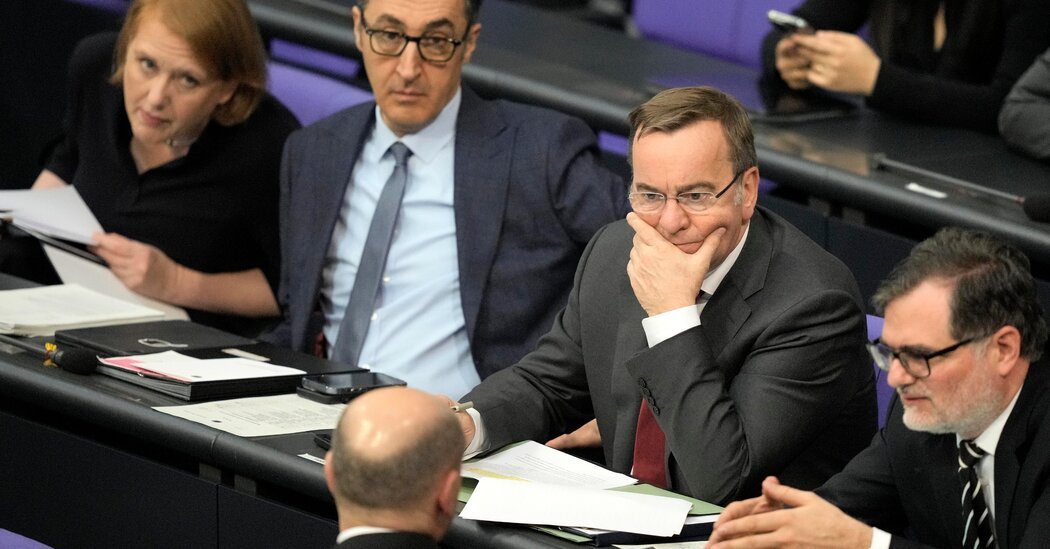
Defense Minister Boris Pistorius has begun warning Germans that they should prepare for decades of confrontation with Russia — and that they must speedily rebuild the country’s military in case Vladimir V. Putin does not plan to stop at the border with Ukraine.
Russia’s military, he has said in a series of recent interviews with German news media, is fully occupied with Ukraine. But if there is a truce, and Mr. Putin, Russia’s president, has a few years to reset, he thinks the Russian leader will consider testing NATO’s unity.
“Nobody knows how or whether this will last,” Mr. Pistorius said of the current war, arguing for a rapid buildup in the size of the German military and a restocking of its arsenal.
Mr. Pistorius’s public warnings reflect a significant shift at the top levels of leadership in a country that has shunned a strong military since the end of the Cold War. The alarm is growing louder, but the German public remains unconvinced that the security of Germany and Europe has been fundamentally threatened by a newly aggressive Russia.
The defense minister’s post in Germany is often a political dead end. But Mr. Pistorius’s status as one of the country’s most popular politicians has given him a freedom to speak that others — including his boss, Chancellor Olaf Scholz — do not enjoy.
As Mr. Scholz prepares to meet President Biden at the White House on Friday, many in the German government say that there is no going back to business as usual with Mr. Putin’s Russia, that they anticipate little progress this year in Ukraine and that they fear the consequences should Mr. Putin prevail there.
Those fears have now mixed with discussions about what will happen to NATO if former President Donald J. Trump is elected and has a second chance to act on his instinct to pull the United States out of the alliance.
The prospect of a re-elected Mr. Trump has German officials and many of their fellow NATO counterparts informally discussing whether the nearly 75-year-old alliance structure they are planning to celebrate in Washington this year can survive without the United States at its center. Many German officials say that Mr. Putin’s best strategic hope is NATO’s fracture.
For the Germans in particular, it is an astounding reversal of thinking. Only a year ago NATO was celebrating a new sense of purpose and a new unity, and many were confidently predicting Mr. Putin was on the run.
But now, with an undependable America, an aggressive Russia and a striving China, as well as a seemingly stalemated war in Ukraine and a deeply unpopular conflict in Gaza, German officials are beginning to talk about the emergence of a new, complicated and troubling world, with severe consequences for European and trans-Atlantic security.
Their immediate concern is growing pessimism that the United States will continue to fund Ukraine’s struggle, just as Germany, the second-largest contributor, has agreed to double its contribution this year, to about $8.5 billion.
Now, some of Mr. Pistorius’s colleagues are warning that if American funding dries up and Russia prevails, its next target will be closer to Berlin.
“If Ukraine were forced to surrender, that would not satisfy Russia’s hunger for power,” the chief of Germany’s intelligence service, Bruno Kahl, said last week. “If the West does not demonstrate a clear readiness to defend, Putin will have no reason not to attack NATO anymore.”
But when they are pressed about a possible conflict with Russia, or the future of NATO, German politicians speak carefully.
In the decades since the Soviet Union collapsed, most Germans have grown accustomed to the notions that the country’s security would be assured if it worked with Russia, not against it, and that China is a necessary partner with a critical market for German automobiles and equipment.
Even today, Mr. Scholz, a Social Democrat whose party traditionally sought decent ties with Moscow, seems reluctant to discuss the far more confrontational future with Russia or China that German defense and intelligence chiefs describe so vividly.
With the exception of Mr. Pistorius, little known before he was picked to run the Defense Ministry a year ago, few politicians will take on the subject in public. Mr. Scholz is especially careful, tending to Germany’s relationship with the United States and wary of pushing Russia and its unpredictable president too hard.
Two years ago, he declared a new era for Germany — a “Zeitenwende,” or a historic turning point, in German security policy, one that he said would be marked by a significant shift in spending and strategic thinking. He made good on a promise to allocate an extra 100 billion euros for military spending over four years.
This year, for the first time, Germany will spend 2 percent of its gross domestic product on the military, reaching the goal that all NATO countries agreed to in 2014, after the Russian annexation of Crimea, but that most experts warn is now too low. And Germany has committed to beefing up NATO’s eastern flank against Russia by promising to permanently station a brigade in Lithuania by 2027.
Yet in other ways, Mr. Scholz has moved with great caution. He has opposed — along with Mr. Biden — setting a timetable for Ukraine’s eventual entry into the alliance.
The most vivid example of his caution is his continued refusal to provide Ukraine a long-range, air-launched cruise missile called the Taurus.
Last year, Britain and France gave Ukraine their closest equivalent, the Storm Shadow/SCALP, and it has been used to devastate Russian ships in Crimean ports — and to force Russia to pull back its fleet. Mr. Biden reluctantly agreed to provide ATACMS, a similar missile though with a range limited to about 100 miles, to Ukraine in the fall.
The Taurus has a range of more than 300 miles, meaning Ukraine could use it to strike deep into Russia. And Mr. Scholz is not willing to take that chance — nor is the country’s Bundestag, which voted against a resolution calling for the transfer. While the decision seems to fit German opinion, Mr. Scholz wants to avoid the subject.
But if he remains reluctant to push Mr. Putin too hard, it is a caution Germans share.
Polls show that Germans want to see a more capable German military. But only 38 percent of those surveyed said they wanted their country to be more involved in international crises, the lowest figure since that question began to be asked in 2017, according to the Körber Foundation, which conducted the survey. Of that group, 76 percent said the engagement should be primarily diplomatic, and 71 percent were against a military leadership role for Germany in Europe.
German military officials recently set off a small outcry when they suggested that the country must be “kriegstüchtig,” which roughly translates to the ability to fight and win a war.
Norbert Röttgen, an opposition legislator and a foreign policy expert with the Christian Democrats, said the term was regarded as “rhetorical overreach” and quickly dropped.
“Scholz has always said that ‘Ukraine must not lose but Russia must not win,’ which indicated that he’s always thought of an impasse that would lead to a diplomatic process,” Mr. Röttgen said. “He thinks of Russia as more important than all the countries between us and them, and he lacks a European sense and of his possible role as a European leader.”
Mr. Röttgen and other critics of Mr. Scholz think he is losing a historic opportunity to lead the creation of a European defense ability that is far less dependent on the American military and nuclear deterrent.
But Mr. Scholz clearly feels most comfortable relying heavily on Washington, and senior German officials say he especially mistrusts Emmanuel Macron, the president of France, who has argued for European “strategic autonomy.” Mr. Macron has found few followers on the continent.
Even Mr. Scholz’s main European defense initiative, a coordinated ground-based air defense against ballistic missiles known as Sky Shield, depends on a mix of American, American-Israeli and German missile systems. That has angered the French, Italians, Spanish and Poles, who have not joined, arguing that an Italian-French system should have been used.
Mr. Scholz’s ambitions are also hamstrung by his increasingly weak economy. It shrank 0.3 percent last year, and roughly the same is expected in 2024. The cost of the Ukraine war and China’s economic problems — which have hit the auto and manufacturing sectors hardest — have exacerbated the problem.
While Mr. Scholz acknowledges that the world has changed, “he is not saying that we must change with it,” said Ulrich Speck, a German analyst.
“He is saying that the world has changed and that we will protect you,” Mr. Speck said.
But doing so may well require far more military spending — upward of 3 percent of Germany’s gross domestic product. For now, few in Mr. Scholz’s party dare suggest going that far.
Germans, and even the Social Democrats, “have come to the realization that Germany lives in the real world and that hard power matters,” said Charles A. Kupchan, a Europe expert at Georgetown University.
“At the same time,” he said, “there’s still this hope that this is all just a bad dream, and Germans will wake up and be back in the old world.”
