
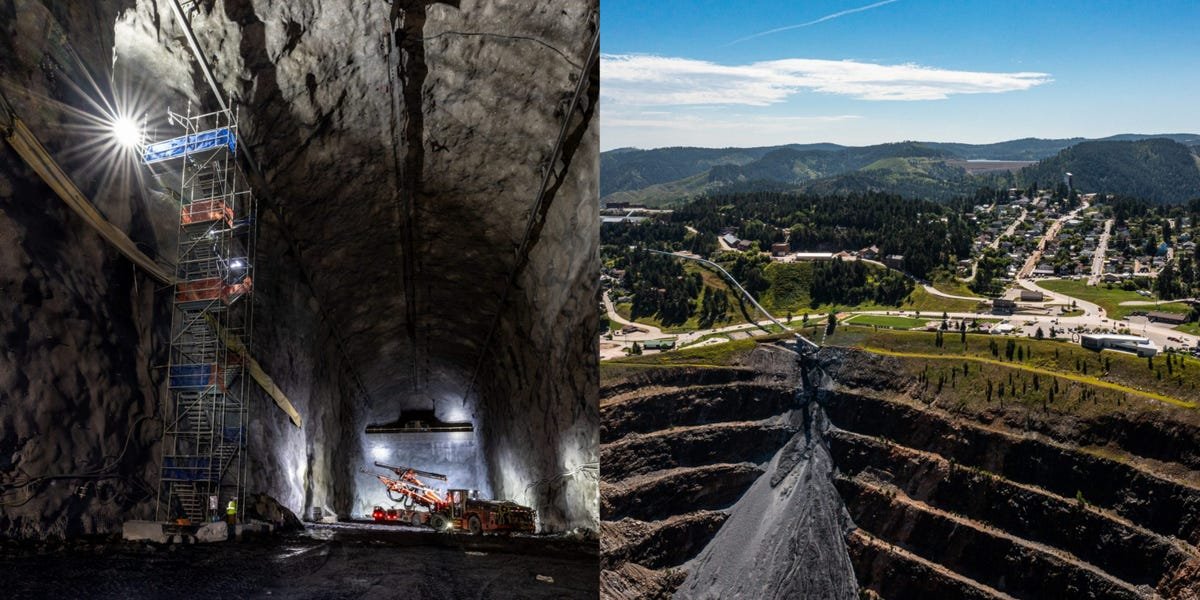
Nearly seven years ago, crews started hauling 800,000 tons of rock out of a former gold mine near Lead, South Dakota.
The three resulting, underground caverns are 500 feet long and almost tall enough to hold a seven-story building.
Estimated to cost at least $3 billion, the project DUNE (Deep Underground Neutrino Experiment), is led by scientists at the US Department of Energy’s Fermilab.
Eventually, each cavern will hold 17,500 tons of liquid argon to help Fermilab physicists detect elusive particles known as neutrinos, aka “ghost particles.”
Neutrinos are subatomic particles all around you, passing straight through you, unnoticed. The sun creates them; supernovae make them; even bananas produce neutrinos.
“If you hold your hand up, there are 10 billion neutrinos from the sun going through your hand,” every second, physicist Mary Bishai and spokesperson for DUNE, told Business Insider.
Neutrinos are nicknamed ghost particles because they lack an electric charge and therefore rarely interact with anything they come into contact with.
This also makes them extremely difficult to study, yet scientists persist nonetheless because neutrinos may hold the key to unveiling the secrets of the universe, from what happened just after the Big Bang to observing the birth of a black hole.
A neutrino beam between Illinois and South Dakota
Studying a particle that doesn’t emit radiation and is lighter than an electron is difficult. “Neutrino interactions are almost needles in a haystack,” Bishai said.
And Fermilab scientists want to study neutrinos in unprecedented detail, like never before, with DUNE.
That’s why DUNE will have the largest neutrino detectors of their type ever built.
Once complete, the experiment is designed to start with a series of particle accelerators at Fermilab outside Chicago, Illinois.
The accelerators will fire an extremely powerful beam of neutrinos first through a detector at Fermilab. The beam will then travel underground for 800 miles to the detectors at the South Dakota Sanford Underground Research Facility.
Along the way, the neutrinos will do something somewhat strange. There are three types of neutrinos, and the particles can switch back and forth between them, a phenomenon known as oscillation. One Fermilab scientist compared it to a house cat transforming into a jaguar and then a tiger before returning to its original shape.
Tracking how the neutrinos change over such long distances between Illinois and South Dakota will help scientists understand these oscillations better by giving them a more complete view than Fermilab’s current 500-mile NOvA experiment between Illinois and Minnesota.
Doing all of this a mile underground protects the delicate, oscillating particles from energetic cosmic rays that shower Earth’s surface every second and could interfere with the data.
Solving the mysteries of the universe
Scientists hope to answer three main questions with DUNE: why the universe is made up of matter instead of antimatter, what happens when a star collapses, and do protons decay?
“Right after the Big Bang, matter and antimatter were created almost an equal amount,” Bishai said. But today, from what scientists can tell, the universe is made almost entirely of matter.
“Why did we end up with a matter universe, not an antimatter universe?” she added.
DUNE’s beam is designed to create both neutrinos and antineutrinos — the antimatter version. Looking at the oscillations in each type may help scientists figure out what happened to all the antimatter.
The project is also set up for supernova physics, Bishai said.
In 1987, astronomers witnessed a bright supernova exploding closer than any had in about 400 years. With the detectors in place at the time, they were only able to detect around a couple dozen neutrinos.
There’s a 40% chance of another nearby star exploding in the next decade, Bishai said, and Fermilab hopes at least one of its South Dakota detectors will be up and running in time.
Such a large detector could capture thousands of neutrinos and give insights into how both black holes and neutron stars form.
Finally, scientists haven’t yet seen protons decay, but theory predicts that they should. Protons are tiny, positively charged particles that are part of the nucleus of an atom.
Observing proton decay would have implications for Albert Einstein’s belief that a single theory could unify all forces in nature.
If protons do decay, it would take roughly 10 billion, trillion, trillion years. But neutrino detectors can look for different signatures of proton decay, Bishai said. “We would have a chance of seeing them, if these grand unified theories are correct.”
An ambitious project
There are currently several neutrino projects around the world, including at the Japan Proton Accelerator Research Complex (J-PARC) and the European Organization for Nuclear Research (CERN).
What makes DUNE unique is its use of argon and the lengthy distance between its near and far detectors.
The project has had some budget and timeline setbacks, Scientific American reported in 2022. It’s supposed to have four argon detectors but will start with two.
The first could be up and running by the end of 2028, Bishai said, with the second detector following the next year. Those will be in place in case a supernova explodes, but the beam portion won’t be ready until 2031.
That said, Bishai thinks the project has already achieved one of its biggest accomplishments, a collaboration of about 1,400 people from 36 countries. “It’s big science,” she said. “It’s also big international science.”
