
Inclusion and openness
In Part 1, I wrote about Don Lavoie’s argument that robust liberalism requires open (democratic) politics that can make useful the tacit, dispersed knowledge of voters’ “interests, concerns, and demands to provide governance structures that people will use to resolve political disagreements peacefully.” Liberalism requires open democracy just as it requires open markets, for many of the same reasons.
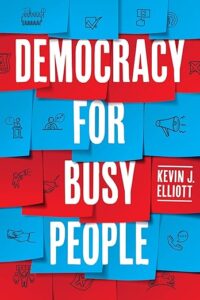
It would be hard to find a better place to go next than Kevin J. Elliott’s Democracy for Busy People.
Elliott, a political scientist at Yale, riffs twice on the late political theorist Judith Shklar to make a case for “putting inclusion first”—making inclusion the first (but not the only) consideration when thinking about democratic theory. His argument complements Lavoie’s concerns about “openness.”
Democratic inclusion matters to Elliott because of his commitment to political equality. He also argues that externalities and associated injustice result from political apathy. By apathy, Elliott does not mean indifference or ignorance but complete inattentiveness to politics—not even being aware of the actions, good or bad, of the government or the challenges facing people in a government’s jurisdiction.
Inclusion matters more than equality because equal but exclusive politics, such as in Athenian democracy or an “epistocratic” system, creates a whole category of unrepresented people. Unrepresented people depend on politically empowered people to a) know best what the disenfranchised want and need and b) actually pursue those things on behalf of the disempowered. In other situations, classical liberals may point out that no one knows better than individuals what they want and need.
Adam Smith warns how feeble is the spark of benevolence when expected to counter the force of self-love. The value of control over political institutions creates a political “rent” that can be used to secure economic rents. This creates an incentive for those with representation to restrict access to it. Straightforward rent-seeking arguments lead us to expect the enfranchised to preserve their special access. Special political power allows those who hold it to extract politically what would be harder to secure economically from (and at the expense of) the disenfranchised.
In an inclusive political system, people can advocate for themselves. Even when there is inequality, so long as people are allowed to represent themselves, there is a path toward representation through sheer numbers that simply does not exist without inclusion.
Demanding democracy
Lavoie was an anarchist, and so he proposed expanding the openness of democracy by doing away with its reliance on government elections. Lavoie worried about the meaning of elections and observed that the mere presence of something called an election is insufficient for democracy without openness and publicness.
Instead, Lavoie suggested a radical expansion of our conception of democratic politics beyond voting to encompass an ongoing public discourse about rights and responsibilities across public life.
In Lavoie’s conception, the appropriate grounds for democratic participation include:
- all conversations about rights and responsibilities and public contestations (advocacy and protest efforts) that form public opinion/political culture, and
- all open institutions that incorporate the revealed preferences of citizens (the common law, market outcomes).
Political institutions can make inclusive democracy easier or harder to achieve. If it’s true that wider participation is better for democracy, and that democracy is crucial to liberalism, then Lavoie falls short when he fails to anticipate problems with such a demanding model of democracy.
Elections might be both insufficient and essential for democratic inclusion. Representative government has a key benefit over Lavoie’s model: it dramatically lowers the demands of politics on ordinary people. The demandingness of Lavoie’s conception of democratic institutions would make those institutions an effective barrier to entry into democratic politics. Such a demanding democracy should be expected not to encourage but to frustrate openness. People are political, yes, and politics are important. But people are not only political, and politics is not all there is.
Kevin J. Elliott to the rescue.
Real-life barriers to political inclusion
One of the most valuable insights from Democracy for Busy People is Elliott’s discussion of busyness and what he calls the paradox of empowerment. These are simple, important ideas.
Busyness is unavoidable: people have to go to and from work; children have to be tended to; emotional exhaustion—from poverty, discrimination, tragedy, or trauma, or even something as banal as difficult neighbours—also takes up time. Elliott doesn’t put it this way, but busyness follows directly from opportunity costs.
People have—and have a right to have—non-political demands on their time, and the demandingness of politics gives citizens a claim against a too-demanding democratic system. Busy people are a fact of life, so a democratic system that is too demanding to include busy people will fail to prioritize inclusion and openness.
The paradox of empowerment is more complicated, but obvious once it’s explained. A democratic system cannot increase the participation of busy people by adding more ways to participate. Someone who can’t make time to vote in regular elections won’t become more involved if they also have the opportunity to attend meetings or vote on more issues directly. They don’t even have time to vote! The people looking for more ways to spend time and resources on politics become more disproportionately influential.
No matter what their intention, democratic innovations that add more ways to participate without reducing the demandingness of politics continue to exclude those who are already underrepresented. More demandingness from politics further empowers those who already have the time, expertise, money, and inclination to participate.
Lavoie’s vision of radically expanded democracy suffers badly from its lack of consideration for busyness and the paradox of empowerment. A system in which everyone constantly participates in conversations contesting and establishing our rights and responsibilities might be “open” in an ideal world. But in this world, busyness and the importance of our lives beyond politics means that Lavoie’s proposed system would produce exclusive politics and empower those who are already over-represented while neglecting normal people with more demands on their time.
Lavoie’s vision of democracy therefore can’t solve the problem of balancing interests and values to secure the buy-in and legitimacy that allow democracy to deliver political peace.
In contrast, Elliott proposes a model he calls “stand-by citizenship.” Stand-by citizenship has three requirements: habitual attention to politics, knowledge of how to participate, and the ability to ramp-up involvement when needed. Awareness of politics ensures that citizens monitor their government and hold elected officials accountable. It also allows citizens to determine whether they consider political participation worthwhile.
With habitual attention, government accountability becomes a small part of day-to-day life rather than a demand for in-depth resources and attention. Habitual attention is a common feature in Lavoie’s and Elliott’s democratic visions, but in Elliott’s conception, the division of democratic labour and the specialization that follows from it relieves ordinary people of much of the burden of democratic governance. For example, some people become elected representatives, others learn about and advocate in the policy areas they consider most important, still others specialize in civic education more broadly.
Nuts-and-bolts knowledge of the political system gives political awareness teeth. Civic knowledge ensures that citizens understand what is politically possible and that their dissatisfaction can be backed by political action. People without civic knowledge are also more vulnerable to demagoguery—they are less able to gauge whether the often vague political aspirations encouraged by charismatic leaders are realistic.
Knowledge of political systems allows every citizen to represent themselves and their political groups, making self-interest an important force supporting political representation.
Finally, the ability to ramp up political involvement, rather than a demand for unceasing, intensive political engagement, limits the demands democracy puts on most citizens most of the time.
This much less demanding model for democratic citizenship prioritizes openness. And it recognizes the problem that democracy solves. It provides a firmer foundation for liberals committed to democratic openness in a world that seems ready to step back from democracy, markets, and liberalism.
Read more:
Socialist Fantasies by Sarah Skwire
Why Libertarians Distrust Political Power by Steve Horwitz
Intellectual Portrait Series: An Interview with James M. Buchanan
Janet Bufton is an educational consultant and copy editor in Ottawa, Ontario, working primarily on projects involving Adam Smith, trade and regulatory policy, and Indigenous and labour market economics.
