

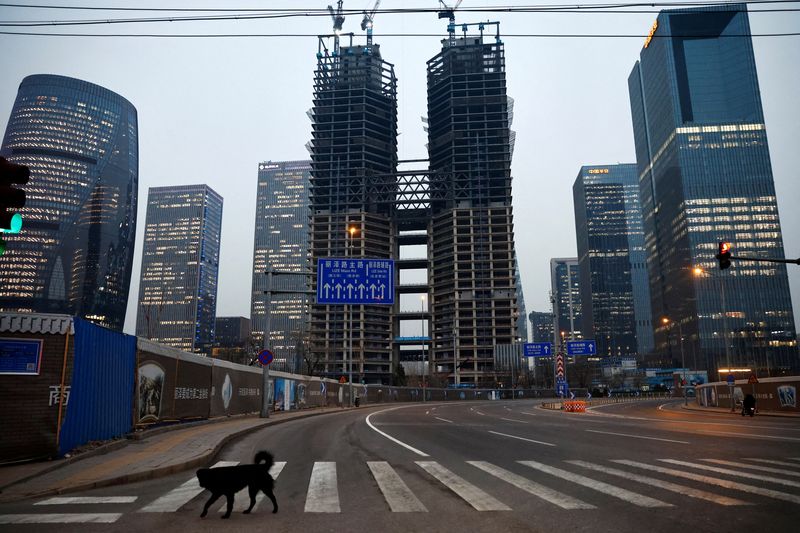
© Reuters. FILE PHOTO: A dog crosses a road at a financial district with buildings under construction, in Beijing, China January 11, 2023. REUTERS/Tingshu Wang
By Mike Dolan
LONDON (Reuters) – Even allowing for China’s messy cyclical ebb and flow and global political tensions of the day, the exit of long-term foreign capital from the world’s second-biggest economy is startling.
China’s spluttering post-Covid recovery this year and the depth of its unfolding property bust has reasonably seen a dramatic underperformance of Chinese markets – compounded by geopolitical posturing that’s sowing long-term doubts about both domestic regulation and the country’s strategic orientation.
Tactical traders desperate to retain a presence in the giant Chinese economy and hungry for “cheap” valuations in a relatively expensive global marketplace continue to tout its attractions and predict turning points.
But the exit of longer-term investors paints a far more worrying picture and suggests deeper-seated concerns.
A survey by the Official Monetary and Financial Institutions Forum of 22 public pension and sovereign wealth funds managing $4.3 trillion in assets showed not one had a positive outlook for China’s economy or saw higher relative returns there. Three-quarters of them cited regulation and geopolitics as chief deterrents.
Preferring to concentrate on inflation-proofing portfolios over the next two years, mainly via infrastructure investments or “green” assets, almost a third of these gigantic funds plan to increase allocations to Europe and North America. They showed little or no appetite to boost emerging market holdings at large.
Even within existing emerging market exposure, India was now identified as the most favoured play. And Brazil was seen on par with China, where 80% said their only exposure was now solely due to its inclusion in benchmark indexes.
With an otherwise huge focus on green investments and the energy transition, that aversion toward emerging markets may seem at odds with climate concerns.
But the extent of the political and economic jitters merely mirrors other signs of a long-term China exit well beyond portfolio flows.
Earlier this month, China recorded its first-ever quarterly deficit in “bricks and mortar” foreign direct investment (FDI).
Direct investment liabilities – a broad measure of FDI that includes foreign companies’ retained earnings in China – were in deficit to the tune of $11.8 billion in the July-September period.
That was the first quarterly shortfall since China’s foreign exchange regulator began compiling the data in 1998 and likely was linked to the impact of “de-risking” by Western countries from China, as well as China’s interest rate discount.
And the number reflects comments earlier this year from U.S. Commerce Secretary Gina Raimondo, who in a tense trip to Beijing claimed many U.S. businesses now saw China as “uninvestable”.
‘MORE THAN WORDS’
Nicholas Lardy, a non-resident senior fellow at the Peterson Institute for International Economics in Washington, points out the data imply foreign firms in China are not only declining to reinvest earnings but – for the first time – are large net sellers of existing investments to Chinese companies and are repatriating the funds.
Those outflows, estimates Lardy, exceeded $100 billion in the first three quarters of 2023.
Alongside the global tensions, regulatory crackdowns and cross-border investment curbs that affected new equity listings and mergers and acquisitions, Lardy points to Beijing’s closure of foreign consultancy and due diligence firms critical to foreigners’ evaluation of potential new investments.
Chinese President Xi Jinping’s assertion in San Francisco this month that China’s modernisation offers huge opportunity for the world will do little to revive the net FDI inflows the country has enjoyed for more than four decades, Lardy said.
“A safe assumption is that it will take more than words to accomplish this objective,” he wrote.
What’s more, a multi-year aversion to China investments then risks colliding with deteriorating long-term economic growth dynamics – heightened by rising youth unemployment and dire demographics.
So what of the cyclical economy in the short term and “cheap” assets?
Despite some recent upgrades of China growth forecasts, yet another business survey this week raised red flags. Manufacturing activity shrank for a second straight month in November and at a quicker pace, suggesting ever more stimulus will be needed to restore confidence.
And much of the shorter-term debate then returns to what level of government support is yet needed and what is coming – and what it can do to put a line under the real estate crash.
No surprise then that easier credit forms a centrepoint of any short-term trading opportunities being discussed.
But, as Morgan Stanley strategists point out, there may be no obvious quick fix for the property bust.
“There is no easy way out of the housing conundrum, or any deleveraging crisis: losses need to be recognised, bad debts need to be restructured and new equity support – or a bailout – might be needed to limit the scope of ‘collateral damage’ as some undershooting is often inevitable,” they said.
That then leaves any value hunters skulking on the sidelines even if, as Morgan Stanley’s team suggests, there’s “a bias to get more constructive” on China from some investors.
And despite that short-term bias, it acknowledges “the conviction is very low.”
Turning longer-term funds around may take much longer still – and possibly require the sort of political changes Beijing itself may not even be willing to make.
The opinions expressed here are those of the author, a columnist for Reuters
(By Mike Dolan; Editing by Paul Simao)
