
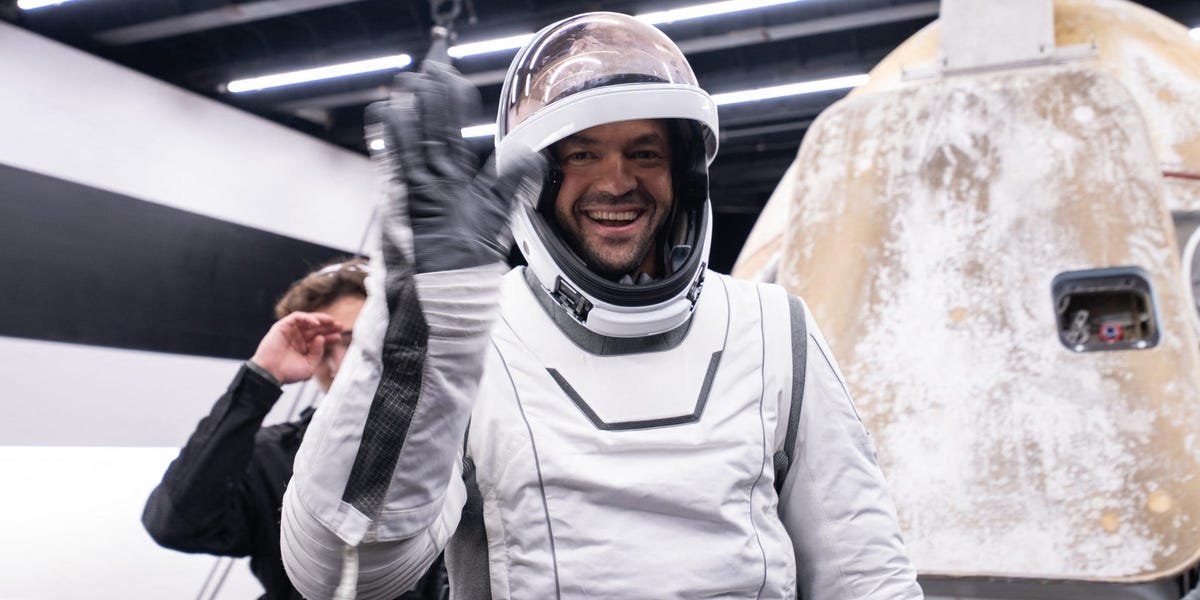
- Jared Isaacman led the first private space walk during SpaceX’s Polaris Dawn mission.
- The mission broke NASA’s Earth orbit record and tested new Starlink communication technology.
- He talked with BI about the experience, what felt different during his second space mission, and the challenges of living off-world.

Jared Isaacman’s second trip to space felt different.
The billionaire CEO of the payments company Shift4 made history two months ago when he opened up the hatch on a SpaceX rocketship and stepped into outer space. The moment marked the first-ever private space walk.
“There’s nothing that’s separating you from the vacuum of death other than the single-pane visor,” Isaacman told Business Insider.
That single-pane visor was part of SpaceX’s new extravehicular activity spacesuits — which Isaacman said “essentially becomes your spaceship — that the four-person crew tested out during its nearly five-day Polaris Dawn mission. In the event that anything went wrong, Isaacman and his crew member, SpaceX engineer Sarah Gillis, only had about two hours of oxygen reserved.
“Everything in that environment is trying to kill you,” Isaacman said. “The radiation, the lack of a habitable atmosphere, there’s debris that’s traveling at many times the speed of bullets.”
The hatch was open for 25 minutes, Isaacman said, during which he and Gillis each spent around eight minutes outside the capsule. The time went by quickly, he said, but they were able to complete a test matrix of three suit mobility demonstrations.
Isaacman likened looking out into the unknown darkness in space to traveling overseas in the 1400s, when humans may have feared sailing off the end of the Earth or encountering some kind of mythical sea monster.
He said being outside the SpaceX Dragon capsule felt “very different” than looking through its window, with an intensity of light coming off of Earth that “no video can capture.”
“You have all these extra senses kind of fusing together and you get, I think, more of an appreciation for just how hostile and unwelcoming Space is,” Isaacman said.
The spacewalk itself, which occurred at altitudes up to 460 miles above the Earth, went as expected. The Polaris Dawn crew carried out around 38 science and research experiments to test the impact of radiation on the human body, contributing to SpaceX’s goal to learn more about long-duration human missions to Mars and beyond.
“The goal was to learn a lot about the mobility of the suit and was also to learn a lot about thermal regulation of the suit, big temperature swings,” Isaacman said.
The SpaceX mission, Isaacson’s second trip to space with the rocket company cofounded by Elon Musk, required flying through risky radiation belts.
It surpassed NASA’s record for the highest Earth orbit and went further into space than humans have traveled since the Apollo 17 mission in 1972. The crew also transmitted the first violin performance in space using Starlink technology.
In a Netflix docuseries about Isaacman’s first SpaceX mission, Inspiration4, his wife describes worrying about what could go wrong. This time around, with Polaris Dawn, those concerns seemed to improve, Isaacman said.
“I think my family and my wife, specifically, were much more charged up and enthusiastic than they were the first time,” he told BI.
Isaacman attributed some of that increased ease to a successful first mission.
The team prepped extensively for Polaris Dawn, spending hundreds of hours in pressurized suit testing. The SpaceX suits were tested in a vacuum chamber at NASA’s Johnson Space Center, which Isaacman said was important to make sure none of the materials would “create a toxic environment or explode.”
screenshot/Polaris Program
Re-entry into Earth’s atmosphere, even with the prep and training from SpaceX, remained a point of nervousness. If there is a problematic amount of debris damage to the heat shield or thermal protection systems, there’s “no backup plan,” Isaacman said.
The CEO said that while he and his family recognize the risks, they keep the mindset that it’s worth it.
He’s going back — and expects breakthroughs are ‘right around the corner’
Once he landed back on Earth, Isaacman went through about three days of medical tests before largely resuming business as usual.
He’s been on the road a lot, visiting facilities and doing debriefs, and estimates he’s only slept in his bed four or five times since his journey to space.
Isaacman has maintained his role as CEO, which he said helps make his work with St. Jude and SpaceX possible. Isaacman funded both Polaris Dawn and his previous mission with SpaceX. The first mission raised over $240 million for St. Jude and was named Inspire4 in an effort to inspire support for the hospital.
His time in space isn’t over yet though — the Polaris Program is intended to be three missions mapped out over the next six to nine years, Isaacman said. He said he expects more progress on suit development in the second Polaris mission and the third will be the first crewed flight of SpaceX’s Starship, the most powerful rocket system ever built that was designed to realize Musk’s dreams of settling Mars.
Isaacman shares the SpaceX cofounder’s view that humans will be multiplanetary — and he said the technological means to make it possible are “right around the corner.” He anticipates fully reusable Starships becoming a tangible reality within the next decade and launching on a frequent basis, whether it be every week or month. That could lead to all sorts of space-related experimentation including asteroid mining or the establishment of bases on the moon or Mars, Isaacman said.
However, the challenges don’t end with the formation of an off-world base — you have to ensure the astronauts maintaining it stay alive and sane, he said.
“Actually having a civilization that can be successful and thrive in space is a much different set of problems,” Isaacman said.
Roughly half the people who go to space get sick, he said. Following the landing, Isaacman said one of his SpaceX crew members experienced a minor case of spaceflight-associated neuromuscular syndrome, which impacts vision. While the symptoms subsided shortly after, he pointed to it as an example of some of the health risks people face when venturing into space.
There’s also never been surgery or childbirth in space, and the psychological challenges of living away from Earth, Isaacman said.
“You’re gonna be in a bubble or living in a cave, or underground on Mars for the entire time you’re there,” Isaacman said. “We’ll never get better than that. So there’s a lot of things that need to be solved.”
While humans don’t have it quite figured out yet, Isaacman sees a future where humans walk on Mars.
“We just got to proceed with caution and just make sure we get it right,” Isaacman said. “And if we do, we stand to learn so much that can change the course of trajectory of humankind.”
