
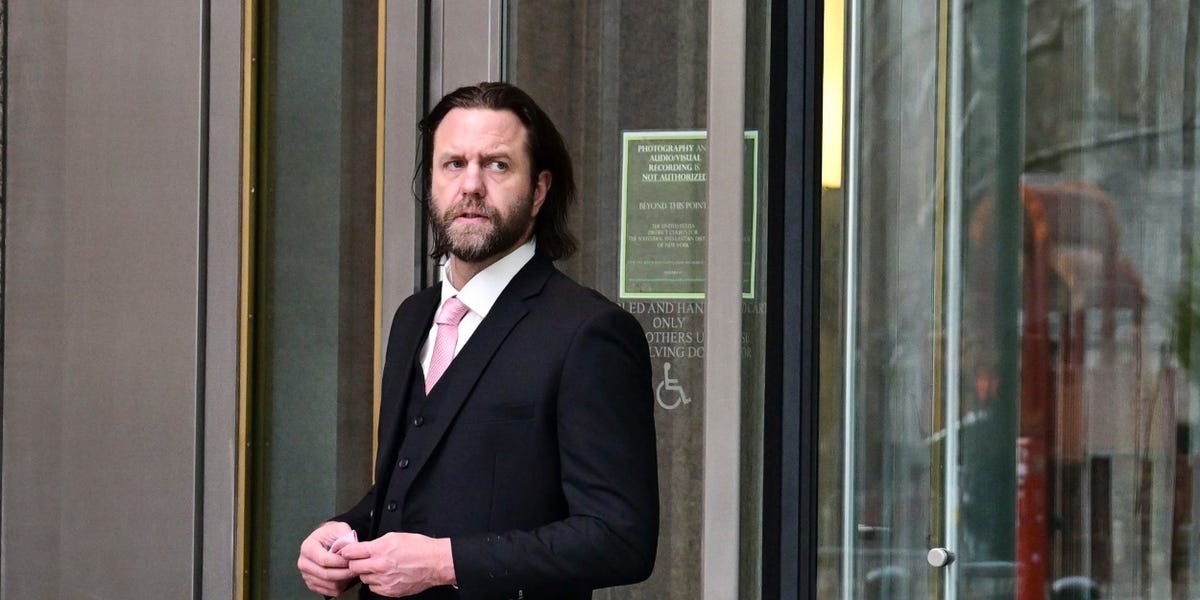
After a week of testimony about how Carl Rinsch spent millions of dollars on luxury mattresses, Uber Eats, Rolls-Royces, and stock and crypto trades — but not the sci-fi epic that Netflix ordered — the director got to tell his side of the story.
On the witness stand Tuesday, Rinsch cast his dispute with Netflix as one big misunderstanding.
In 2018, the streaming service had agreed to spend tens of millions of dollars on “White Horse,” a sci-fi project that depicted a world where artificial, clone-like beings created their own society after a schism with humankind. The show had the endorsement of Keanu Reeves, who starred in Rinsch’s movie “47 Ronin.”
By November of 2019, Rinsch had spent more than the $44 million Netflix had agreed to pay for one season of the show.
With the project overbudget and unfinished, Rinsch and Netflix executives needed to determine what to do next. Would Rinsch agree to cede some creative control to Netflix, surrendering his prized “final cut” privilege? Would he reduce his ambitions and complete the single season Netflix initially ordered? Or would Netflix give him a bigger budget to deliver two seasons?
In Rinsch’s eyes, he was ready to deliver Netflix a mega-franchise on par with “Star Wars” or “Game of Thrones,” and was negotiating the terms for a sequel. He had already spent millions of dollars of his own money on the passion project, he testified, and wanted to go bigger.
“This was, in my eyes, a franchise,” he testified Tuesday. “It wasn’t just one movie.”
In March 2020, Netflix sent Rinsch’s production company an additional $11 million — the money at the center of his Manhattan federal court fraud trial. According to prosecutors, Rinsch used the funds for a personal spending spree. Rinsch, on Tuesday, testified that he completed all the production work Netflix expected — at a fraction of the price. The rest, he said, was his to keep.
The director ultimately never completed a single season of “White Horse.”
Wearing a black three-piece suit with a dark purple tie and pocket square, Rinsch faced the jury as he spoke in a quiet and forceful tone. He kept a sober expression. In a courthouse elevator during the lunch break, he looked heavenward and uttered a short prayer.
The stakes are high. Rinsch — once a Hollywood rising star and protégé of Ridley Scott — has already lost his career and all of his money. If convicted on all charges, he could spend up to 90 years in prison.
‘It’s too much money’
A keystone of the criminal trial is a March 2020 email that Bryan Noon, then a Netflix executive, sent to Rinsch and his lawyer the day before the $11 million payment.
According to the email, the $11 million was meant to go toward production costs on “White Horse,” which had stalled after wrapping up a shoot in Budapest the previous fall.
Noon said Rinsch was required to spend the funds in a five-week period for editing the existing footage and for the costs of storyboards, production design, costume design, location booking, securing talent, and building sets for future filming.
Rinsch testified Tuesday that he estimated all of that would cost only $500,000.
“It’s too much money,” Rinsch told jurors. “I would never spend $11 million in five weeks.”
The other $10.5 million, Rinsch testified, was meant to reimburse him for costs he had paid out of his own pocket to continue filming “White Horse” while the production had gone over-budget.
“I had a crew of probably 100 people staying in a hotel — everybody’s ordering room service, everybody’s exposed,” Rinsch said. “So the idea was I subsidize and pay for us all to be here while we negotiate what the sequel is going to be. That was my cost — and it was a very big cost.”
TORU YAMANAKA/AFP via Getty Images
Some jurors wore coats in the chilly courtroom on the 14th floor of the lower Manhattan courthouse, where temperatures outside dipped to 30 degrees. One juror nodded along as Rinsch said that Netflix, in his view, owed him money at the time.
The director contended that he had completed principal photography on the first season of “White Horse” by the end of November 2019, when he had shot scenes in Budapest. In his understanding, Netflix executives wanted him to conduct “soft pre-production” over five weeks and show them visual concepts that would help them decide whether to order a second season — before the first season even hit the streaming service.
In his testimony on Tuesday, Rinsch walked the jury through some of his spending in the weeks following the March 2020 deal that he said was for the production of “White Horse.”
Rinsch hired Clayton Townsend, an experienced producer who had worked on several Judd Apatow and “Fast and Furious” movies, paying his production company $30,000. He also paid over $33,000 to secure a castle in Vienna as a shooting location.
He testified about the Rolls-Royces the government accused him of buying with Netflix’s money. He explained that in the sci-fi world of “White Horse,” he had wanted a “fleet of Rolls-Royces” carrying diplomats between the areas controlled by humans and those controlled by the “organic intelligent” beings.
Rinsch said he continued working on the show throughout 2020 and early 2021, including hiring a production designer to put together concept art. Netflix didn’t formally tell him it was done with “White Horse” until March 2021, Rinsch said.
In a civil legal dispute with Netflix, Rinsch’s side of the story didn’t prevail. An arbitrator in May 2024 awarded the company $8.8 million and control over the “White Horse” footage. Rinsch was indicted by federal prosecutors nearly a year later.
The $11 million question
On cross-examination, Rinsch gave explanations that contradicted the accounts of other witnesses. And, at times, that appeared to contradict himself.
During cross-examination, a prosecutor showed Rinsch transcripts of his under-oath answers from a deposition and a hearing tied to his earlier legal dispute with Netflix.
While Rinsch said Tuesday that the bulk of the $11 million was for himself, he said in those earlier settings that he would use the funds for additional production work.
Lloyd Mitchell for BI
Rinsch said he completed filming principal photography for the first season of “White Horse,” and that planned shoots in Kenya and Holland were meant for a second season. Former Netflix executives testified earlier in the trial, however, that the planned shoots were for scenes that were part of the script for the first season.
Under questioning on Tuesday, Rinsch didn’t address testimony about him rushing to spend millions of dollars on luxury goods in 2021. Nor did Rinsch share his own account of meetings with former Netflix executive Peter Friedlander, where Friedlander testified that he flew to the set of “White Horse” in Budapest to try to resolve budget issues, but the director walked out of them without a resolution.
Ahead of the trial, Rinsch’s lawyers said that his “mental state” could be an issue in the case. While the trial didn’t feature any testimony about Rinsch’s mental health, jurors saw outlandish text messages and emails he sent to Cindy Holland, the highest-ranking Netflix executive overseeing “White Horse.”
In one document attached to an email, Rinsch laid out a scenario where President Donald Trump would “mobilize Chinese community and create a destabilization” of Chinese President Xi Jinping “by unifying the Chinese people to support the one thing they fear more than XJ… death.”
He cited this scenario among his reasons for making risky options trades in the pharmaceutical company Gilead.
“I was hedging the market,” Rinsch said during cross-examination. “In the instance that we had a total calamity where millions of people died, we would be able to continue working on this show.”
Rinsch ultimately lost millions of dollars on his Gilead trades.
It was a long way from when Holland sat in Keanu Reeves’ home and read the script for “White Horse,” thinking it could be the next big thing.
“I thought it had incredible potential,” Holland testified.
