
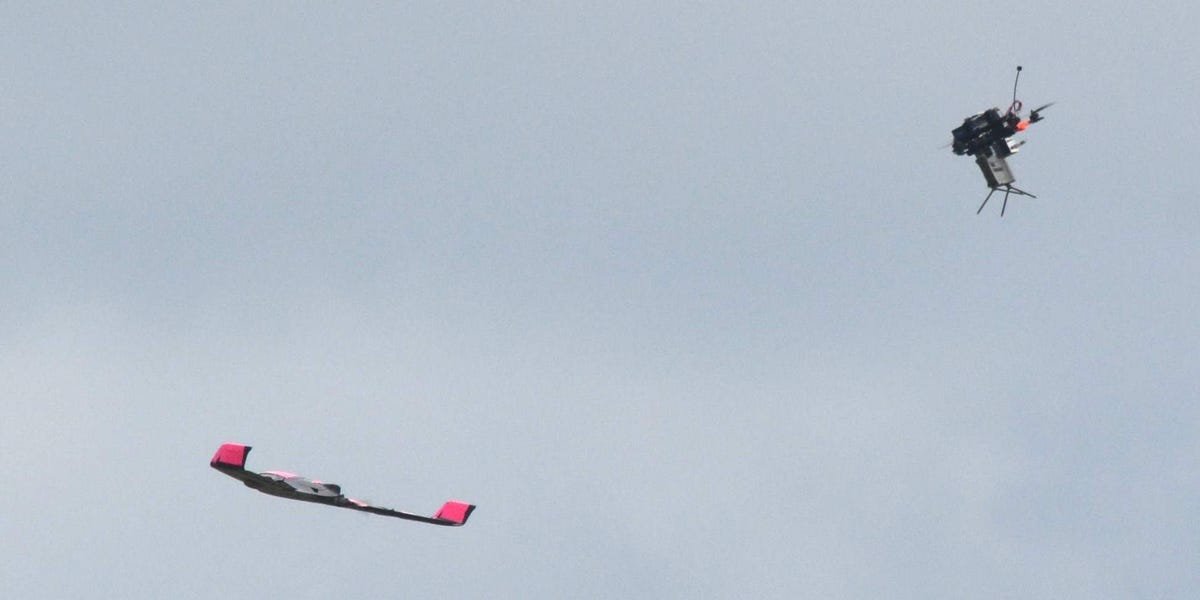
It was a windy, rainy day at Fort Rucker, Alabama, not exactly ideal conditions for flying a first-person-view drone armed with a Claymore mine on a hunt for a fixed-wing aircraft.
Weeks of practice, however, gave US Army soldiers a sense they’d be able to achieve the drone-on-drone kill, a first for the service.
The Army’s achievement showcases the drive to master the ins and outs of fast-moving drone warfare as the Pentagon prioritizes uncrewed combat systems, with which troops across the military are increasingly experimenting.
While Ukraine regularly uses drones to intercept uncrewed surveillance assets, this was new ground for the Army.
Earlier this month, at the US Army’s UAS and Launched Effects Summit, the Bayonet Innovation Team of the 173rd Airborne Brigade, out of the Army’s Southern European Task Force, Africa, experimented with flying FPV drones to intercept other uncrewed aerial systems.
The FPV drone was flown by Chief Nate Shae with the Pennsylvania National Guard, who has a background in uncrewed operations, including serving as an instructor and time in Germany in support of Joint Multinational Training Group-Ukraine.
Photo courtesy of 1st Lt. Francesco La Torre
Prior to the summit, Shae spent roughly two weeks practicing flying drones with a friend. “I would try to stay as close as possible. He would fly, and I would try and chase him as best as possible,” he told Business Insider.
Shae’s prior experience proved especially valuable during the milestone drone-on-drone kill, when he flew his FPV drone within range of a fixed-wing drone, operated by Chief Andrew Topits with the 173rd, and detonated the explosive payload.
The initial challenge with this kind of intercept is just locating the target aircraft, he said.
Related stories

Business Insider tells the innovative stories you want to know
Business Insider tells the innovative stories you want to know
“We’re flying with analog systems,” Shae said. “They’re not digital systems, so they don’t have the greatest picture quality.”
The next challenge is keeping up with the target.
The flight time, speed, and movement limitations of the FPV were factored in as well. “We literally only had about six minutes to perform the kill,” 1st Lt. Francesco La Torre, also with the 173rd and the officer in charge during the kill, told Business Insider.
Safety was also important, even as the training sought to make the intercept scenario as realistic as possible. In the lead-up to the summit, much of the brigade’s focus was on rehearsing the engagement and ensuring that when it came time to execute the kill, everything went smoothly.
“You only have really one chance” to take it out, Shae said.
Practice makes perfect
Photo courtesy of 1st Lt. Francesco La Torre
For nine months before the summit, 173rd had been hard at work on short-range attack drone training, including one-way attacks with FPV drones, live ordnance — grenade — drops, and other activities in exercises across Germany, Tunisia, and Lithuania.
“Each of those live fires was kind of a stepping stone in terms of complexity leading towards the UAS summit,” La Torre explained. Through the training exercises, soldiers became familiar with engaging static and moving targets, as well as targets at increasing distances.
At the summit, Shae and Topits ran multiple test fights each day, with each run usually anywhere from five to 10 minutes. They’d work on getting the fixed-wing aircraft assembled and taken apart, 3D print different pieces, and practice with inert Claymores.
The training event provided a lot of opportunity for planning that isn’t always available in combat, but it was a valuable educational moment for the Army.
The 173rd is the Army’s only airborne brigade forward-stationed in Europe, and it works closely with other NATO allies. They’re designated as the Contingency Response Force for US European Command as well, meaning they can deploy on short notice to deter aggression or defend NATO’s eastern front against Russia.
The brigade left this month’s summit with plenty of feedback on how to incorporate drones. The Army has acquired a variety of UAS capabilities. Now, the next step, La Torre shared, is going to be looking at “tying systems together, so designing the data and network architecture that can display all those systems in a meaningful way for commanders to make decisions.”
Betting on drones
Photo courtesy of 1st Lt. Francesco La Torre
Army leadership is pursuing a massive transformation initiative, the size and estimated cost of which make it one of the biggest overhauls for the service since the Cold War. Weapons deemed no longer valuable for potential future conflict are out; uncrewed capabilities, counter-drone systems, and other future warfare technologies are the priorities now.
Within the next two years, every Army division will be operating small drones. Units will be flooded with thousands of drones. Much of the adoption of these systems has been a work-in-progress, as soldiers test drones out in the field, experiment with new tactics, and work together across ranks and specialties.
While drones aren’t everything and the US and its allies possess other essential combat capabilities, drone and counter-drone capabilities could be critical in a future fight. US rivals and adversaries have been investing heavily in these technologies, which lower the cost and technological barriers for surveillance and precision strike.
At the UAS summit, one notable point of collaboration was the different component units, namely the active-duty Army and the Army National Guard, which were “merged together working seamlessly,” Shae said.
For drones, that cooperation results in a combination of approaches from civilian jobs and active-duty experiences, whether that be recreational flight skills, combat training, or new technology.
