
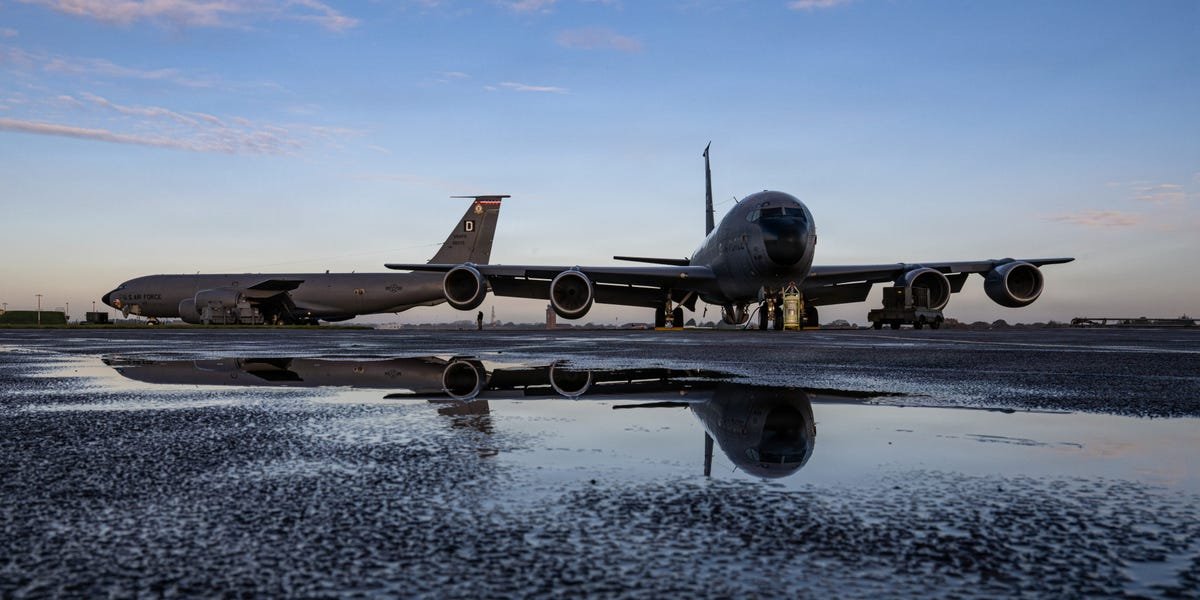
Inside some of the Air Force’s oldest refueling aircraft, technicians are crawling through tight, dirty spaces, painstakingly cleaning sealant on fuel tanks and tightening loose rivets.
They climb into the dark, cramped tanks with little more than a flashlight, some tools, and shaky comms. It can be hard to breathe, the air smells like jet fuel, the fixes aren’t always clear, and the punishing work can be dangerous if done wrong.
It’s a job that hasn’t changed much in over 50 years, but new gear, including a live-feed video headset and artificial intelligence-enabled technology, is finally bringing it into the 21st century.
The Integrated Respirator Information System, known as IRIS and developed by MetroStar and ActionStreamer, is speeding up the maintenance process, company officials and Air Force technicians say, and making it safer and more efficient.
Tankers are important logistics assets, what the Air Force calls “silent enablers,” that support missions by helping keep fighters and bombers airborne for longer than the onboard fuel tanks can sustain alone. For instance, Operation Midnight Hammer, which saw US stealth bombers strike Iran’s nuclear site this year, involved dozens of refueling tankers supporting the strike package.
Although fighter aircraft like the F-35 Lightning II Joint Strike Fighter or bombers like the B-2 Spirit get the most attention, tankers like the KC-135 Stratotanker are critical to US and allied airpower. For them to be useful, though, they have to be well-maintained.
IRIS began as an idea from two maintainers who noticed the broader potential of ActionStreamer’s live-streaming tech — gear originally built for athletes to capture first-person views during games. The Air Force technicians pursued the concept for years, even as they rotated through new assignments and bases.
The Air Force had long believed that tools like this could be a major boost for maintainers. There were early forays into video tech in the 2000s, but the “technology wasn’t quite there,” Master Sgt. Troy French, a former 100th Maintenance Squadron member, told Business Insider. “An initial phase of this was kind of set up and abandoned because cameras weren’t small enough.”
Now, though, Air Force maintainers based at Royal Air Force Mildenhall, a central refueling base for the US missions in Europe, Africa, and the Middle East, have been testing out IRIS.
“They were, to be honest with you, a little apprehensive to start with,” ActionStreamer CEO Bob Lento said, noting it was the first significant change to how technicians have done their jobs in years. But by the end of the first week, attitudes had flipped. “We were taking the cart out of the hangar into a safe area to do some software punch-ups, and they were like, ‘Wait a minute, where are you going with that? We need to use that now.'”
A hard, multi-step, high-risk job
US Air Force photo by Senior Airman Cody J. A. Mott
On a tanker aircraft like the KC-135, there’s a hole just big enough for a person to fit through under the wing. It’s the access point for the fuel tanks. “You crawl up there and you contort your body to be able to lie down flat and then put your feet in,” French said. Inside, it is a tight space with lots of bumps and edges.
The workers wear heavy protective suits to guard against fuel exposure and keep sweat out of the tanks. They carry a flashlight and breathe through respirators that feed fresh air in from a hose running outside the aircraft.
Outside the aircraft, a support team stands by. One person runs tools to the person inside the tank while another monitors for any hazards or issues.
“If you need something, sometimes you just have to peel the respirator back, like, ‘Hey, I need this extra wrench that I forgot,'” French said.
The runner will grab it and bring it to the entry point, screaming into the tank or pulling on the respirator hose to get the technician’s attention. “If you’re really deep in the tank, then you have to crawl back to get it from them, and you have to wait there for them to bring it, reducing the amount of time you’re actually working.”
Before a worker enters the aircraft, they’ll know what issues they’re looking for. A broken rivet, for instance, along with regular fuel tanker maintenance to keep the aircraft operating. But sometimes they adjust a different part in the wrong area of the refueling aircraft or leave a tool inside the tanker.
There’s a lot of double-checking the work. Steps like removing sealant, cleaning, and putting adhesion in the tank require approval from other team members. It’s inherently an hourslong job made even longer by wait times and communication lags.
And that’s if it all runs smoothly. Sometimes, technicians make mistakes, extending the time. “A simple sealant job can turn from a couple of hours of scraping and then eventually reapplying to another day because it turned out that you applied it to the wrong spot,” Tech Sgt. Chris Anderson, with the 100th Air Refueling Wing, said. “The way that we did things left a lot of room for error.”
A logical fix, Frank said, was something wearable: “a camera with two-way audio would be awesome, and if it had lights, that’d be a second bonus.”
A new way of doing an old job
Courtesy of MetroStar
The IRIS technology sits on top of the face mask tanker maintenance workers wear. It features a high-definition video camera, a two-way comms system that goes inside the mask, and a hands-free light. IRIS shows everything the technician is looking at to those outside the fuel tank and allows them to communicate with their team.
It connects to a mobile workstation outside the aircraft. On the cart, which can host up to four IRIS units simultaneously, the support team can see what the technician sees, talk them through the work, and record the footage.
Video records help verify what each shift completed and resolve disputes quickly. For instance, Anderson said that the day shift had cleared a fuel puddle, but the next shift found one and questioned the work. IRIS showed that the first team had done the job, revealing, as French said, ” another problem, something’s leaking.” That prevented unnecessary rework and let them fix the issue.
In the past, a tricky aircraft issue could halt work while the right Air Force experts traveled in to assess it. Now, IRIS can send video to them instantly or launch a group call so everyone can see exactly what the technician sees.
Developers also see AI playing a growing role in streamlining the job. As a technician uses IRIS, an AI agent compiles images and data to make requests, anticipate needed work, and handle forms. That frees technicians from what retired Air Force Maj. Gen. Cedric George called “shallow work,” so when their shift ends, “all he or she has to do is button up, clean up, go home.”
IRIS is currently in use only at Mildenhall, but early results are promising, as the Air Force considers expanding it to other bases. Technicians using the system haven’t had any safety incidents, and inspections are running 60% faster in test environments, according to pilot evaluations and internal logs. Based on KC-135 maintenance baselines, MetroStar estimates IRIS could save 35,000 maintainer hours and add more than 7,000 aircraft availability days.
George attributed the success of IRIS to the technicians who wanted to revamp the decades-old process to make it better for future workers. “This is not for the faint of heart, it’s dirty work,” he said, saying current technicians who worked on IRIS believe future maintainers “have to have something better than what we have now.”
