

By Nora Eckert and Chris Kirkham
(Reuters) – It might seem like U.S. President-elect Donald Trump’s plan to gut automotive emissions restrictions and fuel-efficiency standards would be a boon to General Motors (NYSE:), America’s leading purveyor of full-sized trucks and SUVs and its biggest tailpipe polluter.
Yet GM has emerged as Detroit’s biggest potential loser from Trump’s expected automotive-policy shifts.
The automaker may eventually realize moderate benefits from eased pollution restrictions. But GM faces immediate and severe threats from the incoming administration’s plans to end a $7,500 consumer electric-vehicle subsidy, first reported by Reuters, and to slap a 25% tariff on imports from Canada and Mexico. GM is among the most exposed companies on both fronts because of its aggressive EV investments and its extensive manufacturing of U.S.-market vehicles in these neighboring nations.
GM did not comment on how Trump policies would impact its business but said in a statement that it would be a “constructive partner” on auto-industry issues.
The automaker’s plight underscores the broader industry challenge of strategic planning for an existential clean-energy transition — in a capital-intensive business where product development takes years — while navigating regulatory upheaval from election to election.
Trump has argued that lowering pollution standards and ending EV subsidies would “save” the U.S. industry from a job-killing “EV mandate” by Democratic President Joe Biden. But allowing more emissions won’t necessarily enable GM to sell more of its most profitable and polluting trucks, a mature business it already fully exploits: Full-sized trucks and SUVs accounted for more than 40% of its deliveries through the third quarter of 2024, company data shows.
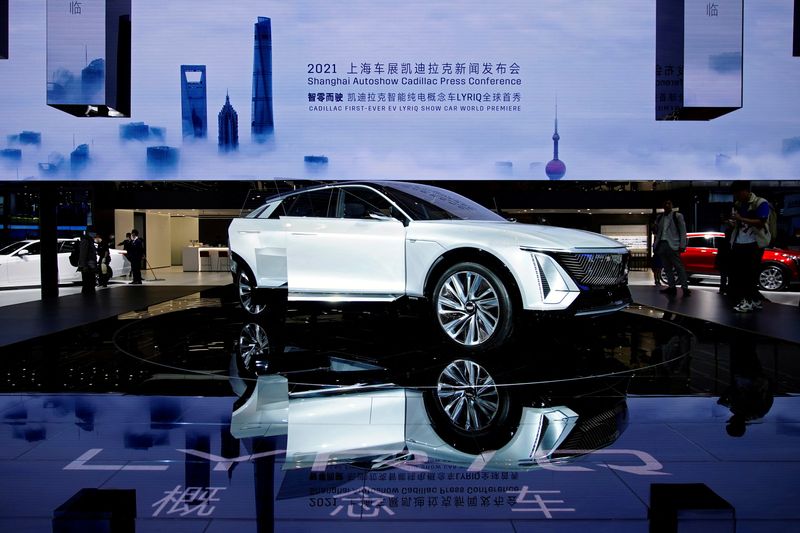
Neither can GM abandon its billions of dollars in investments aiming to fully electrify its fleet by 2035, industry analysts said. Ending EV subsidies would come at a particularly bad time for GM because it finally has a wide array of electric offerings, from its luxury Cadillac Lyriq to its mass-market Chevrolet Equinox, said Morningstar Research Services analyst David Whiston.
“It’s too simplistic to say: ‘They’ll be fine to sell trucks and SUVs,’” he said. “You can’t just turn off all the battery plants and forget about EVs.”
GM must also consider consumer and regulatory trends worldwide, for instance in China, where EVs and hybrids now account for half of cars sold. GM and all other foreign automakers are rapidly losing sales in the world’s largest auto market to homegrown EV makers that are heavily subsidized by China’s government. GM CEO Mary Barra said in July that its money-losing China business, once a profit engine, had become “unsustainable” without a restructuring.
Europe, a market GM recently re-entered with an all-electric lineup, also likely will continue policies promoting rapid EV adoption.
“EV penetration is a long-term objective,” GM CFO Paul Jacobson said at an auto conference just after Trump’s election.
DOUBLE TROUBLE
GM’s Equinox EV, its most affordable electric model, starting at $34,995, faces losing the $7,500 subsidy and also getting hit with Trump’s tax on imports. The vehicle is built in Mexico, along with the slightly bigger and pricier Chevrolet Blazer EV.
GM’s core truck business could also get heavily taxed: About half of the more than 750,000 vehicles GM expects to import this year from Mexico and Canada are full-sized, gasoline-powered pickups, according to business-analytics firm GlobalData.
GM’s stock dropped 9% on Nov. 26, the day after Trump posted his tariff threat on social media.
Detroit auto executives and analysts told Reuters they don’t yet know how seriously to take Trump’s tariff threat, which he described as retaliation for an “invasion” of “Illegal Aliens” and drug traffickers.
Despite Trump’s repeated claims that foreign nations pay U.S. tariffs, such taxes are paid by U.S. importers, including automakers. U.S. companies must either absorb tariff costs by cutting profits or raising consumer prices, or avoid them by shifting production to other nations.
The Trump transition team said in a statement that his tariffs would create jobs, raise wages and protect workers from the “unfair practices of foreign companies and foreign markets.” Trump’s team did not comment on his auto-emissions and electric-vehicle policies.
GM produces the most vehicles among Detroit automakers in Mexico and Canada, although the tariffs could also hit Stellantis (NYSE:) hard, according to a Barclays (LON:) bank analysis. Both automakers produce more than a third of their North American fleets in the two countries, which are also major suppliers of U.S. vehicle parts.
REGULATORY REPRIEVE?
GM could get some regulatory relief if Trump eases emissions restrictions the Biden administration enacted last spring. Biden’s rules would phase in stricter limits between 2027 and 2032 to boost the EV transition.
Ditching those rules could potentially extend the life of GM’s gasoline-truck lineup and lower future compliance costs; the automaker has historically had to buy regulatory credits from other manufacturers, including Tesla (NASDAQ:), because its fleet has exceeded emissions limits.
But GM’s regulatory risks remain high. Future administrations beyond Trump could crack down on pollution, and California and more than a dozen other states already have stricter emissions standards than the federal government. California plans all light-duty vehicles to be EVs, plug-in hybrids or hydrogen fueled by 2035.
This year, GM surpassed Stellantis as the automaker with the highest average emissions per-vehicle-mile, according to preliminary EPA data for the top 14 manufacturers selling cars in the United States.
Gas-powered trucks and SUVs drive GM’s current earnings before interest and taxes, expected to hit more than $14 billion this year, up from $12.4 billion last year. And large trucks are among the most difficult models to convert to battery power.
“If you just try to rely on the cash cow, it works until it no longer works,” said Jeff Alson, a veteran former EPA engineer who helped craft the Obama administration’s vehicle-emissions regulations.
UNCERTAIN ELECTRIC FUTURE
GM has historically invested more aggressively in EVs than its Detroit rivals. Yet EVs accounted for just 4% of GM sales through the third quarter, compared to an 8% share for the U.S. market overall, up just slightly from 7% during the same period last year, according to Cox Automotive data.
GM promises investors that its big bets will soon pay off with its next-generation EVs. GM currently sells 10 U.S.-market EVs, including commercial vans, compared to Ford’s three and Stellantis’ two.
GM CFO Jacobson acknowledged in October that GM has plowed far more money than some competitors into EV development.
“We dug a bigger hole very intentionally” to build a foundation in manufacturing and battery technology, he told investors just before Trump’s election.
Jacobson said GM expected to narrow its EV losses next year by $2 billion to $4 billion, without disclosing its total annual losses. Jacobson stuck by the prediction when questioned about it after Trump’s election at a conference, saying the wide range accounted for EV demand uncertainty.
GM wanted to “make sure that we don’t overpromise,” Jacobson said. “Ultimately, the consumer is going to determine our volume of production.”
